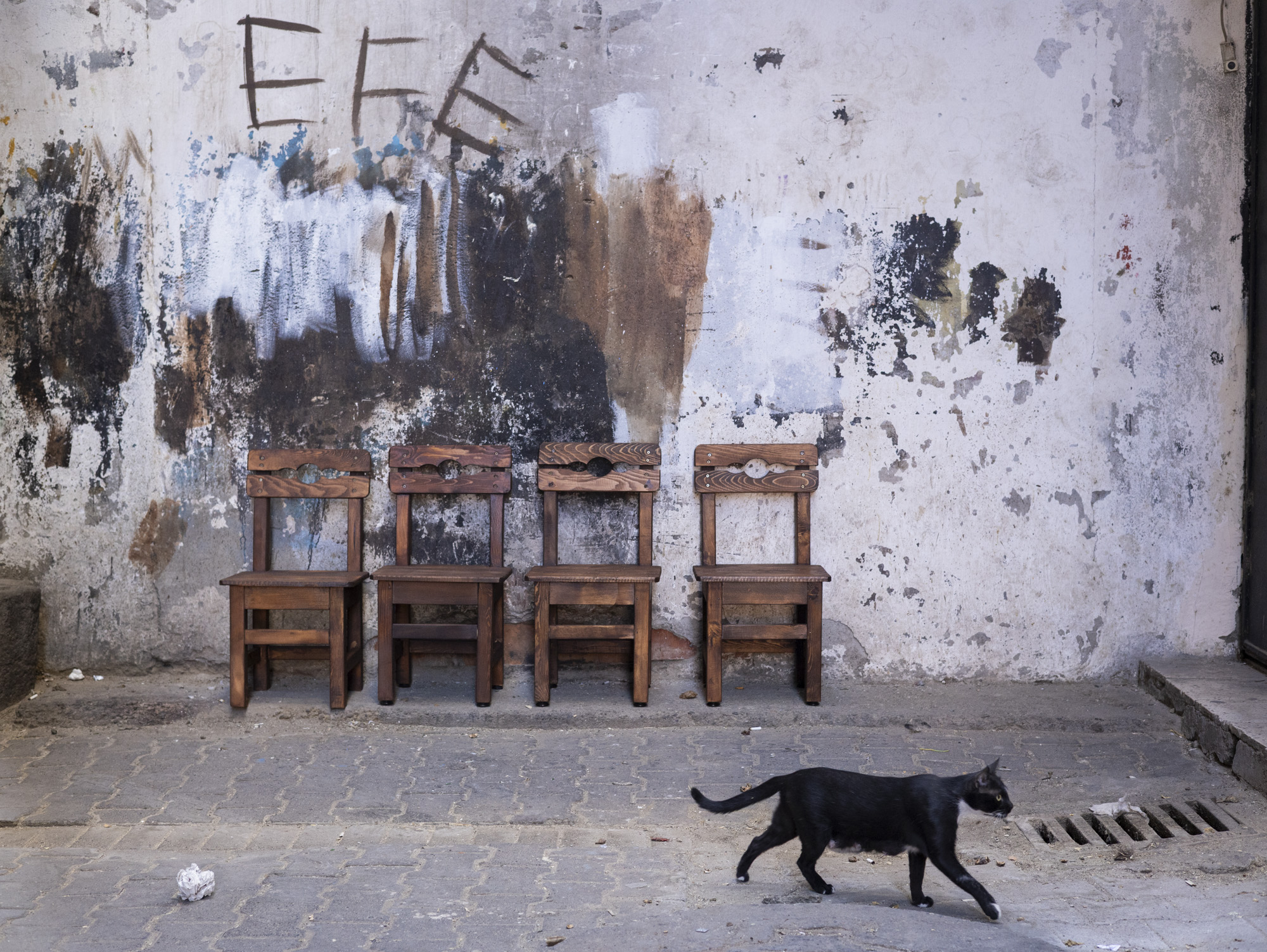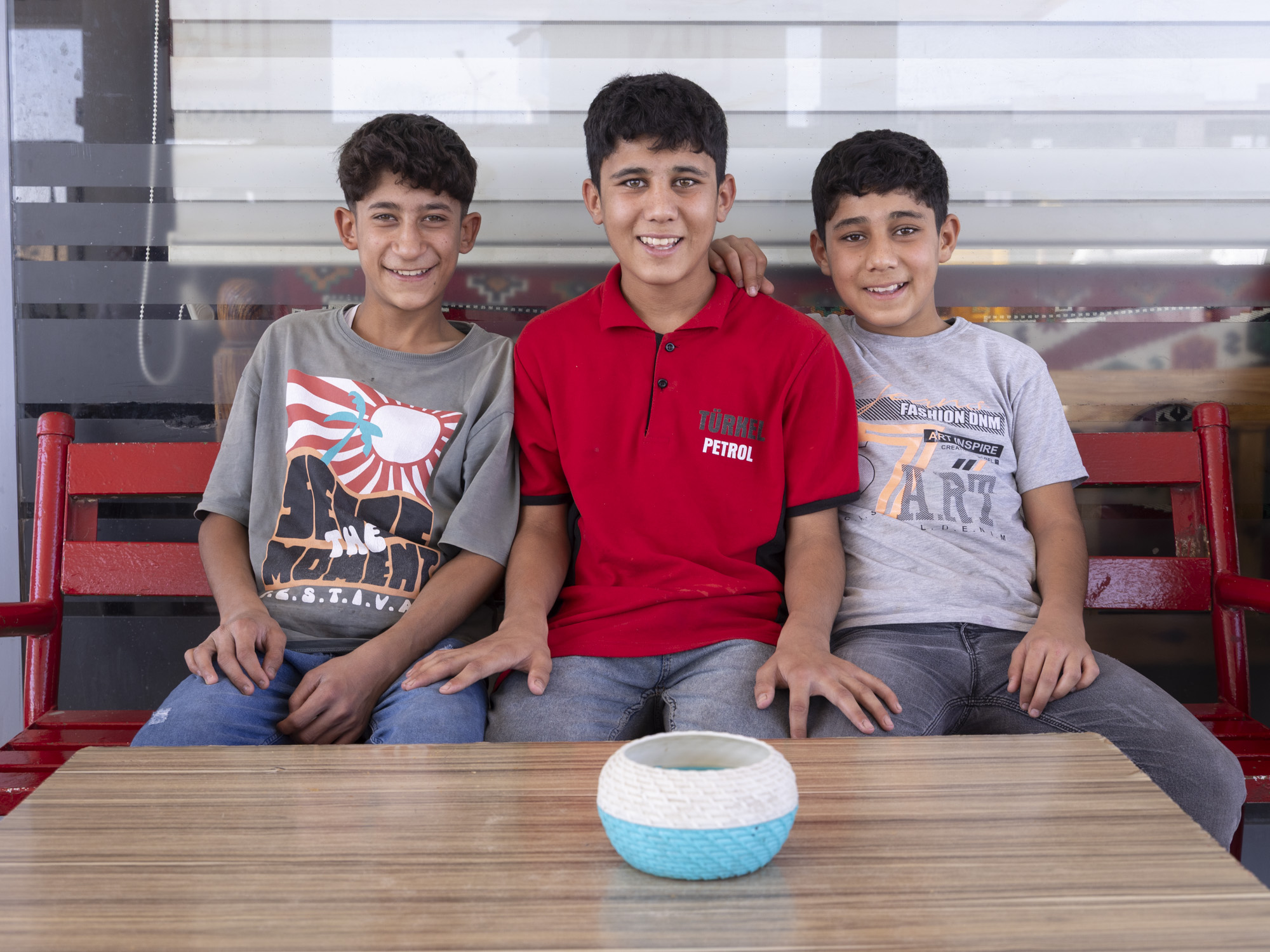
Gaziantep can be said to be the Syrian “capital” in Turkey: of approximately two million inhabitants, one in four is from the Arab country. Or at least that was the case until the fall of the Assad regime. For several weeks, I had been searching for contacts in this city, whether from NGOs, people who live there or have lived there. I would have liked to breathe it and describe it, trying to capture the nuances and the scars of coexistence between the Turkish and Syrian people. The doors that have opened and those that have remained closed behind anger and weariness, largely due to an economic crisis that has been gripping the country for over a decade. The most classic accusation is at the root of discrimination against Syrians: they are stealing our jobs. Furthermore, as is normal in a population of 500,000 people from a country with a desperate history, there have been several cases of violence involving Syrians. Sometimes, tarring everyone with the same brush seems like the easiest solution, and so for many Turks, Syrians are just a nasty problem to be gotten rid of as quickly as possible.
Unfortunately, however, none of the people I manage to contact live in Gaziantep anymore, and the NGOs refuse to collaborate.
So I find myself staying with an Argentinian, found on Couchsurfing. At Carlos’s house, I also meet Faizan, an Afghan with a British passport, with whom I share a couple of days of exploration like true tourists. Museums, food of all kinds, coffee, trips out to the most iconic places, and so on. Carlos’s hospitality is true Muslim: we practically never manage to pay anything. Couchsurfing, for those unfamiliar, is an online platform for meeting people while traveling and finding a bed, or a couch, to sleep in, hosted by a local. The price is an exchange of stories, shared time, and experiences. This app’s community is immense worldwide, with hundreds of thousands of people. It’s a wonderful way to get to know a city and its residents, and to save precious money. Of course, the only variable is that you never know who you’ll meet: whether you’ll get along, whether they’ll give you free time, whether they’ll insist on organizing your day. It’s essentially like playing roulette: how will I experience the next city?
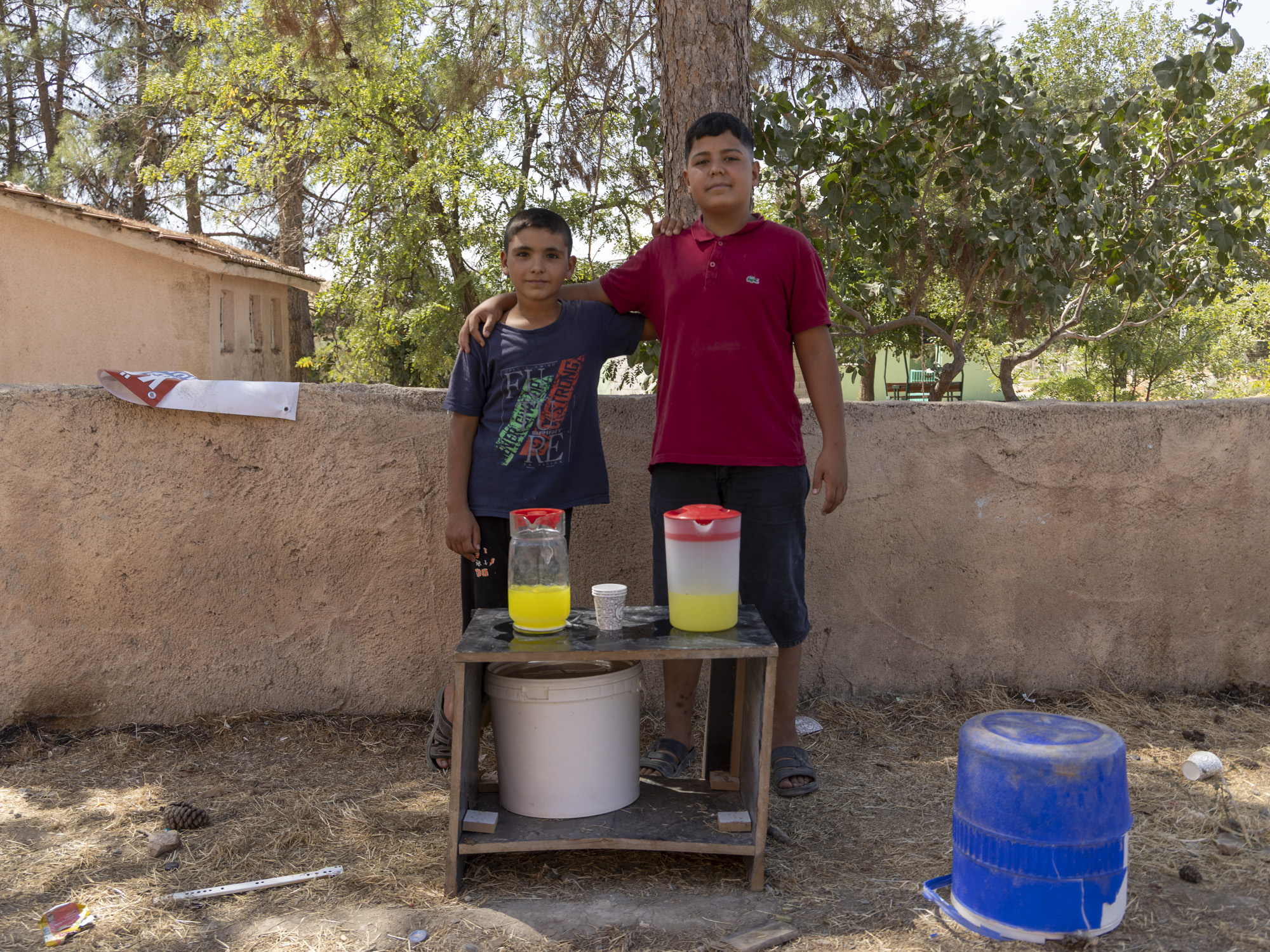
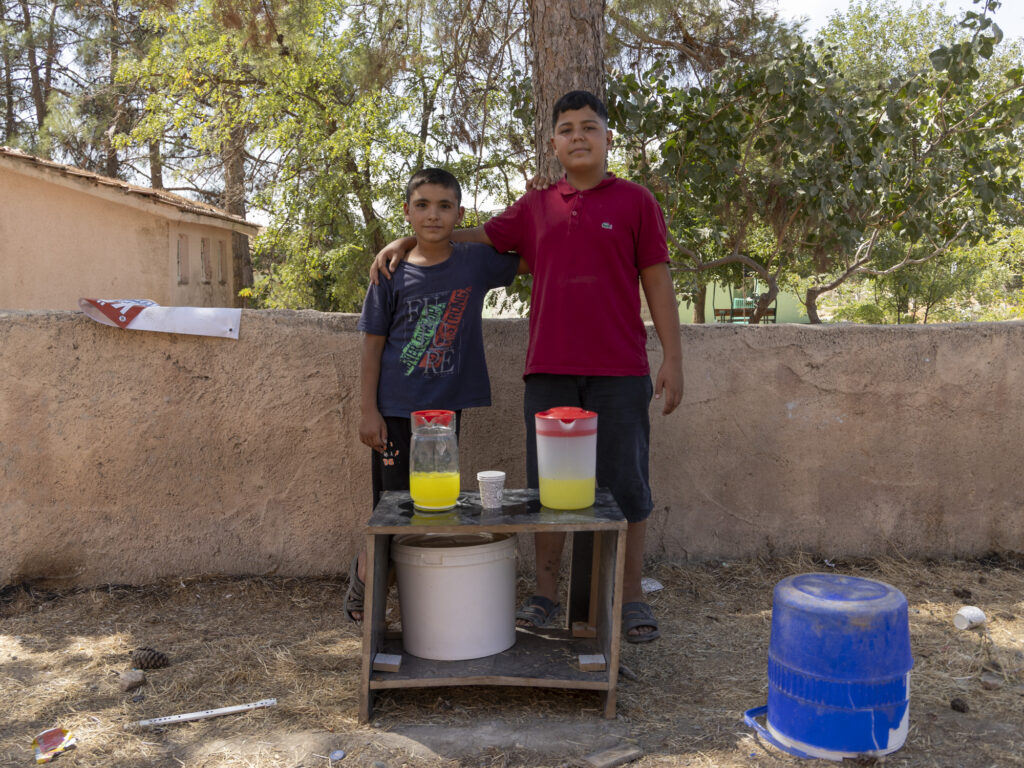
I set off again towards Sanlıurfa, still in Turkey but effectively heading towards a new world: I’m entering Kurdish territory. I pedal through vast fields of pistachios and olive trees, past dogs sleeping in the shade and horses pulling carts on dusty dirt roads. Syria appears through the haze along the dry, rolling horizon. Children selling lemonade greet me with shouts and excitement in the tiny village of Keçikuyusu, where as the minutes pass, more and more people arrive to greet me and see who I am. Gifts of food and cold drinks are plentiful, as are efforts to keep me there as long as possible. Along the road, there are many smiles, greetings, people placing their hand on their heart, and people stopping me for a photo. Back on the main road, I stop at a gas station, which seems more abandoned than usual. A young man welcomes me kindly and lets me eat quietly in the shade, sitting at a table. Soon, however, his brother joins him and immediately strikes up a conversation. “Italian girls are really beautiful! But he’s a faggot, you know?” With annoying nonchalance, he continues to take my phone, taking pictures of himself and writing on the translator. “Take me away, there’s no life here, there’s no future. We can’t make love. Take me to Italy! In Italy, we fuck!” He’s starting to make me nervous. With increasing insistence, he pushes me to call someone in Italy, but I categorically refuse, until I ask him why he’s so insistent. “I want to see beautiful girls! Call them!” If mine was already a 100% no, it becomes a 2000% no. I wouldn’t feed him even the shadow of a memory of any friend or woman I know, much less a stranger. I’ve already interrupted lunch and am applying sunscreen to leave. My friend looks at me embarrassed, sensing my annoyance. “He’s crazy. He likes to joke.” I get up to leave, but the man grabs my arm and sits me down. He holds me back forcefully. “No! It’s hot! Stay here! Don’t go away!” I wriggle free and glare at him, leaving. “Bye bye, George! Bye bye!” He keeps yelling at me as long as he can see me.
The nerves remain, and I completely lose the desire to interact with any human being. A little further ahead, just after crossing the Euphrates River, I’m chased by some children. Instead of shouting “Hello,” they yell “Money, money!” I mentally tell them to go fuck themselves and continue on.
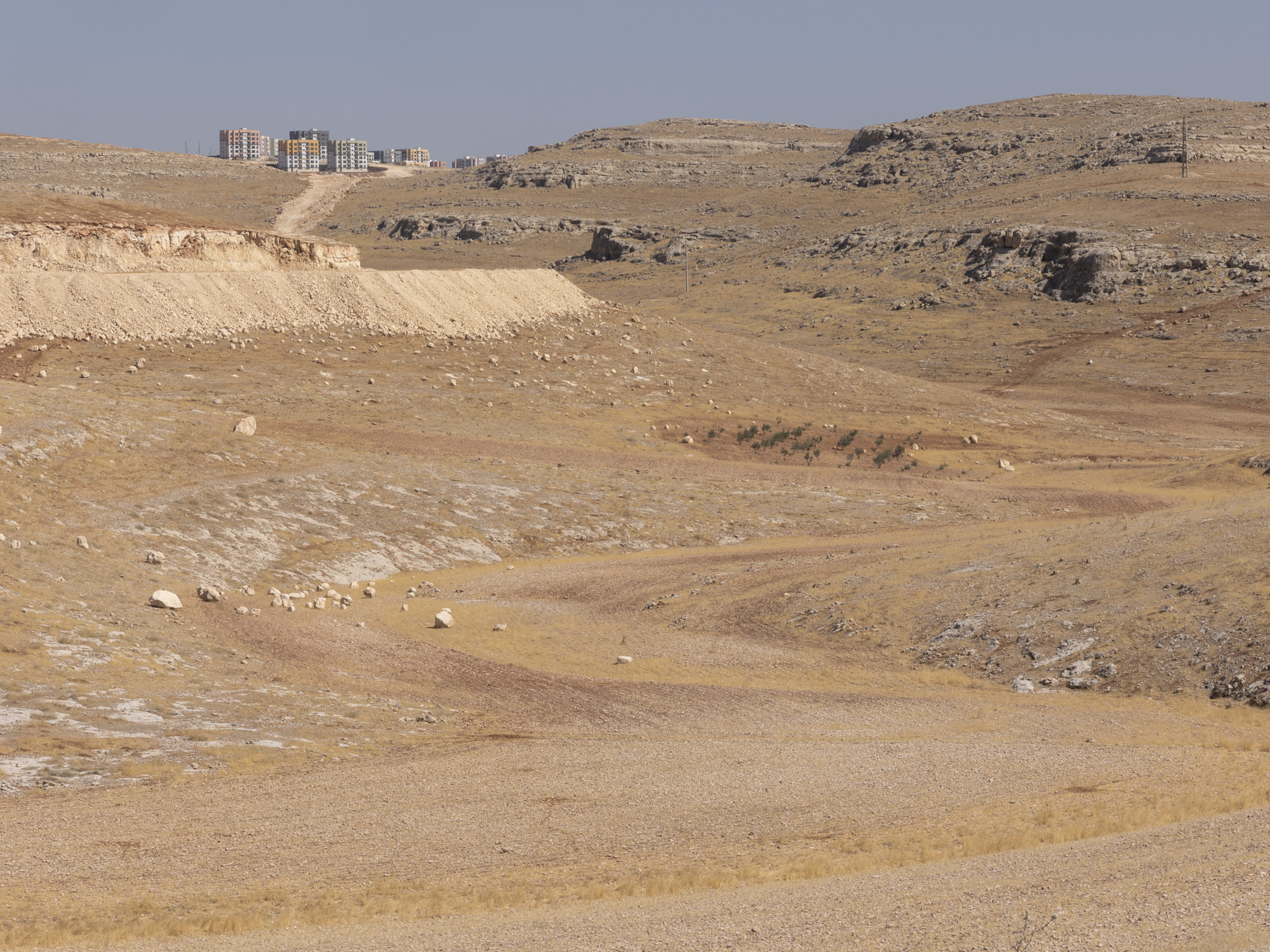
More of the gas station attendant’s words come to mind: when he asked if there was water in Italy, I answered yes, and he looked at me with a desperate expression: “It’s all deserted here. There’s no water, there’s nothing. There’s no life.” The children probably have every reason in the world to ask me for money. We’re in areas where stories and life are incredibly harsh, where people have been killing each other almost nonstop since history began. But I just can’t tolerate homophobia and sexism beyond a certain point. And if I’m nervous and tired, I’m treated more like a “dollar” than a human being. It’s 39 degrees Celsius. The sun is setting, and I find a rather run-down gas station that seems like a great place to sleep. I ask permission to set up the tent: “I’m Italian.” “I’m Turkan,” the older man replies, calling out to the younger boys because he can’t read. I get a strange yes, one of those kind answers that sound more like a “yes, but…” But it’s too difficult to converse without a common language, so they say, “Go, go.”
I settle in among the trees, on some loose earth littered with trash and broken glass. At least there’s shade. I take my time and sit down to watch the boys and girls cleaning the concrete lot in front of me. They emerge from a large warehouse they’re cleaning, where I imagine a wedding has just taken place. Slowly, however, one car after another begins to arrive. The parking lot fills up quickly, and from dilapidated cars emerge entire, elegant families. Every time a door opens, you don’t know when you’ll stop counting the people: six, seven, eight, nine. The wedding has yet to begin. The first children begin to approach, curious and asking questions. They’re polite, almost fearful. After a few minutes, they leave me alone, and I realize it’s time to set up the tent. But it’s too late; I’ve waited too long. A second wave arrives, and within seconds I find myself surrounded by children and teenagers, a bit like a swarm of bees. There must be twenty, maybe thirty, and they keep coming. They put their hands everywhere, take off my bike seat, ask me a hundred things. Even the nicest ones, who try to help me set up the tent, are often more harmful than helpful. Some become downright annoying. A small group, led by the biggest bully, starts insistently asking me if I’m Muslim. They keep making the slit-throat gesture. “You know, Christians here get their necks slit.” I pretend not to understand and talk about something else. They don’t scare me, they just piss me off. If only they knew I spent a year with kids their age who would eat them alive, and that they actually held a machete blade to my neck, in a drugged-out frenzy, whispering, “I’ll cut your head off…” My patience is almost infinite, so I play along, while they try to scare me in every way. “It’s full of snakes here! And the dogs come at night!” Someone dares to say there are even lions. One of them pretends to have a knife in his pocket and threatens to stick it in my stomach. The real luck, however, is that even if they put their hands around a little too much, they don’t dare take anything. If I’d been in this situation in Ecuador, among my little brothers in the Cristo Vive neighborhood, half my stuff would have disappeared.
Every now and then an adult comes by to say hello, or a shy child approaches and says something nice. After all, it’s crazy. Between one thing and another, it takes me an hour to set up the tent and pack everything inside. Just as I’ve managed to do so, two older boys arrive, one of them very elegant, perhaps the groom. Finally, someone with authority: with two words, they silence the swarm; in twenty seconds, there’s not a single child left. They apologize and invite me inside to the party. I dream of saying yes, but I refuse. I wouldn’t leave the tent alone out there, not even under torture. It’s very early, but I lock myself inside. The plan from now on is to play dead: I know the calm won’t last long.
Music is blaring from the shed; there’s a terrible racket. The children return in small groups to tease me. I hear some “motherfucker” shouting; someone approaches and pretends to bark. Then a full, but open, Coca-Cola can flies onto the tent. I pretend nothing’s happening and continue minding my own business. I won’t give him any satisfaction. But when the adults arrive, I open the door: they’ve brought me dinner. A little over two hours after I locked myself in, I hear car doors slamming. The music dies down. And then, suddenly, silence. It’s only 9:15 PM. A miracle.
The dogs don’t come, nor the lions.
When I wake up in the morning, the gas station attendant seems to have stopped in time. A boy sleeps on a bench, another on an outdoor sofa, another on a chair with his feet up on the table. An elderly man is reading the Quran in a low voice, sitting on the floor, his legs crossed. He nods at me.
I don’t want to talk to anyone. I don’t want to meet other human beings. But I don’t even go 500 meters before a car stops me. A Syrian boy gives me some figs and drives away. As if to say, within the first 30 seconds of the day, that the day before was just a bad interlude, almost as if the world wanted to make a hasty apology.
A few minutes later, a few kilometers away, I see Kobane rising. I’ve been waiting for it. The skeletons of gray buildings cut across the horizon beyond the cultivated fields. I can see the massive wall separating Turkey from Syria. And there it is, the center of the Syrian Kurdish resistance in Rojava, the citadel that resisted ISIS’s siege for many months, inflicting one of the Islamic State’s first major defeats; effectively showing the world that it was not invincible. A symbol of the Kurdish victory over ISIS, but also a symbol of the Kurdish struggle for self-determination against Turkey. Since its liberation from ISIS in January 2015, the city has been the target of the Turkish army and its snipers, who consider its fighters, the YPG, an arm of the PKK: terrorists. The situation, however, is much more complex than that. Turkey cannot accept another independent Kurdish state so close to its border. Moreover, in those territories it is fighting for a great power: that of water.
While it’s true that Ankara withdrew its troops from Syrian territory a few months ago, the situation, particularly around the Tishreen Dam, remains very delicate.
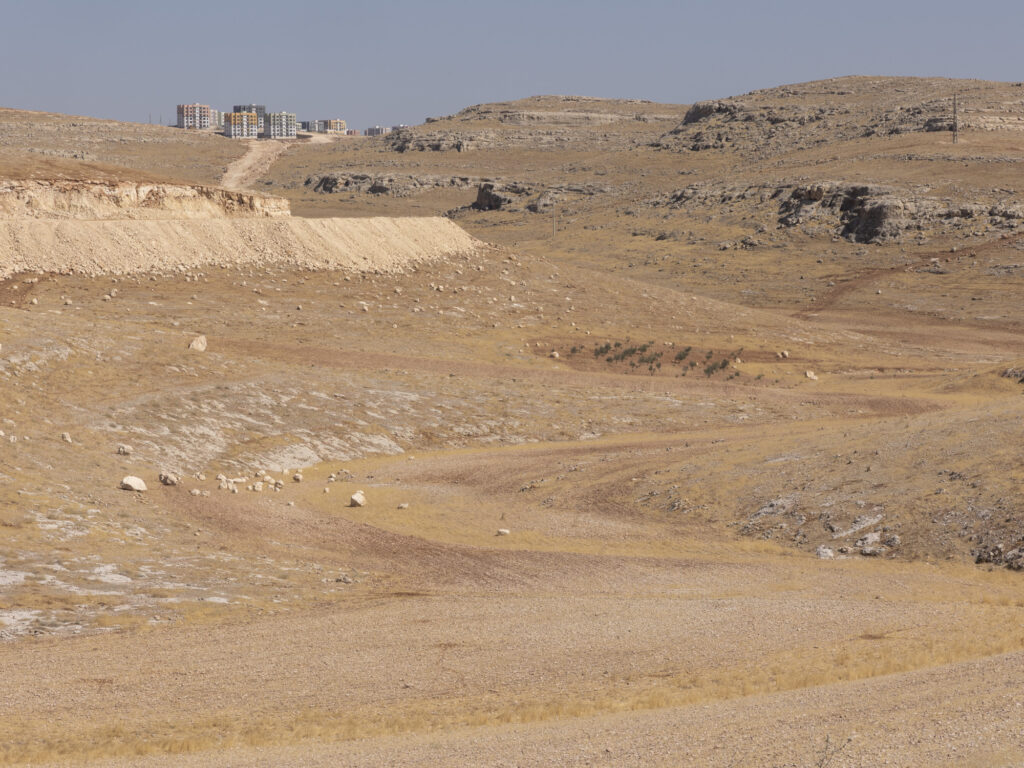
I think back to the gas station attendant’s words. “It’s all desert here. There’s no water, there’s nothing. There’s no life.”
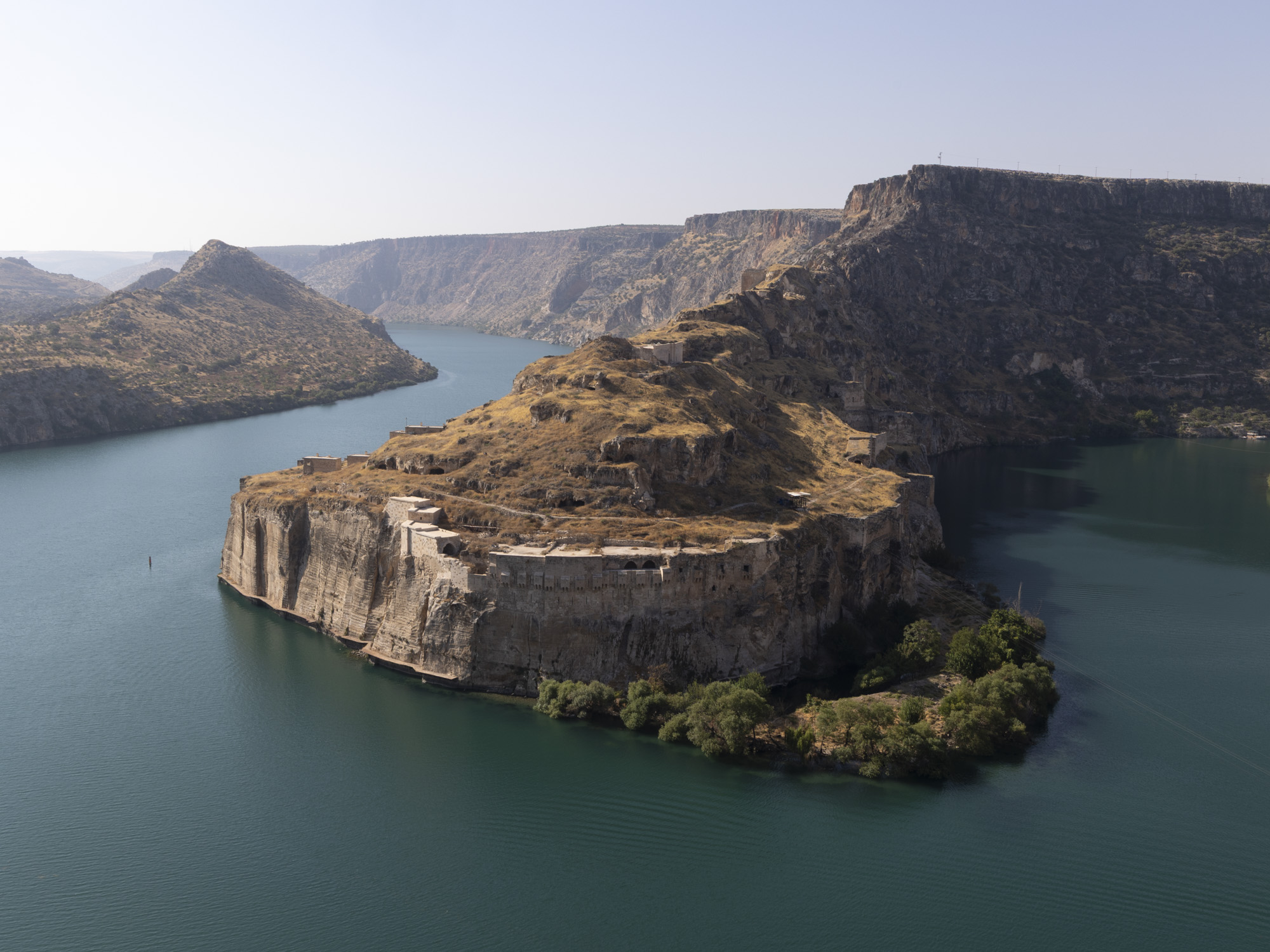
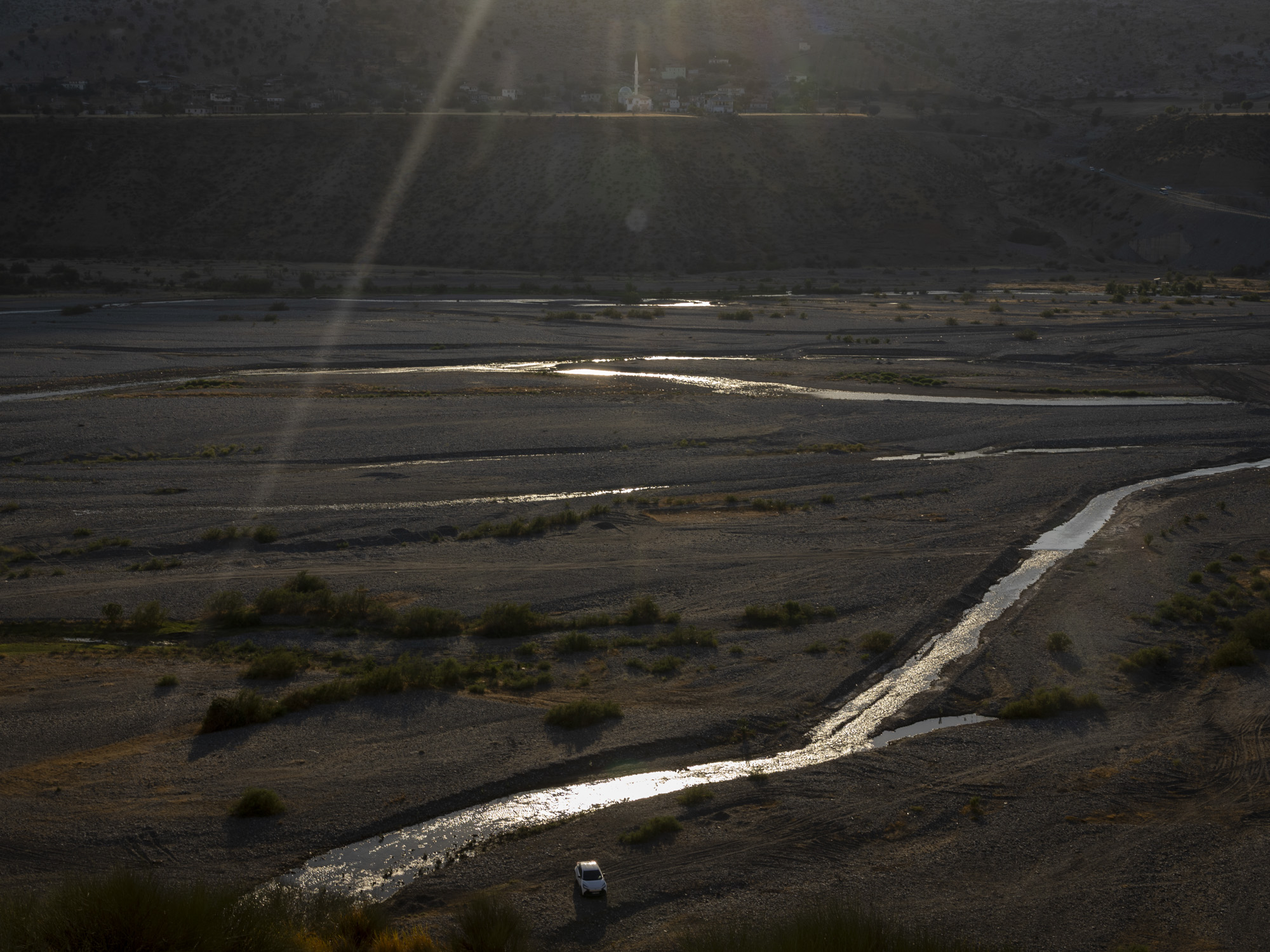
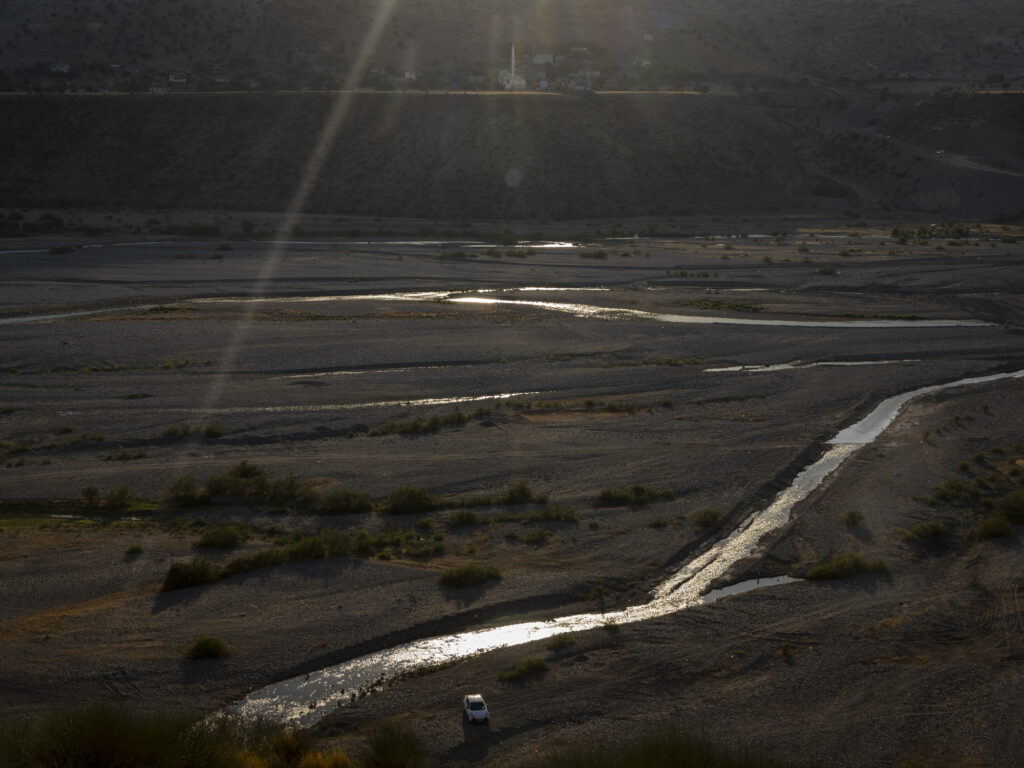
In the arid areas of southeastern Anatolia, Turkey has been implementing the GAP plan for years. This is a massive project of dams and hydroelectric plants on the Tigris and Euphrates rivers. The plan is to revitalize these lands, making them more fertile and more energy-independent. It’s also a plan of great control, however: both over Turkish territories inhabited by the Kurds, where the presence of government representatives is increasing, and over Syria and Iraq. In this way, Turkey controls the flow of the great rivers thanks to which the two southernmost countries survive, effectively managing a vast geopolitical tap.
As my thoughts slowly run through Kobane, I’m awakened by the sound of a car horn: a woman without a veil waves to me from a car. An unusual occurrence these days, in these Islamic lands where a woman rarely speaks to me. It seems like a signal, just as I gaze upon Rojava, a land of great warrior women.
At the end of the day, I arrive in Şanlıurfa, after hours of trying to avoid human encounters at all costs, and where instead I continued to receive water and food on several occasions. I’m immersed in the Kurdish world of Turkey.
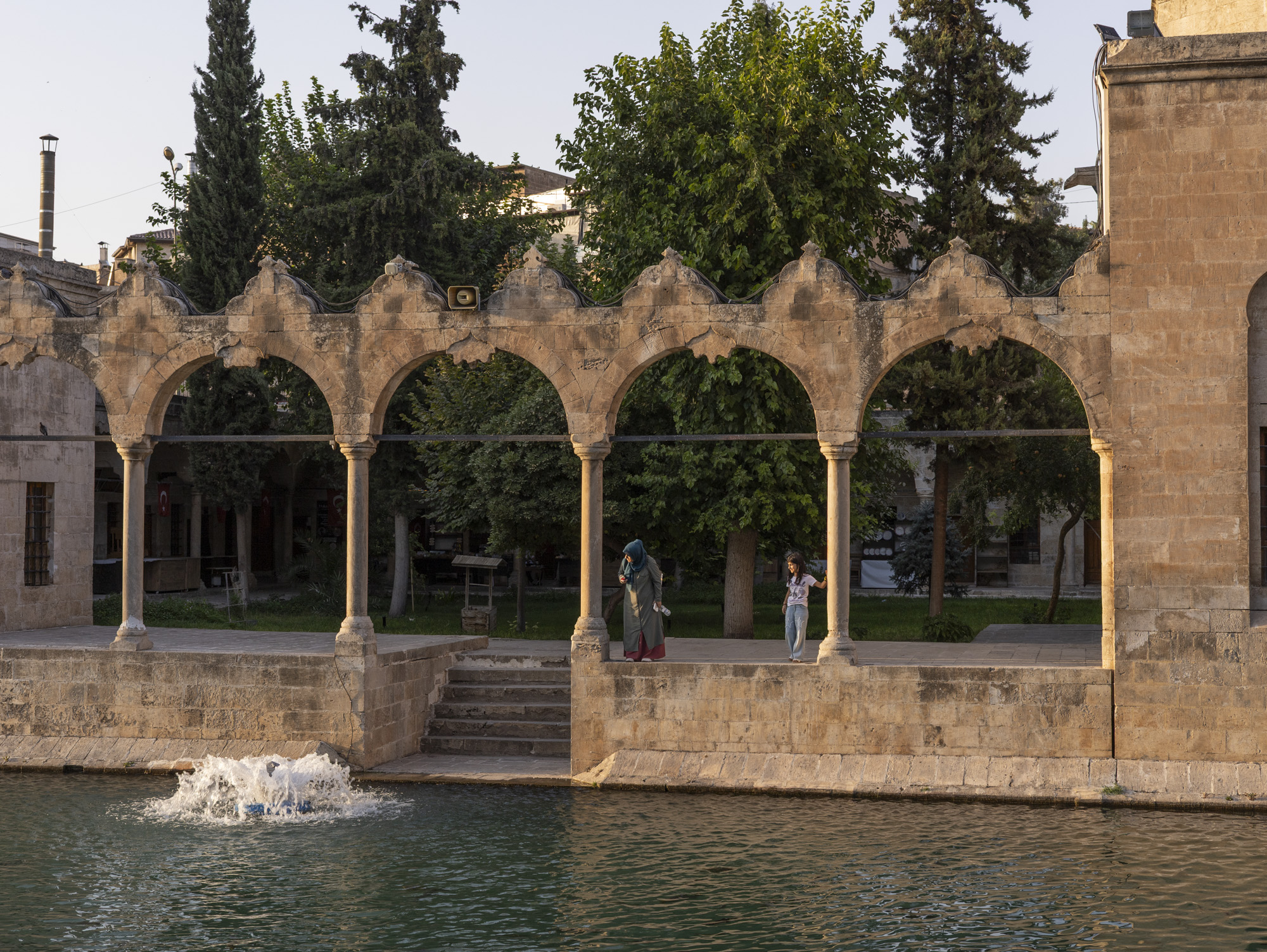
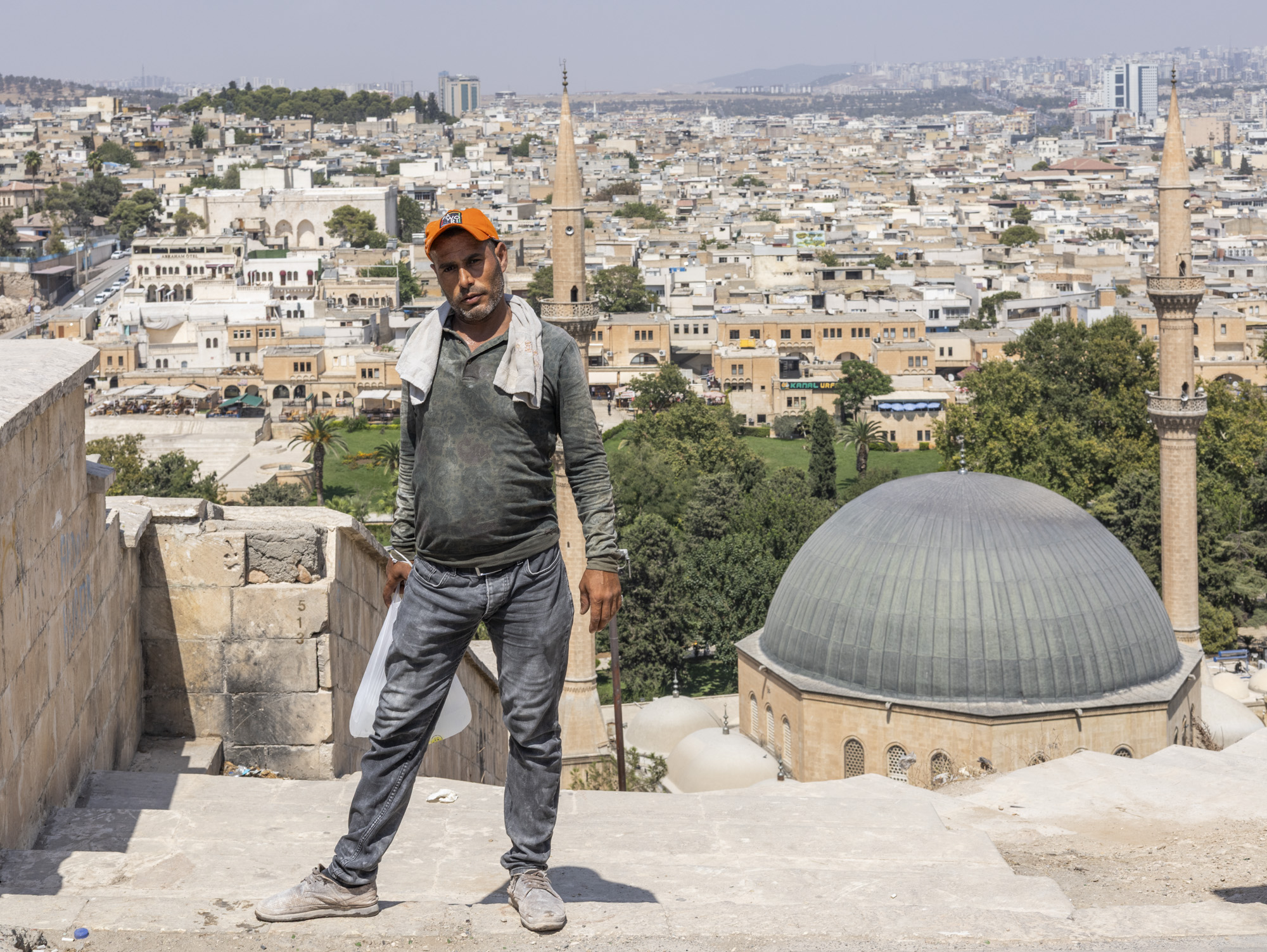
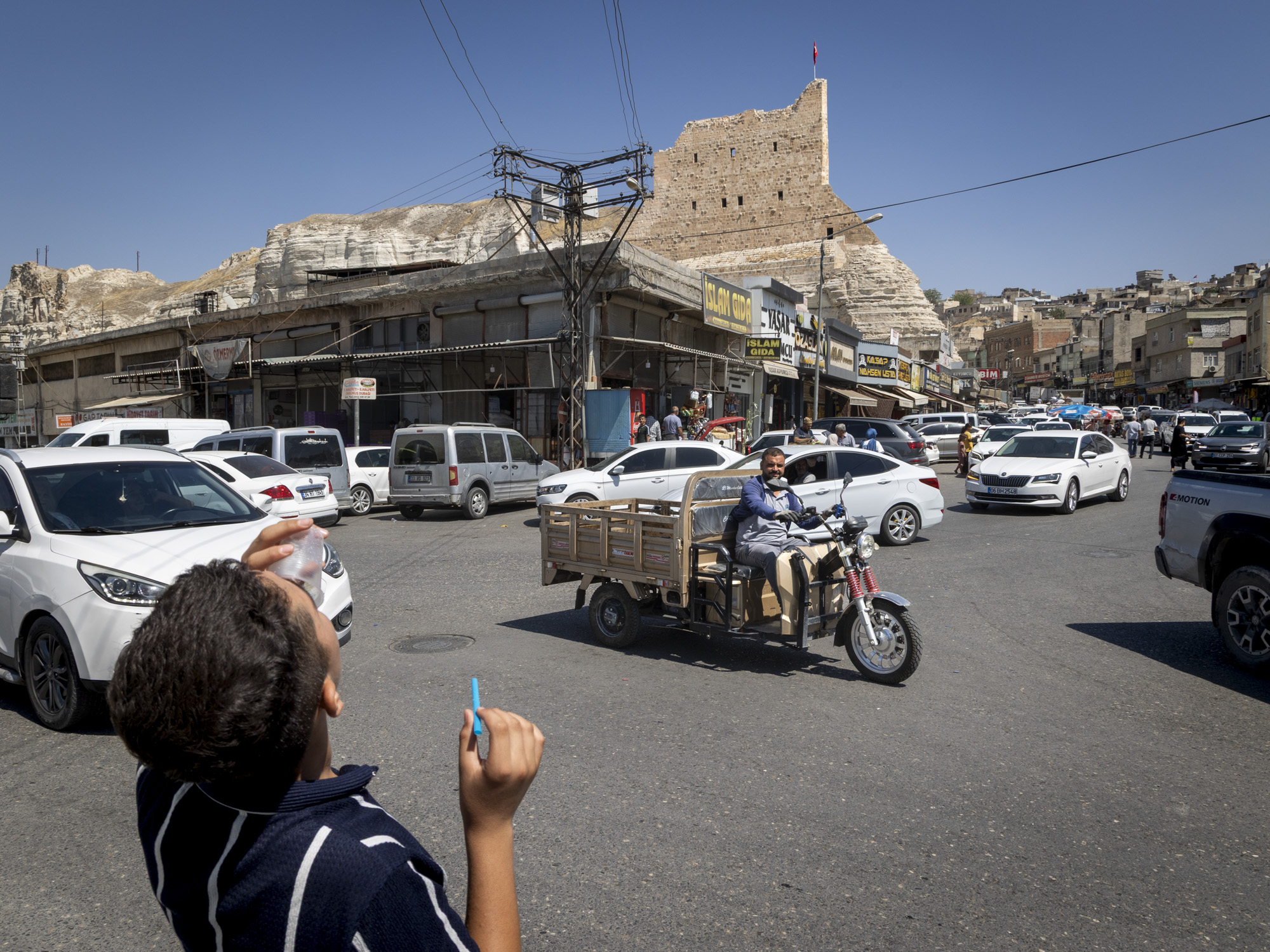
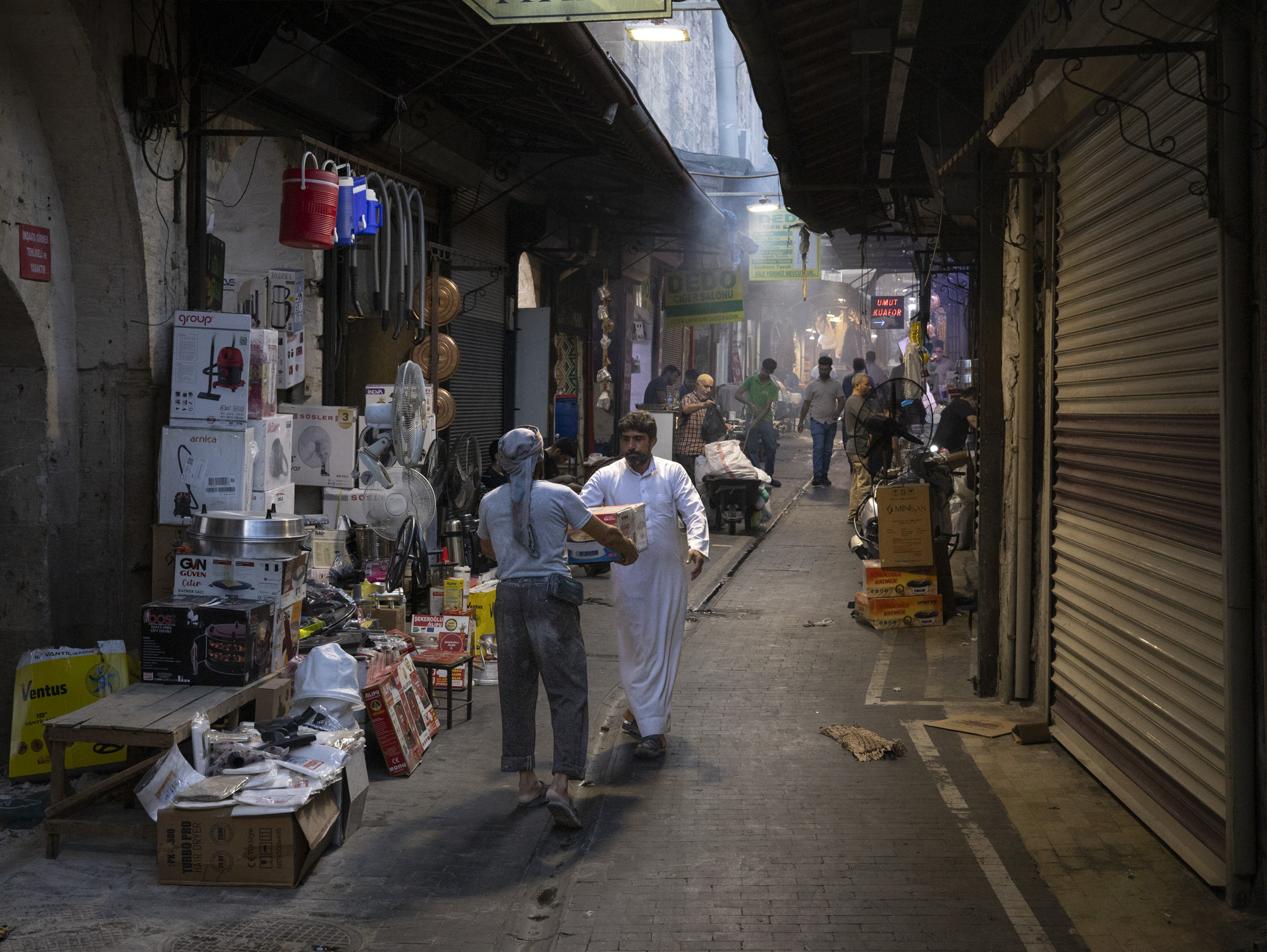
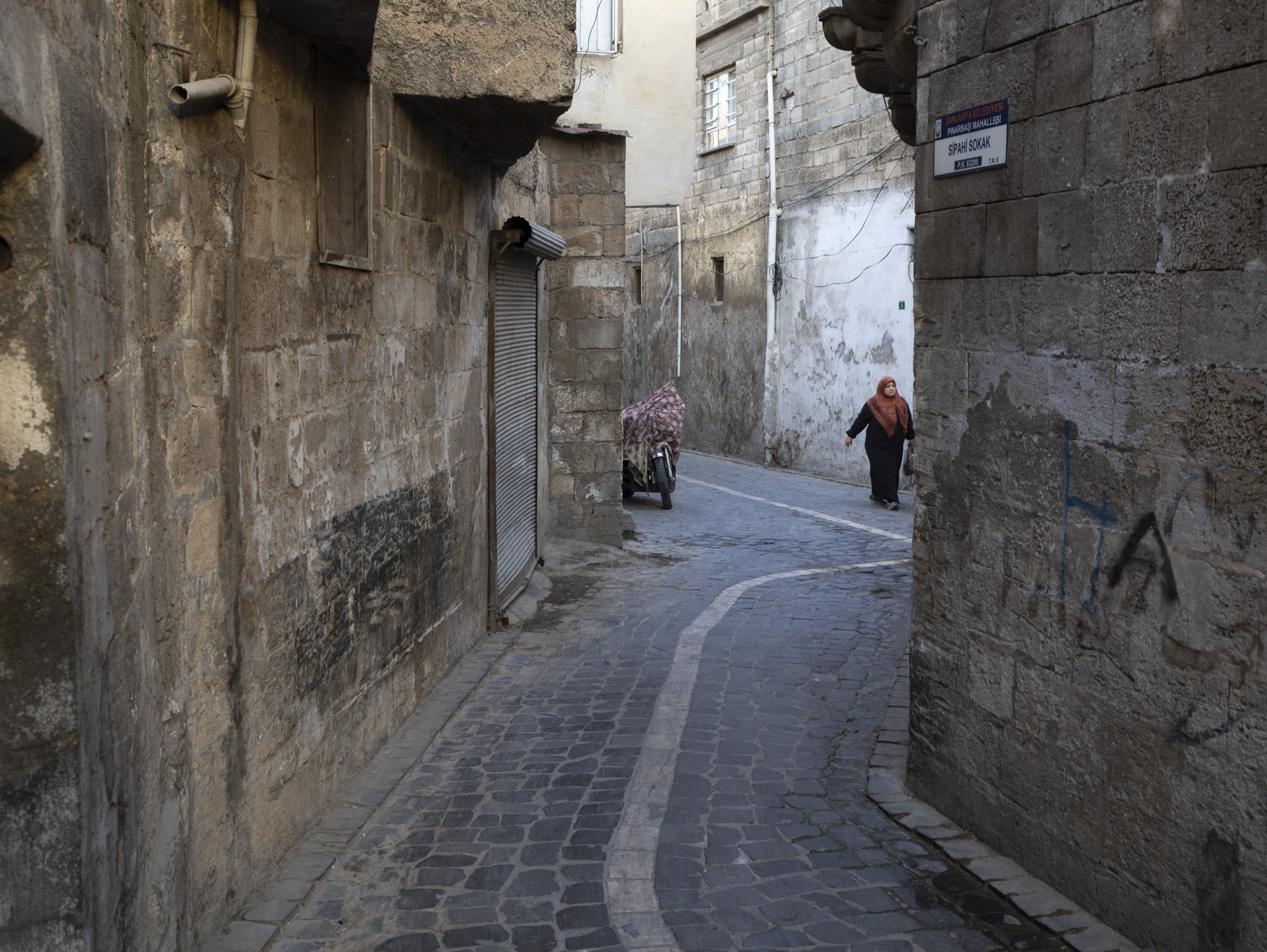
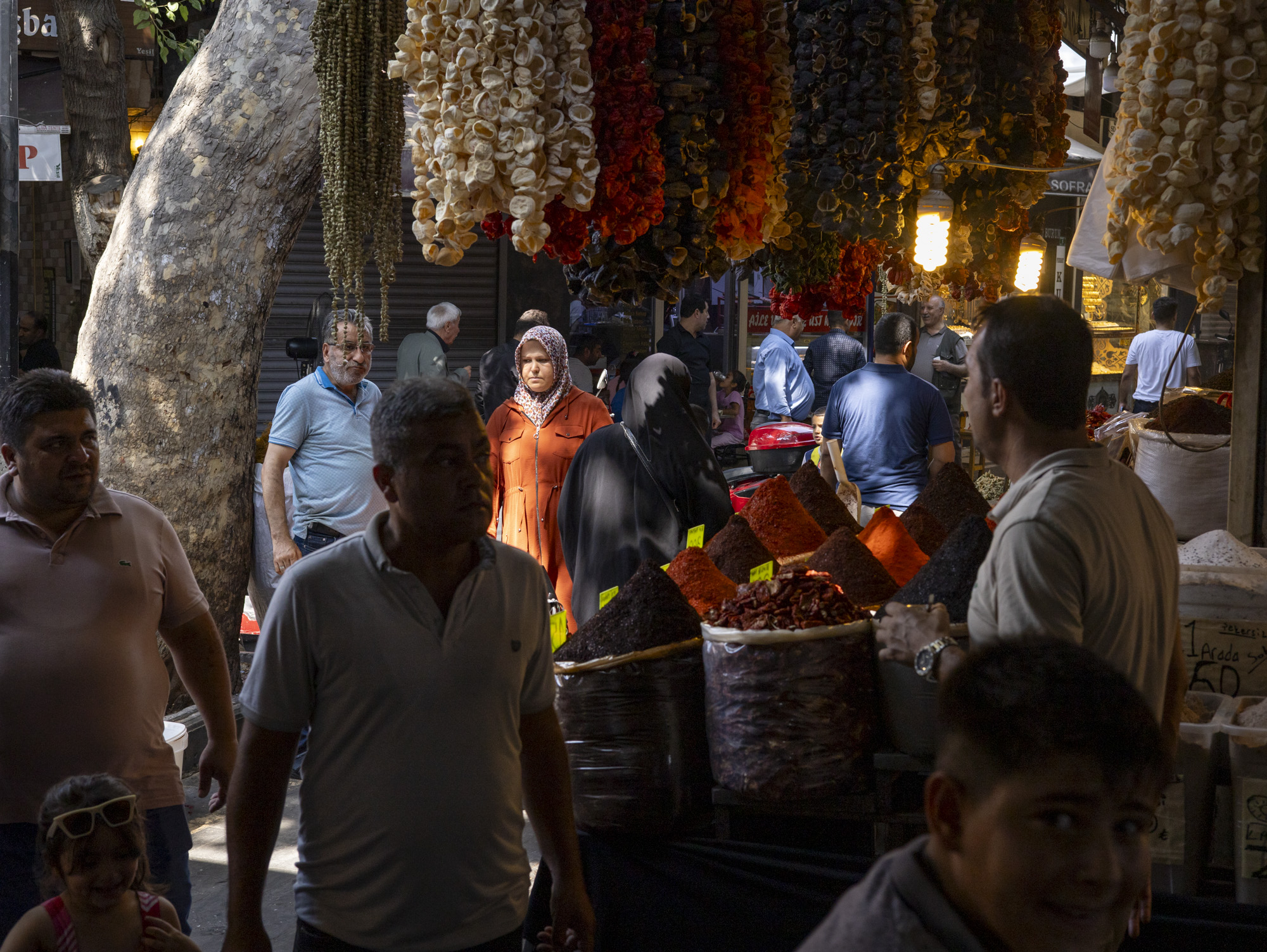
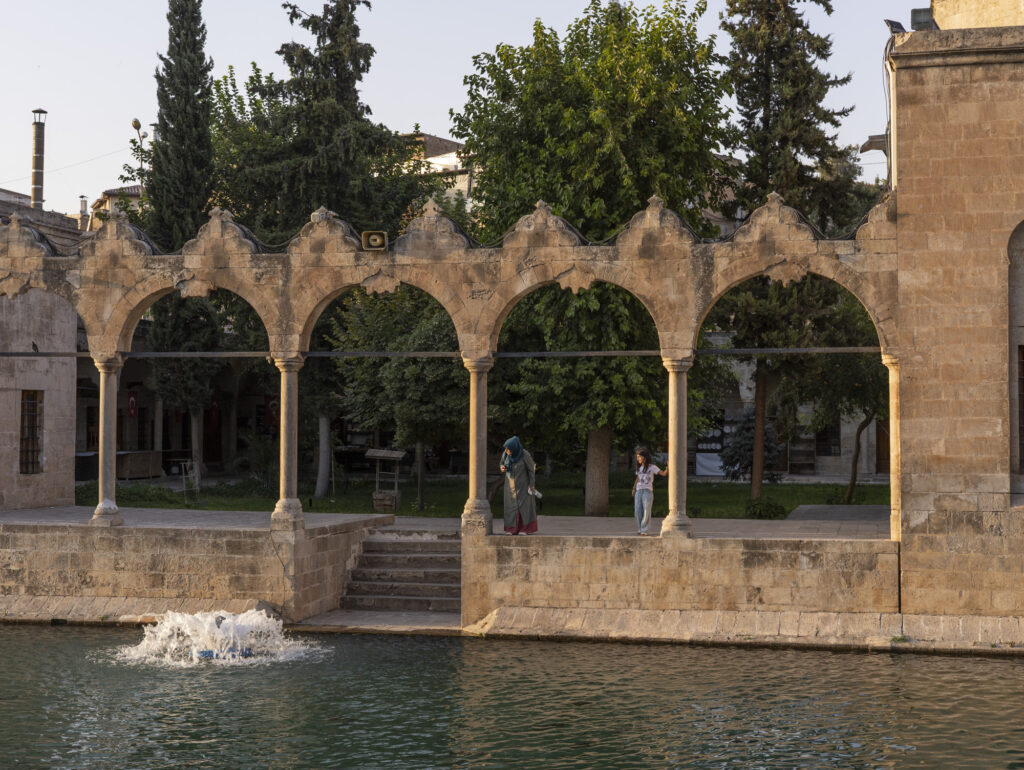
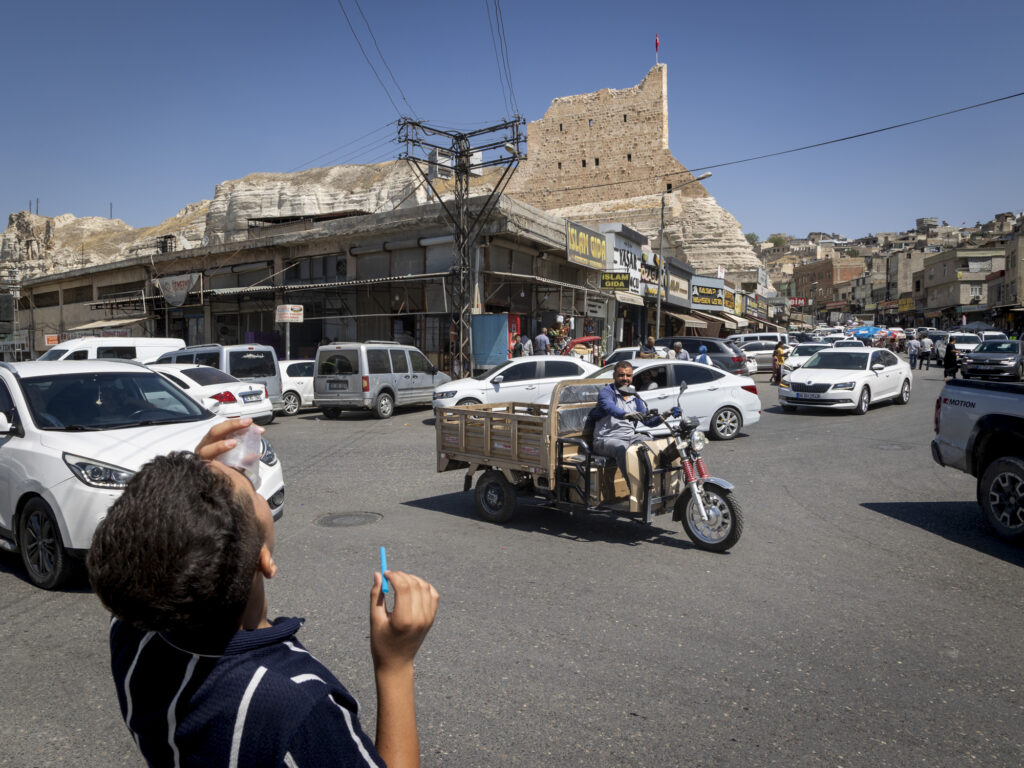
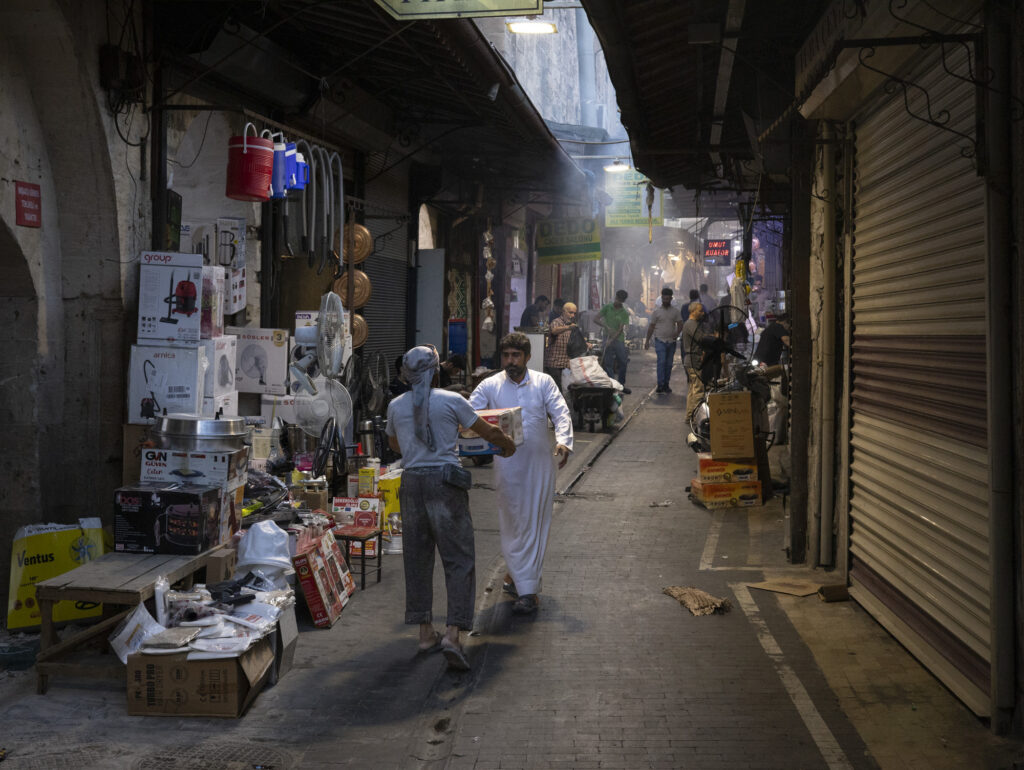
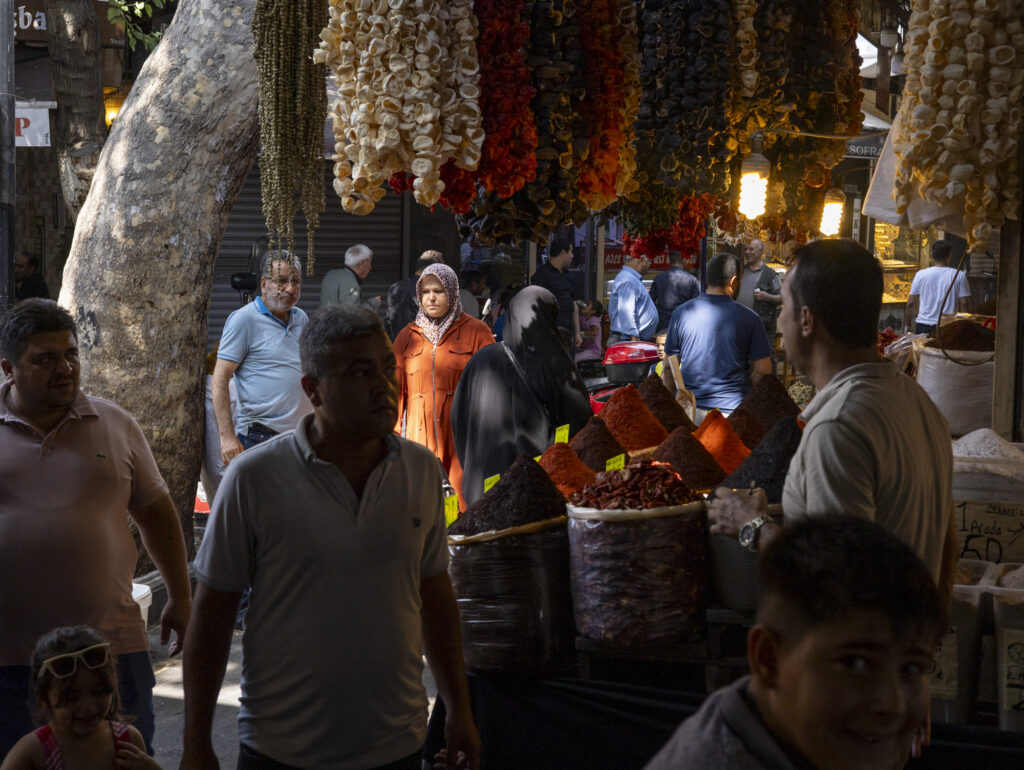
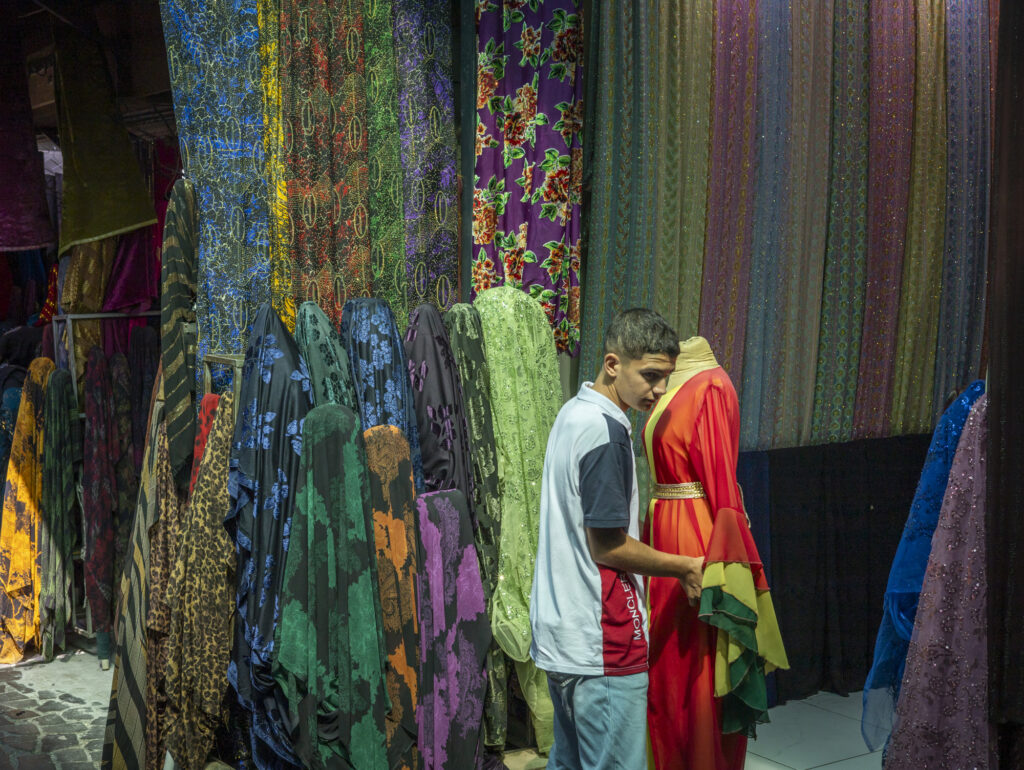
Here I’m once again staying with a guy I found on Couchsurfing. Ismail is a true movie buff, obsessed, I’d say. He tells me he’s seen over two thousand films, and he keeps watching new ones, nonstop, on his phone. I’m staying in what is effectively a hotel. A beautiful old traditional house, which Ismail has renovated and transformed into a tourist accommodation. My bed is on the terrace, practically on the roof. Ismail gives me a lot of freedom, and in the rare moments we spend together, he continues to watch movies. At most, he asks me if I’ve seen any of the ones he knows, reeling off a long list of which I know little or nothing. My first day wandering around Sanlıurfa is quite shocking. The city is a raging human river, a rapid in a narrow valley. The bazaar is among the most beautiful I’ve ever seen, and it’s enormous. Every time I change direction, I find myself in a completely different environment. The architecture, the light, the people change. I feel like I’m in a market on a “Star Wars” planet, where the faces around me are absurd, each so different from the next. In the alleys of the old city, however, silence suddenly falls. The streets are hairpin bends that rise and fall, covered in pigeon droppings. In the labyrinth, it’s easy to stumble upon collapsed buildings, among which you can glimpse people hiding, squeezed between the rubble, doing who knows what. The true masters of the destruction left by the 2022 earthquake, however, are the cats, who in large groups observe passersby like lookouts. Şanlıurfa intimidates and fascinates me tremendously at the same time. It’s the first time I haven’t felt entirely safe in a place, but I can’t stop. The first evening, I retreat a little dazed, as if I weren’t yet ready to understand such a city. Shortly before, as I was emerging from the now darkened alleys, a group of boys and girls blew me kisses as I walked away toward my accommodation. They had beautiful faces. I don’t know if they were Kurds or Syrians. But they told me that those mysterious, rubble-filled alleys are more welcoming than they seem. They told me to come back. And I have to, because the first time around, I didn’t understand anything. And so I do for the next two days. Sanlıurfa is best known as the birthplace of the Prophet Abraham. The sacred complex of Balıklıgöl is its beating heart, a destination for thousands of pilgrims from around the world. It is said that the miracle that saved Abraham occurred in the waters of its lake: after King Nemrut, following a prediction that he would be deposed by a child, had all newborns executed, Abraham was hidden in a cave. Discovered years later, now a young man, for having destroyed the king’s idols, he was condemned to the stake and catapulted into the flames. But God intervened, transforming the fire into water and the burning embers into carp. This sacred lake has existed ever since, today surrounded by gardens and mosques, and protected from above by the city’s ancient castle.
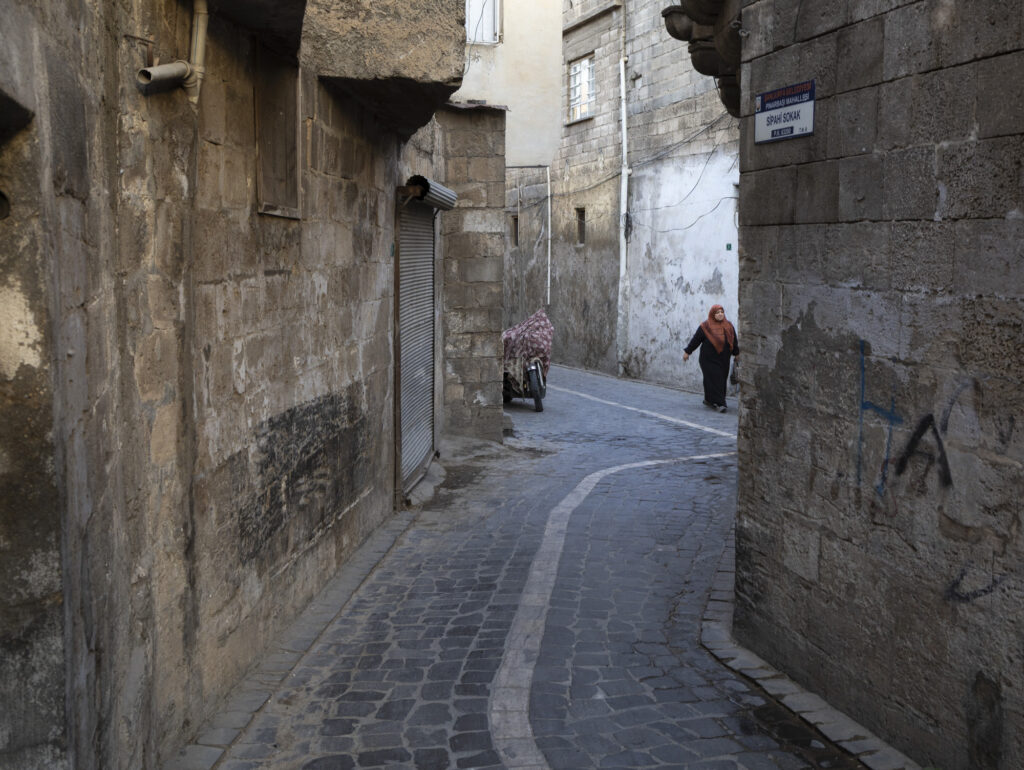
Despite these places of intense spirituality, the places that most attract me remain the narrow alleys, the vibrant capillaries of the old city. My shyness toward it slowly dissipates. During the day, when the walls burn from the scorching sun, the only inhabitants seem to be children. As I pass, some run away, some follow me, some stare transfixed, some ask for a photo. The adults, for the most part, watch me furtively from behind the windows, some from the peephole in the door. As I gaze out over the city, a man approaches me and asks if he’s already been robbed in the labyrinth, then walks away. As the hours pass, the sun leaves the streets and the world finally comes back to life. I now find myself talking to a lot of people. I’m welcomed into a bakery, where I’m ushered triumphantly among those rolling out flour, baking, and seasoning. Many curious people watch me from outside. Just next door, along the street, I meet Halil, a man who runs a small photo print shop. I spend long periods of time with him, drinking tea, speaking in broken but effective English, and people-watching. He sells all kinds of images: landscapes, iconic cities, famous people, soldiers. What amazes me most, however, is that the ones I see him selling the most are of The Godfather, various mafia-looking characters, and a Korean man in a black down vest and sunglasses, looking extremely tacky. He dreams of buying a camera and moving his shop to a busier street. Business is tough where he’s currently located.
He creates a small neighborhood where within a couple of days everyone knows me. During the day, I come over to drink tea with Halil and chat with the people; in the evening, I drop by to collect the invitations I’ve received: the hospitality is overwhelming, to say the least. On the last night before leaving, I’m chatting with Halil, who’s already invited me to his house for dinner as soon as the shop closes. From the little shop next door, young Mohammed brings me a piadina filled with meat and spicy vegetables. I don’t have time to finish it before the bakery calls me back. I’d better stop by to say hello to them too. I find myself back in the kitchen, stuffed with the “pizzas” they’re making on a continuous basis. If that weren’t enough, a family who ordered trays of vegetables and baked chicken prepares a plate for me before heading home to eat. In the space of a few dozen minutes, I’ve collected three dinners. Halil calls me again: it’s time to go home. To dinner.
The kindness of Halil and his wife is so profound that I can’t help but sit down to eat again. To my surprise, we sit at the “table”—that is, on the carpet—all together, with his wife and only daughter also present. Of his four daughters, she’s the only one not yet married, and I wonder if that’s why she can sit next to me. In recent weeks, at the invitations, the women had always prepared and brought the food, but they had never sat with us to eat. It had always been just the men. I leave “Urfa” with a bout of indigestion and a stomach upset. The next day, however, people’s generosity gives me no respite. I continue to receive food in abundance, from cars stopping on the street or from people who see me pass by their house. My social batteries are still not fully recharged, and I try to avoid people as much as possible. I’m tired of the same old conversations in which I never understand anything beyond the same routine questions, which I now know how to answer like a tape recorder, even though they’re asked in Turkish: Where are you from? How long did it take you to get here? How old are you? Are you married? Are you single? What do you do for a living? A list that repeats itself over and over again every day. The reality is, however, that they are all very kind, welcoming people, and simply curious and interested in me. After so many days, I’m tired, but deep down, I wish the whole world were this open to others. At times I almost feel guilty trying to avoid them, but I also have to accept that not every day I have the energy to be open to the world.
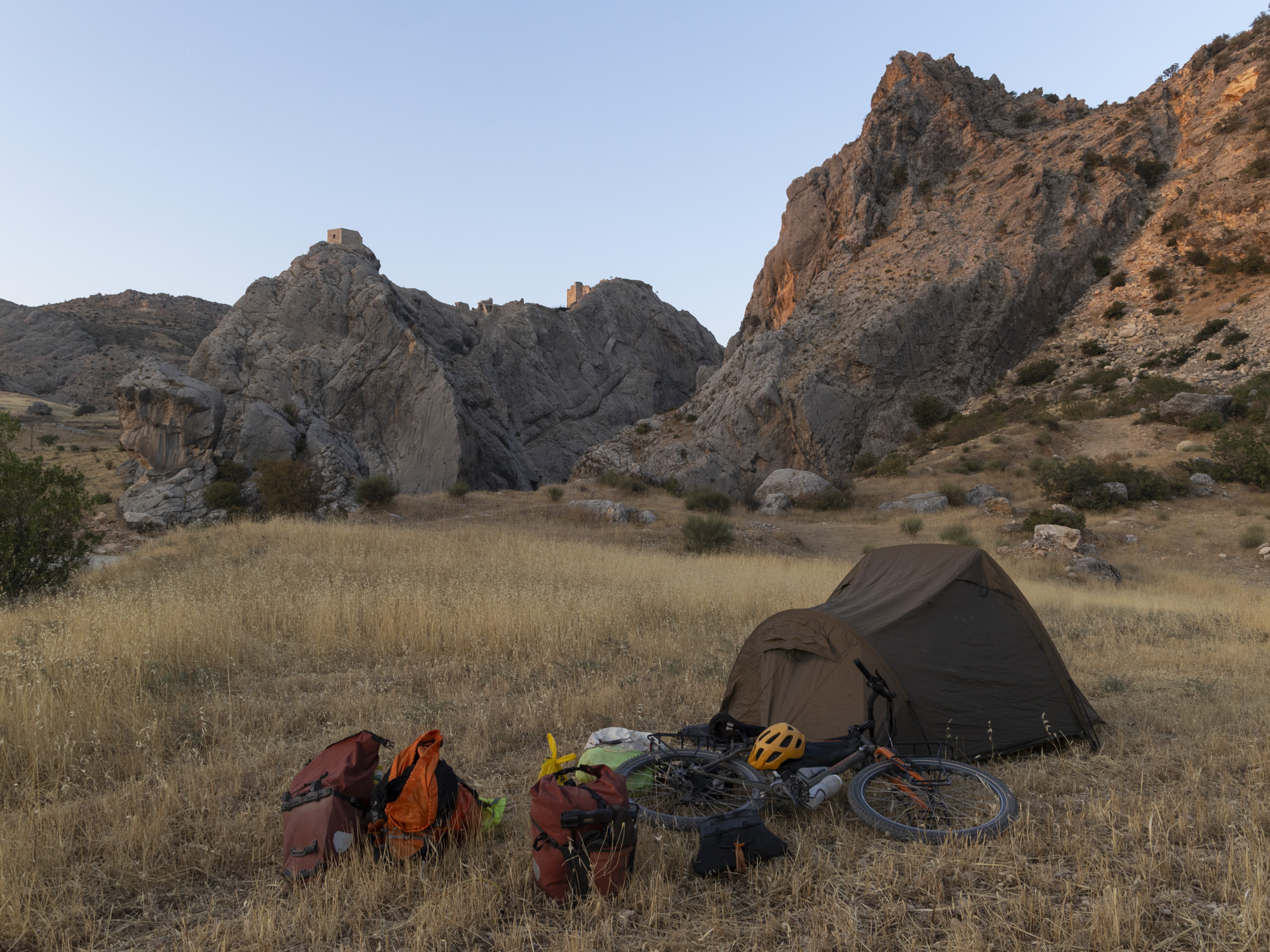
In any case, whether I like it or not, it’s inevitable. In the days that follow, making progress becomes almost a feat. It’s a constant stream of invitations to people’s homes, of people calling me for tea, of gifts. Every 20-30 minutes of pedaling, I’m stuck at someone’s place for the same amount of time. Sometimes saying I was stuffed just half an hour earlier seems like an incomprehensible statement, so much so that I’m asked three or four times if I’m sure I don’t want to eat. In any case, there’s no escape, because if I don’t eat with them, I have to take the food with me anyway. Some people even try to give me sandals, given the condition of mine, which for weeks have been a mass of tape trying to hold them together. Size 46, however, doesn’t exist around here. I pass through tobacco fields and the town of Adıyaman, then begin to climb the mountains. I reach the ancient Roman bridge of Cendere and then the castle of Kâhta, where I decide to pitch my tent before tackling the fearful climb to the summit of Mount Nemrut the next day.
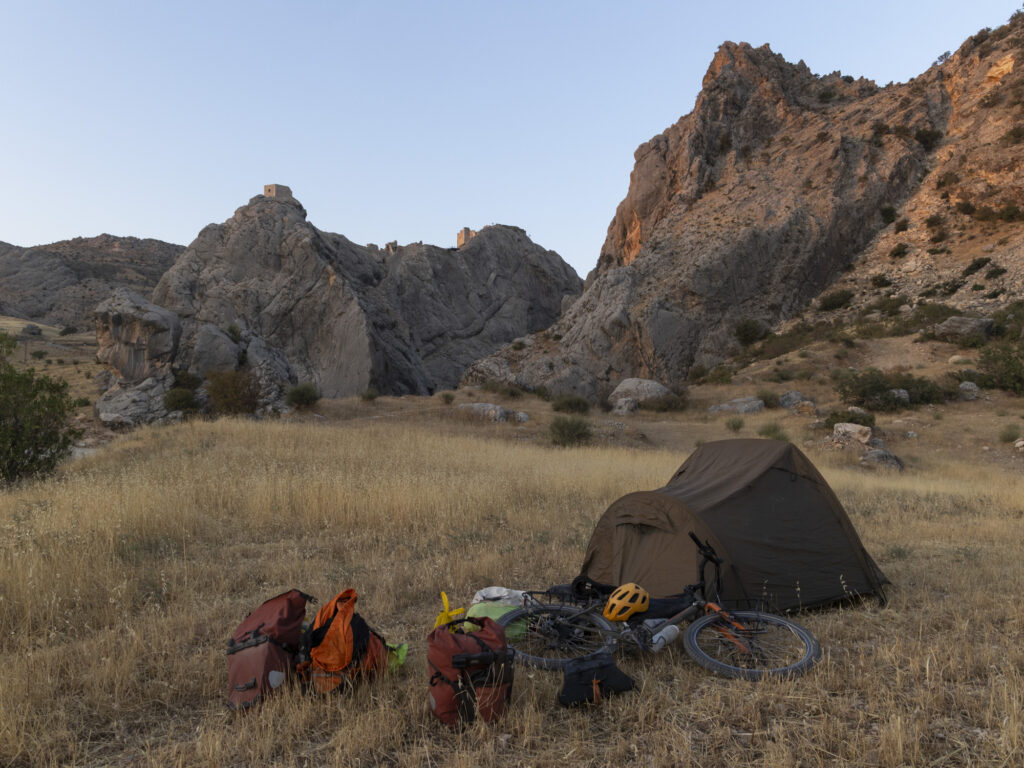
I sleep on the dry grass in the mountains near a magnificent gorge. The moon is very bright, making the fields around me glow. The night is silent until I am suddenly awakened by moans. Strange screams come from the rocks of the canyon, the same ones I had already heard on the Evros River, on the border between Greece and Turkey. They sound like many cats screaming at once. Or even more like souls crying from hell, tormented and heartbreaking. They are a little scary. But they remain there, in the air and in the gorge, until they fall silent.
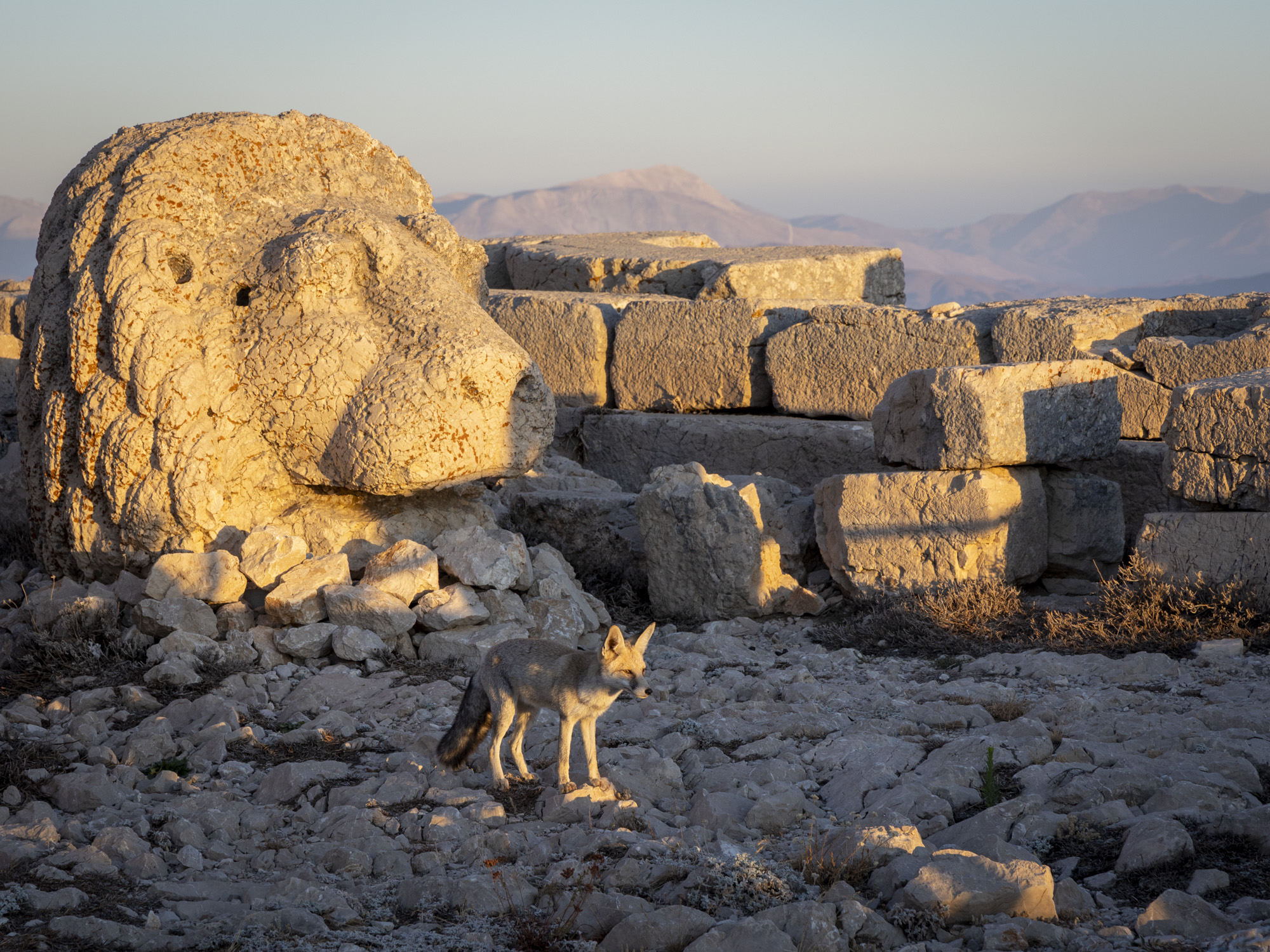
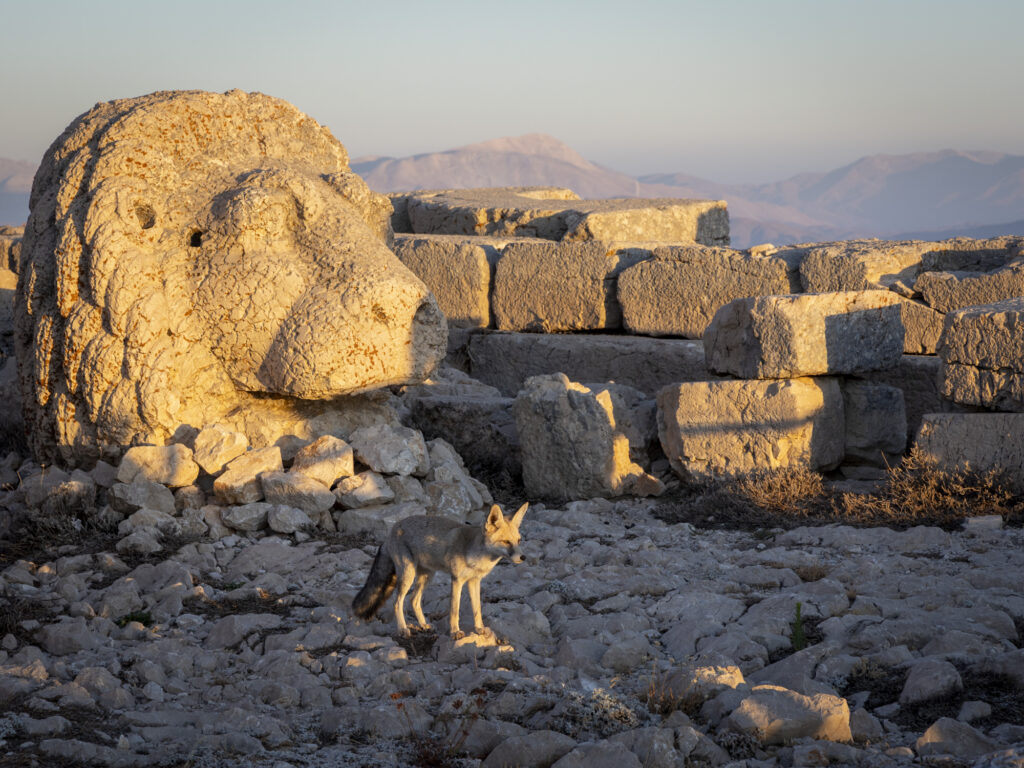
When I wake up, I have the company of a small fox wandering near the tent, and an elderly gentleman with a long white beard silently passes by on a donkey.
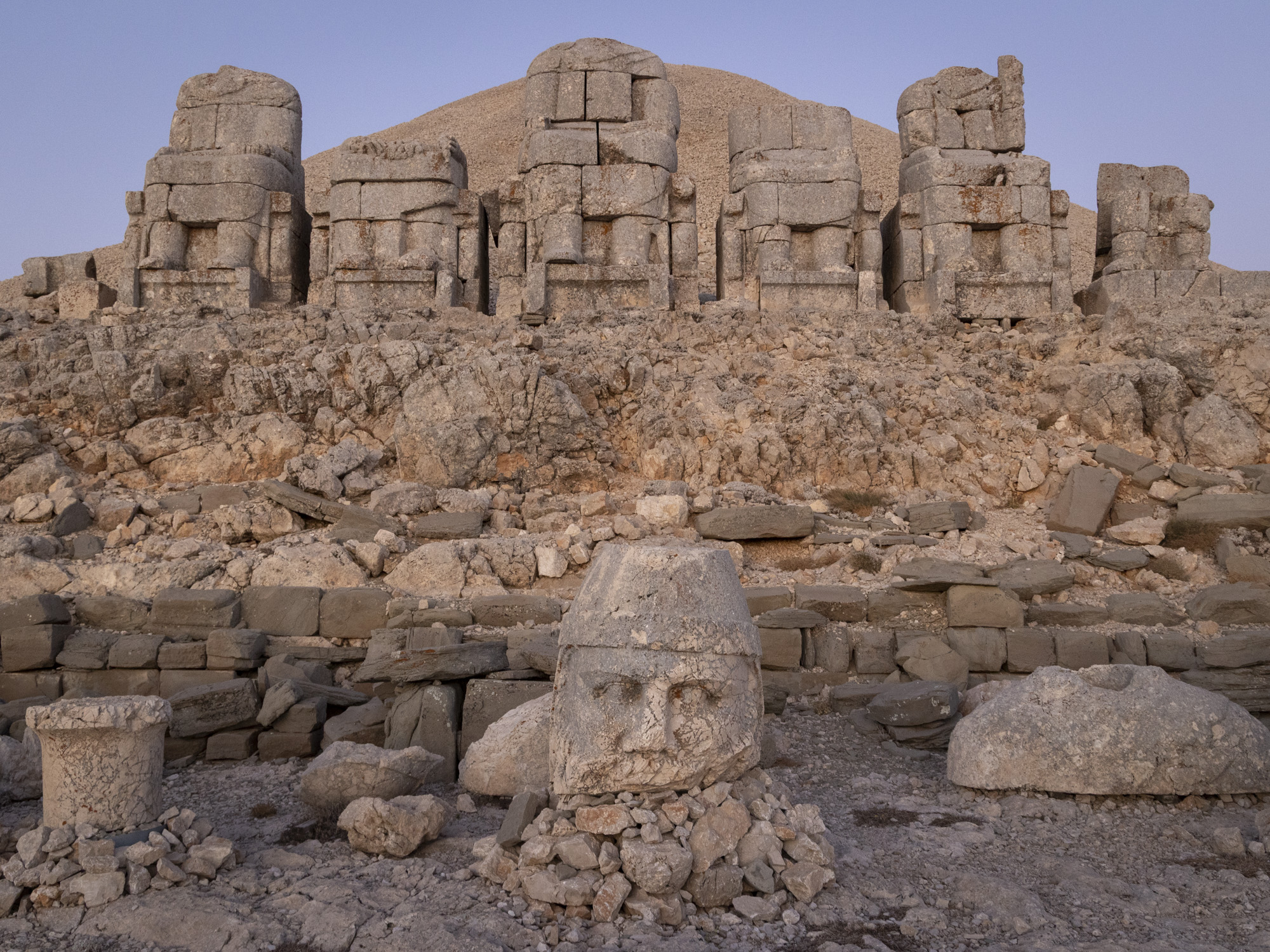
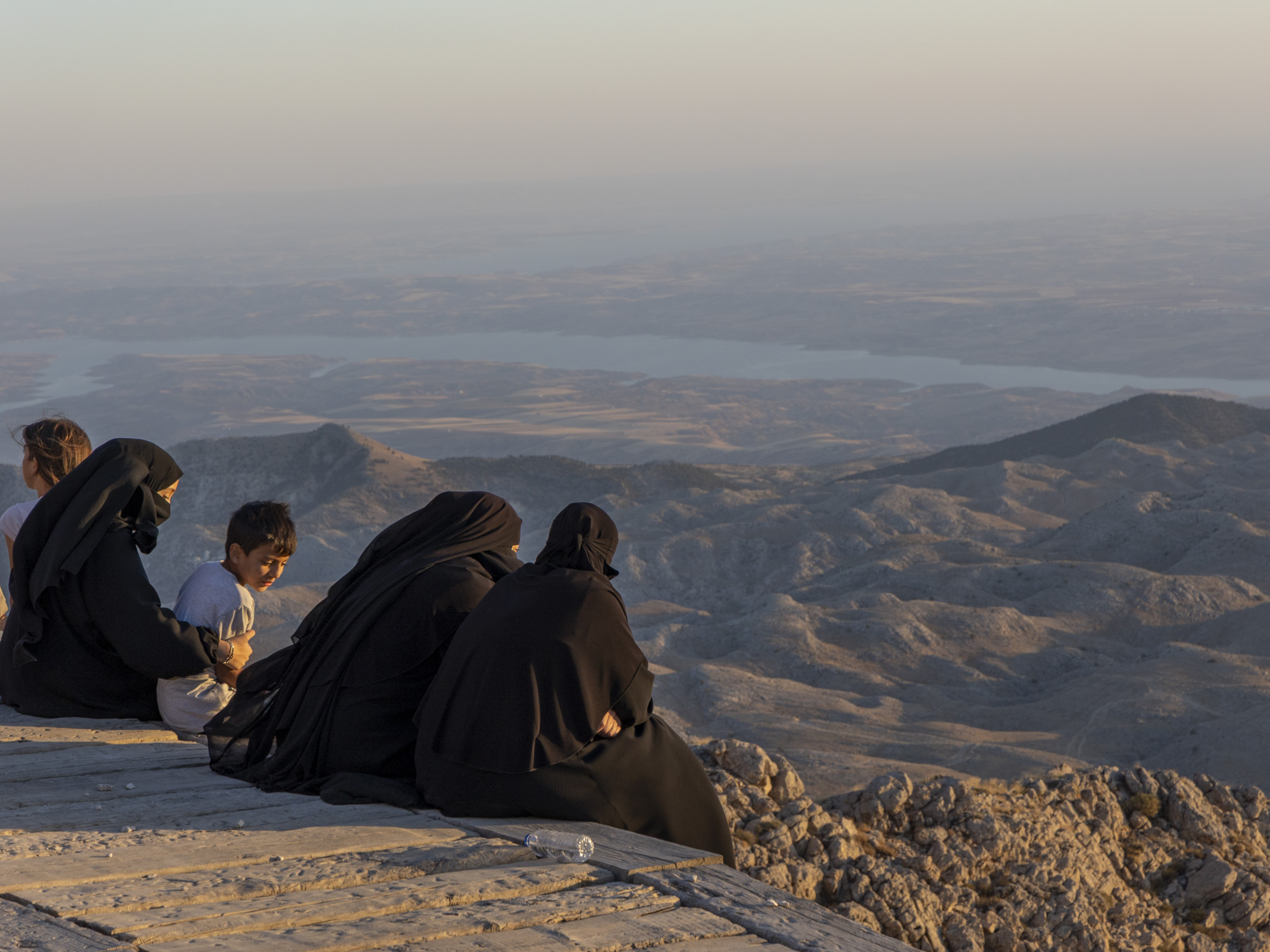
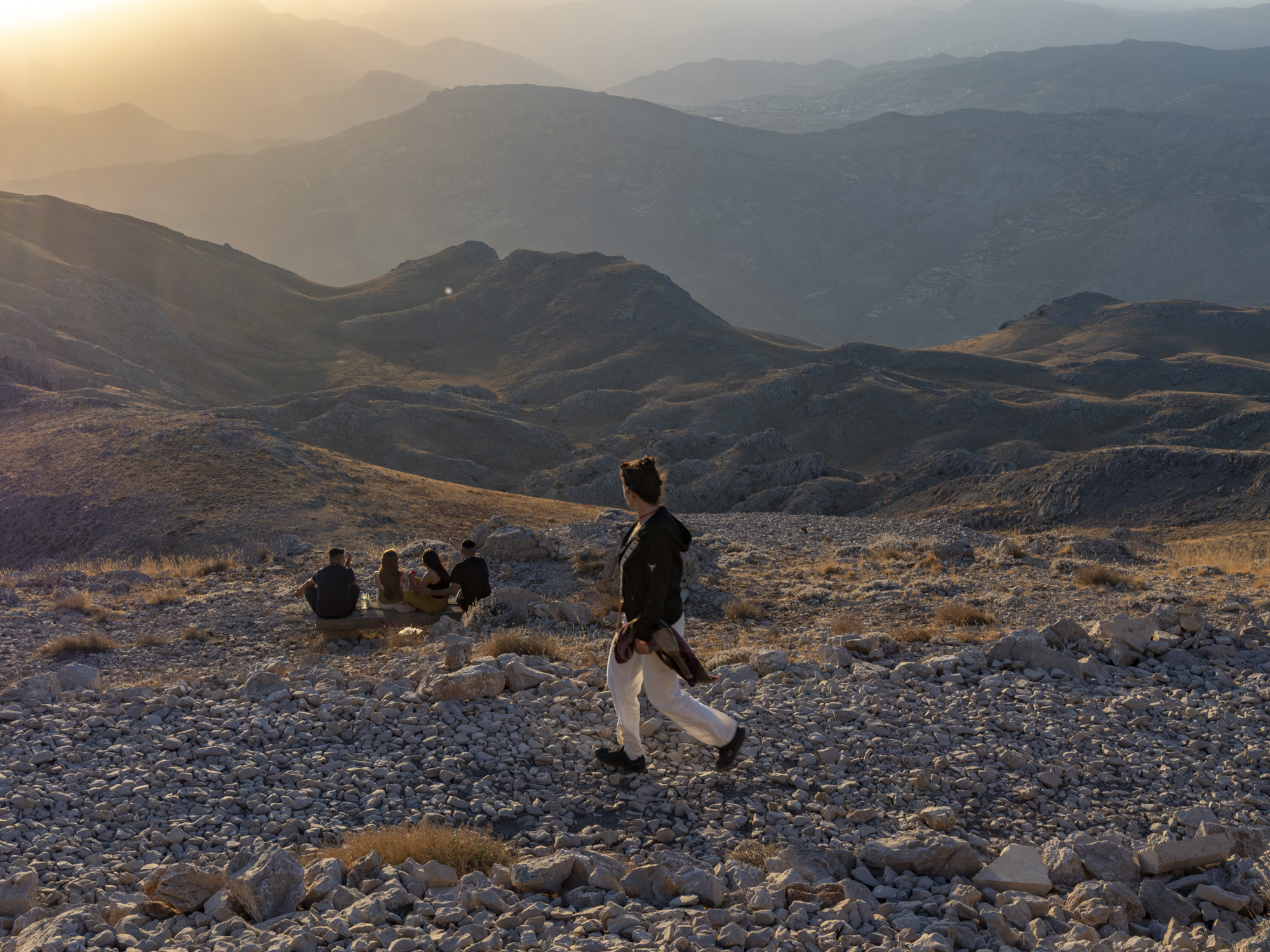
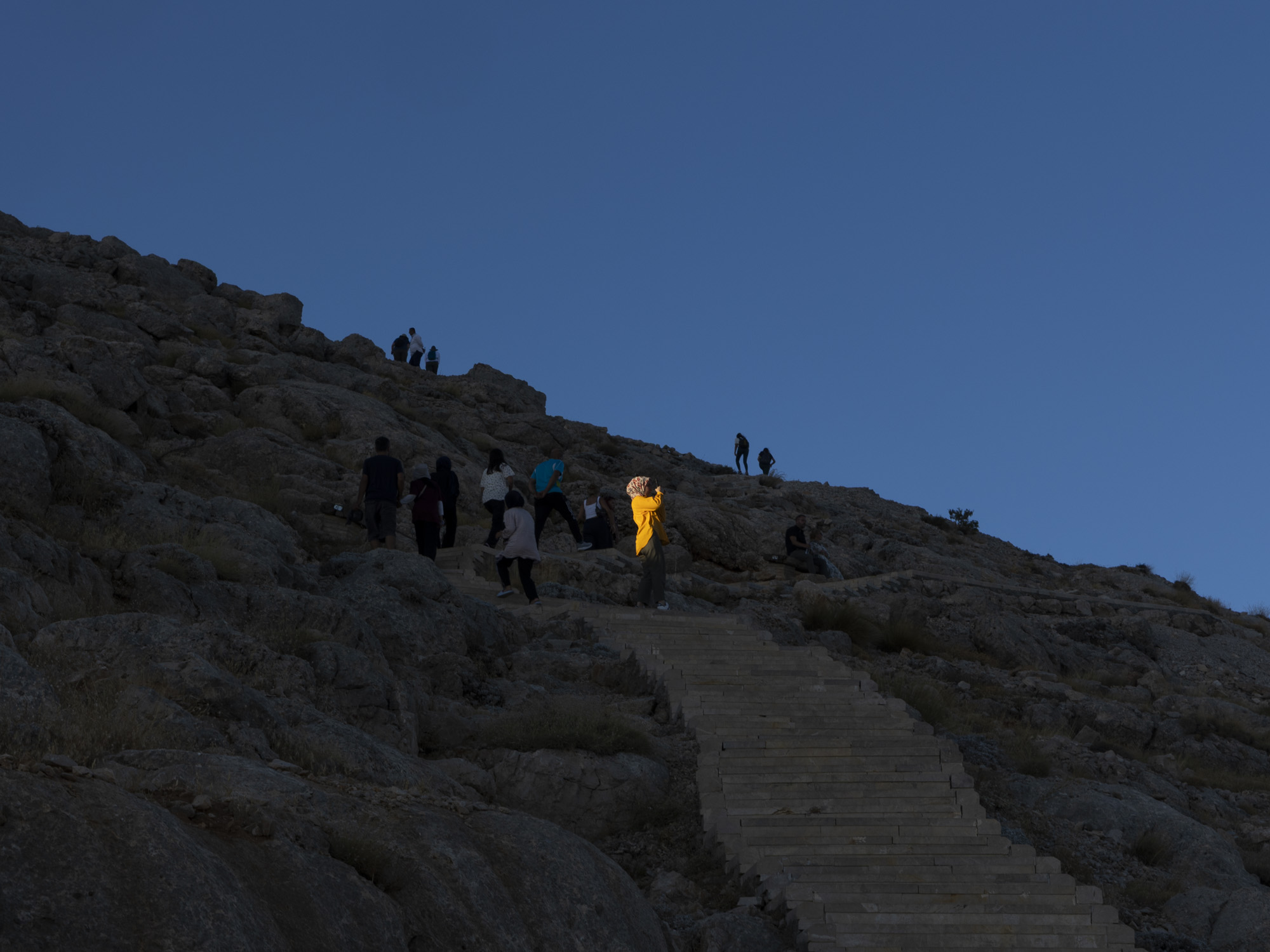
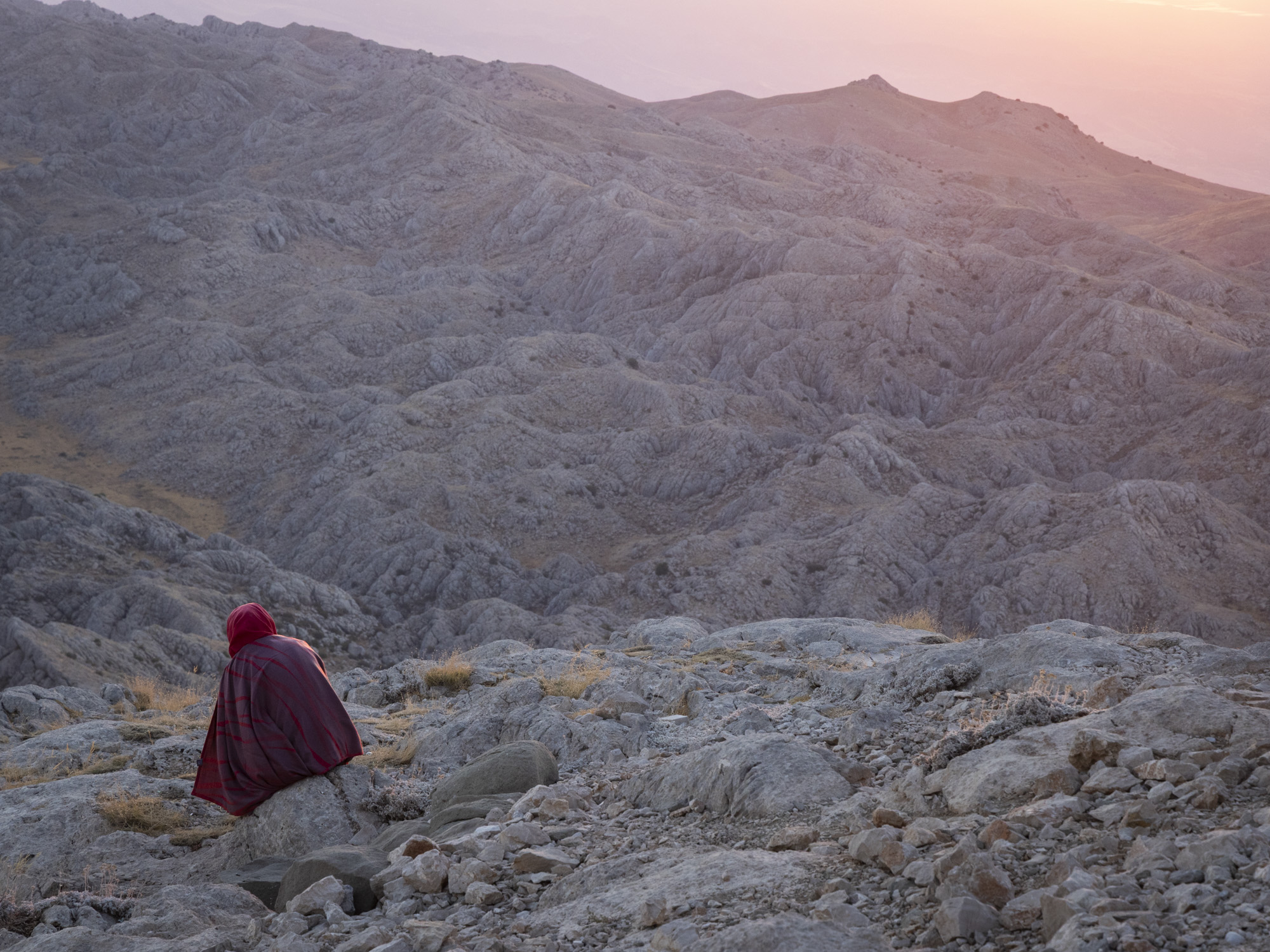
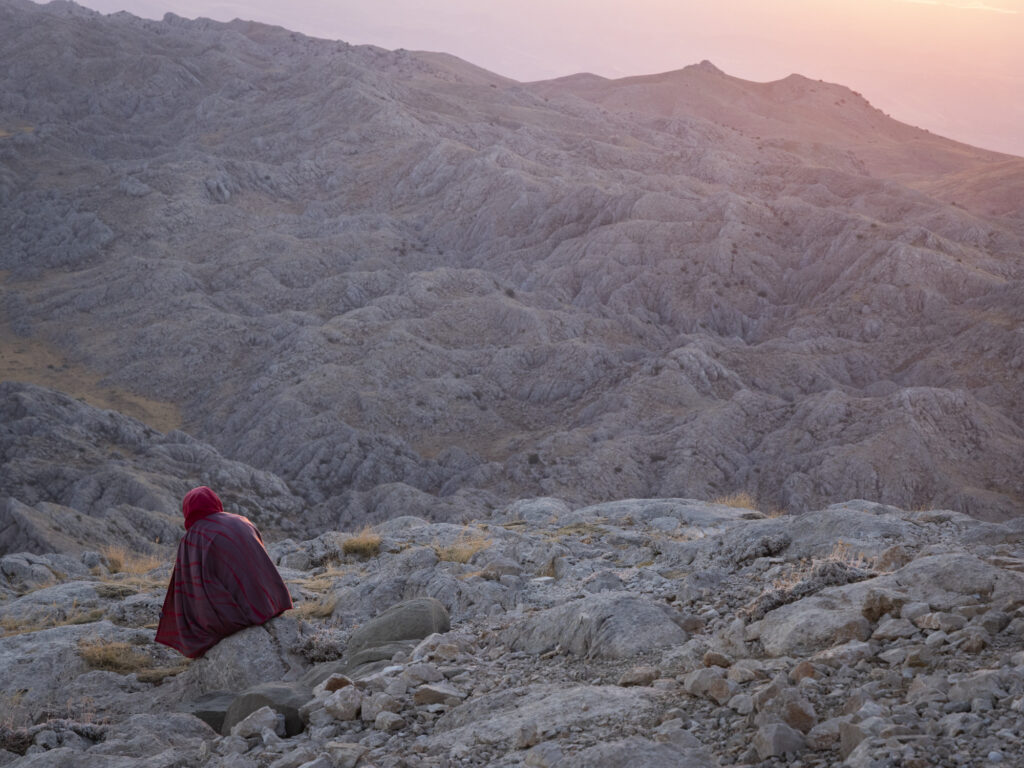
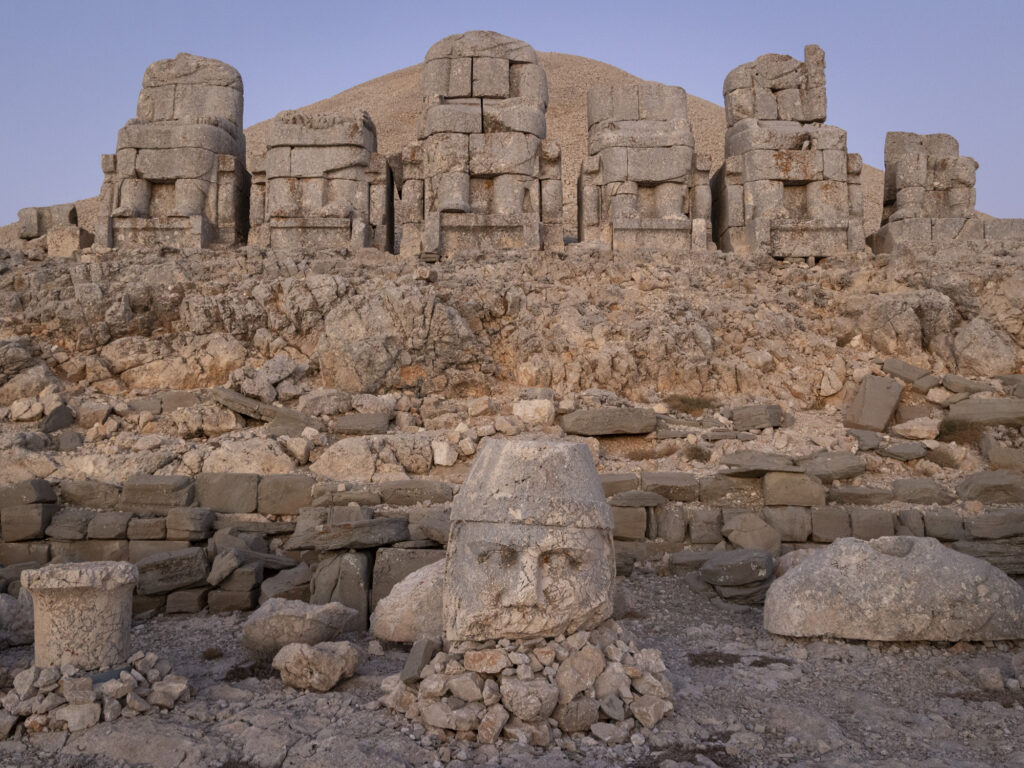
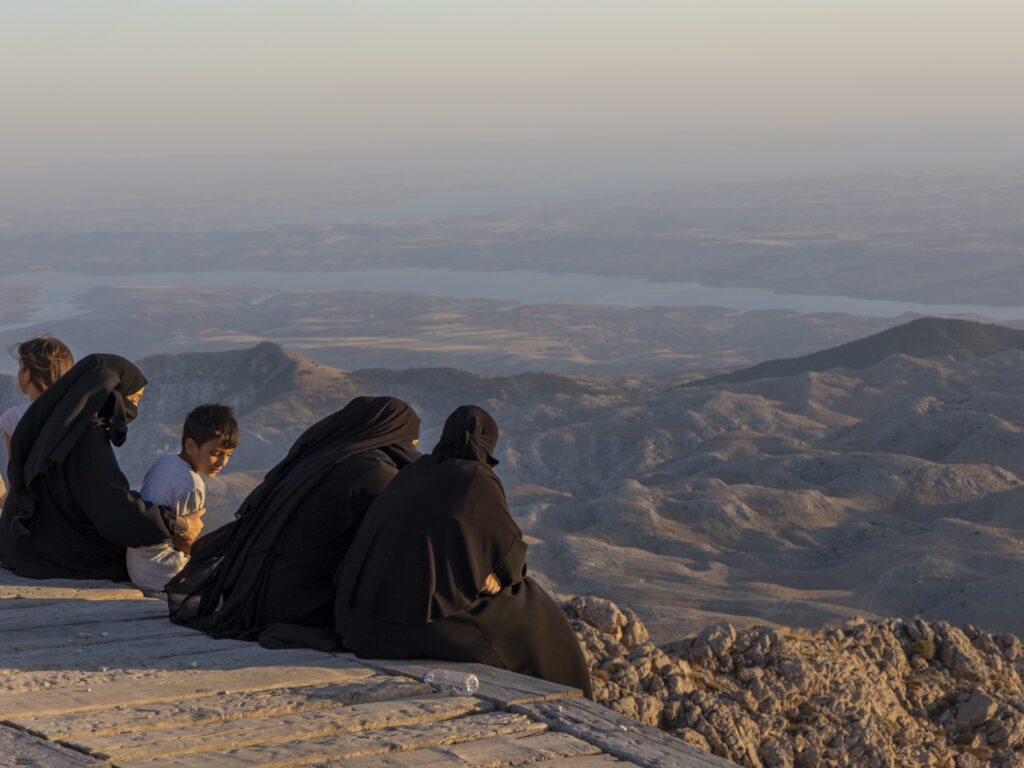
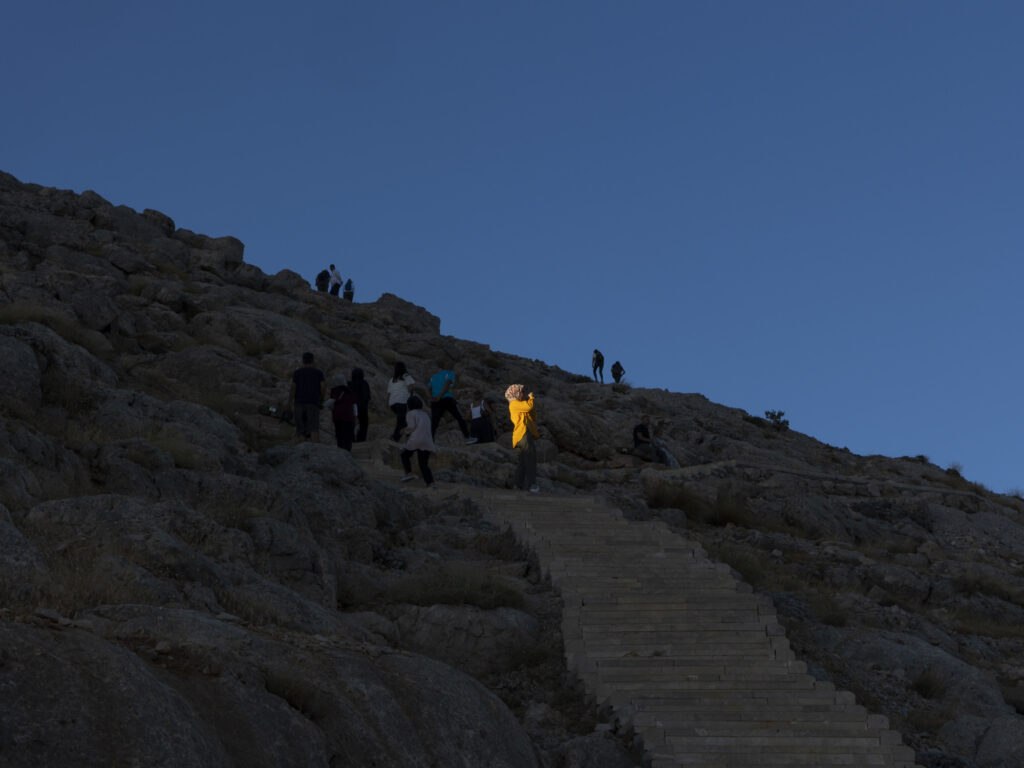
I begin my Stations of the Cross. I stock up on sugars, nuts, mineral salts, and water, and slowly begin to zigzag up the steep climb. It takes me over six hours to cover just 16 km, with about 1,500 m of elevation gain. At a certain point in the climb, I had to stop, bursting with laughter. My endorphin levels must have reached their peak, because for no reason at all, I found myself with tears in my eyes, laughing alone in the silence of a desert canyon. At the top of Mount Nemrut, at an altitude of 2,150 meters, stands a marvelous archaeological site commissioned by King Antiochus I Theos of Commagene in the 1st century BC. Today, you can still see the large heads of the imposing statues that once decorated the site, a complex that served as a tomb-sanctuary for the king and a place of worship for a syncretic pantheon of Greek and Persian deities.
Here, I meet Eymen, a former Turkish journalist who tells me how difficult the reality is today for those who do his job. In past years, he had published information about witnesses who had been hidden, related to serious crimes committed by prominent figures. The government had covered it up. Within a short time, he had to resign, following threats of arrest for disclosing dangerous data. Today, after years, he wants to return to his job. Or at least try. Freedom of information in Türkiye is in enormous difficulty.
The descent from the mountain takes me toward the city of Diyarbakır, considered the Kurdish capital in Turkish territory. The kilometers to get there are long and monotonous, graced by the classic expanses of dry grass and stones that stretch as far as the eye can see. The journey becomes a journey of my fantasies and memories, dreams and ideas, interrupted only occasionally by someone stopping to give me a gift or a large dead dog on the side of the road.
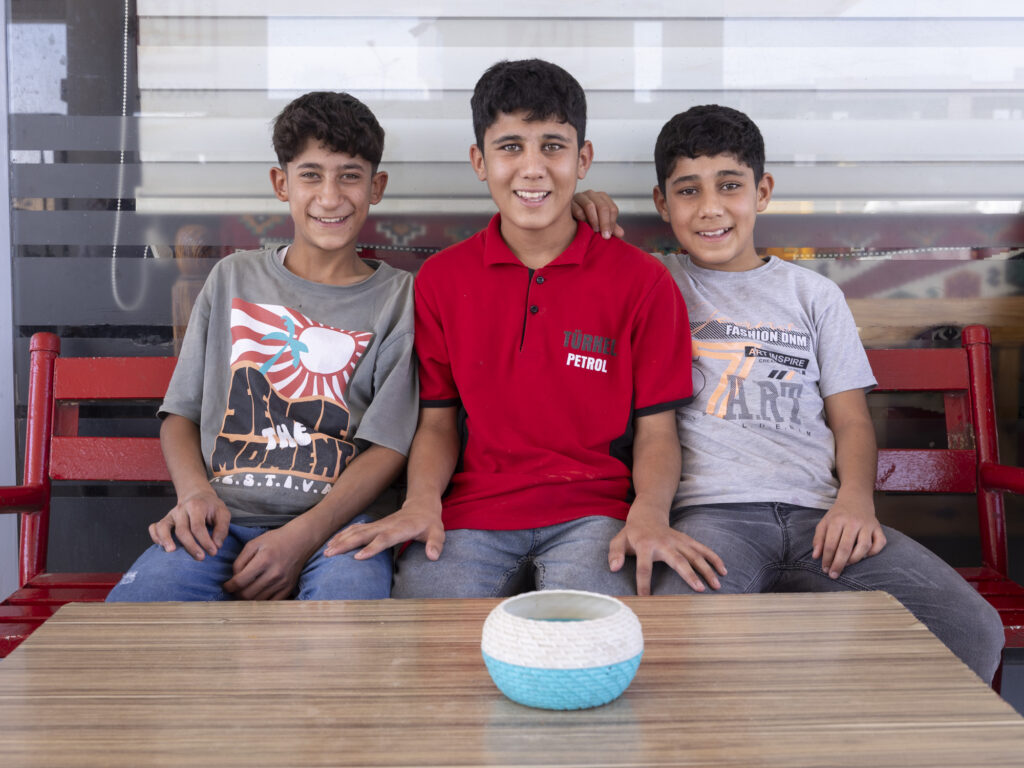
In Diyarbakır, the welcome is wonderful. I’m Ferrat’s guest, always found among those offering hospitality through travel apps. When I arrive, he’s still at work, and he tells me to sit near his house. Within minutes, I’m surrounded by curious children, fortunately very kind. A first car with some kids stops to ask if I’m a friend of Ferrat’s: “Welcome! We’re his friends!” Shortly after, an older man arrives: “Ferrat? Come, I have the keys!” It seems everyone knows it and knows it hosts travelers, mostly cyclists. The large group of children helps me unload my bike and takes care of carrying all my bags into the apartment, which they know perfectly well where it is. They leave everything tidy at the entrance and say goodbye, then knock on the door a little later and leave me a note written by one of them: “Hi Emiliano, welcome to Turkey. My name is Hogir. I love you.”
What a kiss to the heart. I still think about the terrible children at the gas station that evening, and the constant jumping around this life forces me to do every day. The night before arriving in Diyarbakır, I went to bed cleaning up the diarrhea a little kitten had given me inside the tent. Today I have a double bed and an entire apartment all to myself.
On days in the city, I relax a lot. Private space is a rare joy; Ferat works all day and picks me up in the evening to show me around. He’s 47 and a teacher, but he also produces wine on land outside the city and is a psy-trance DJ. So, after about a month, I frequent a place with music, where I can meet people, dance, and drink beer. Life with Ferat, for the few days we share, is an alternative bubble in a world of travel that is mostly Muslim and conservative. Personally, I’m deeply more interested in experiencing a reality so different from my own, where I have to adapt but where I have so much to discover and learn, but sometimes a nice, more libertine evening is really nice. And so, tango, techno, art galleries, and girls with their hair uncovered are welcome.
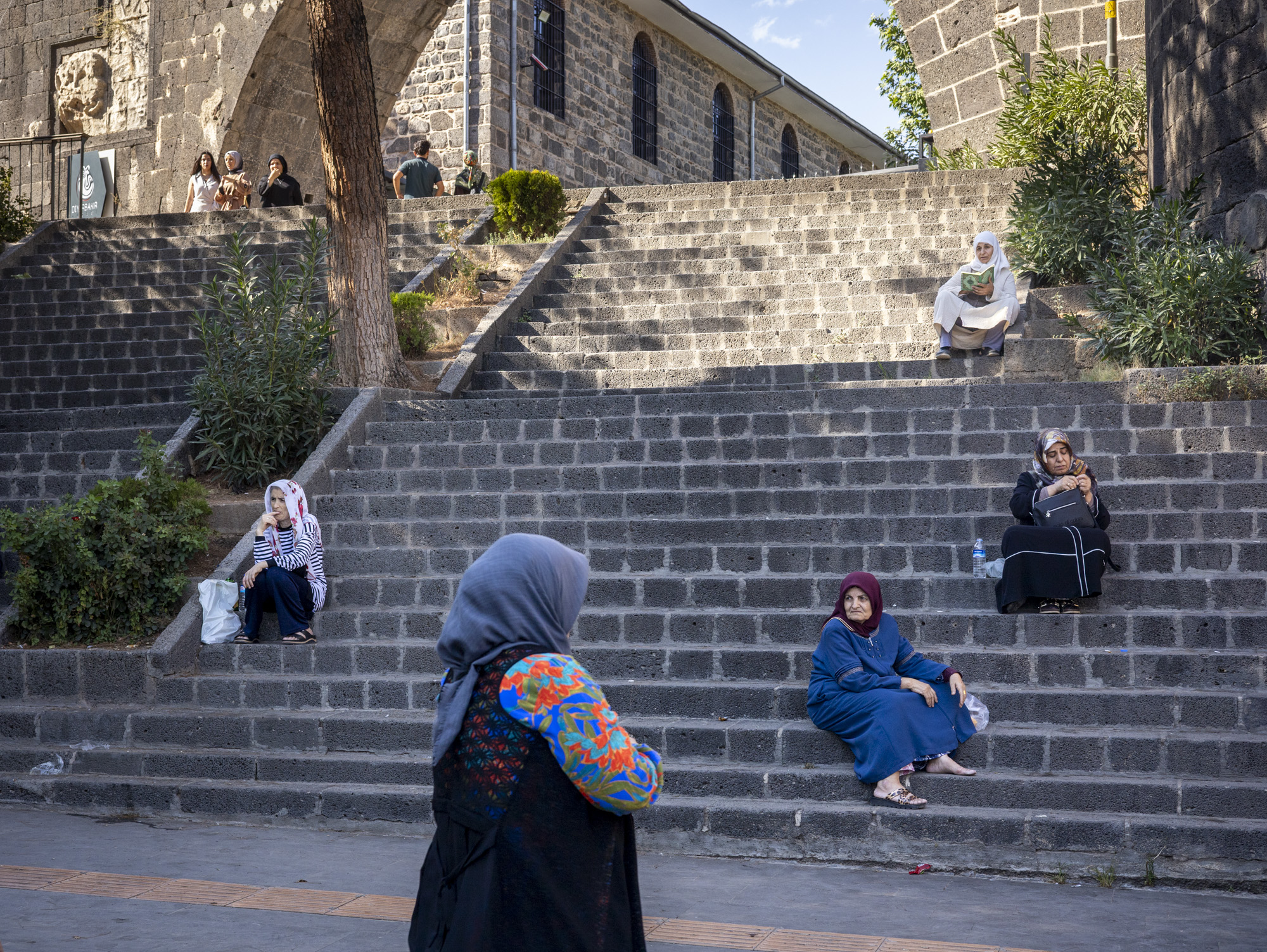
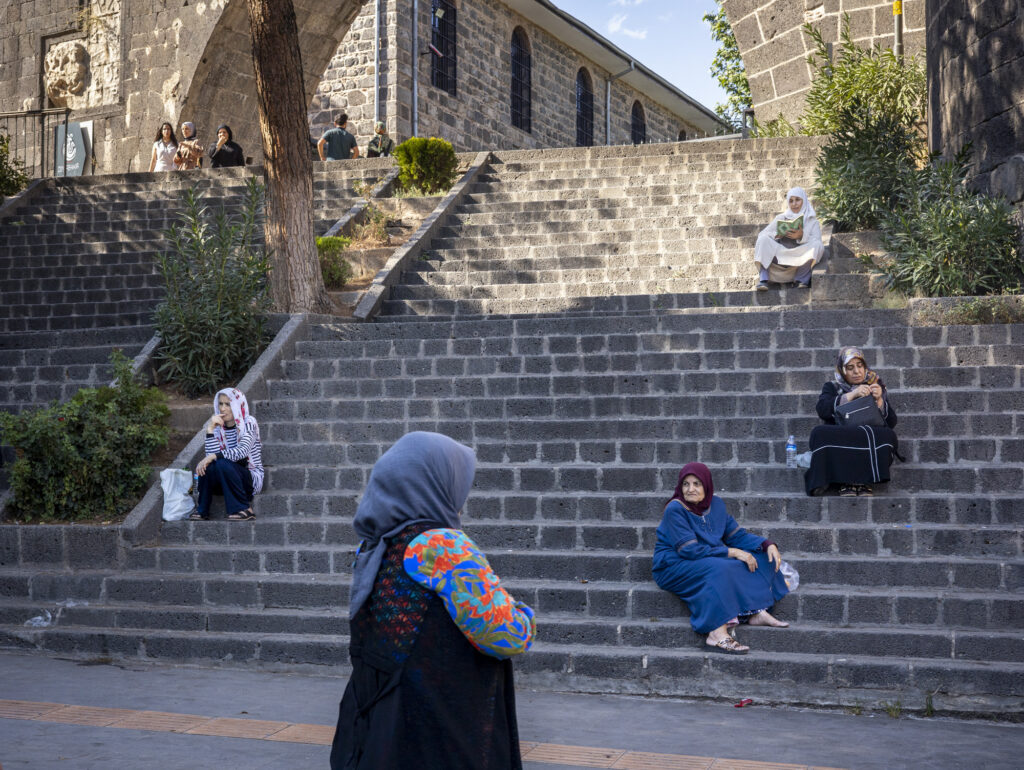
In Diyarbakır, the Kurdish presence is felt, as is the proximity to conflict zones with the Turkish army and Syria. Fighter jets constantly circle the city, and the military presence is massive. Every few blocks there’s an army compound. To the southwest, not far from the old city, lies a large air base. As I move through the city, my Bluetooth headphones continually drop out, lose connection, or experience severe interference. My GPS goes haywire, veering off in random directions, veering around, constantly losing track and position. And so it goes all the way to Mardin, for almost a hundred kilometers. My headphones and GPS recover, but every few kilometers there’s a control tower with soldiers. The first checkpoints with ID checks appear, and a growing tension can be felt in the air.
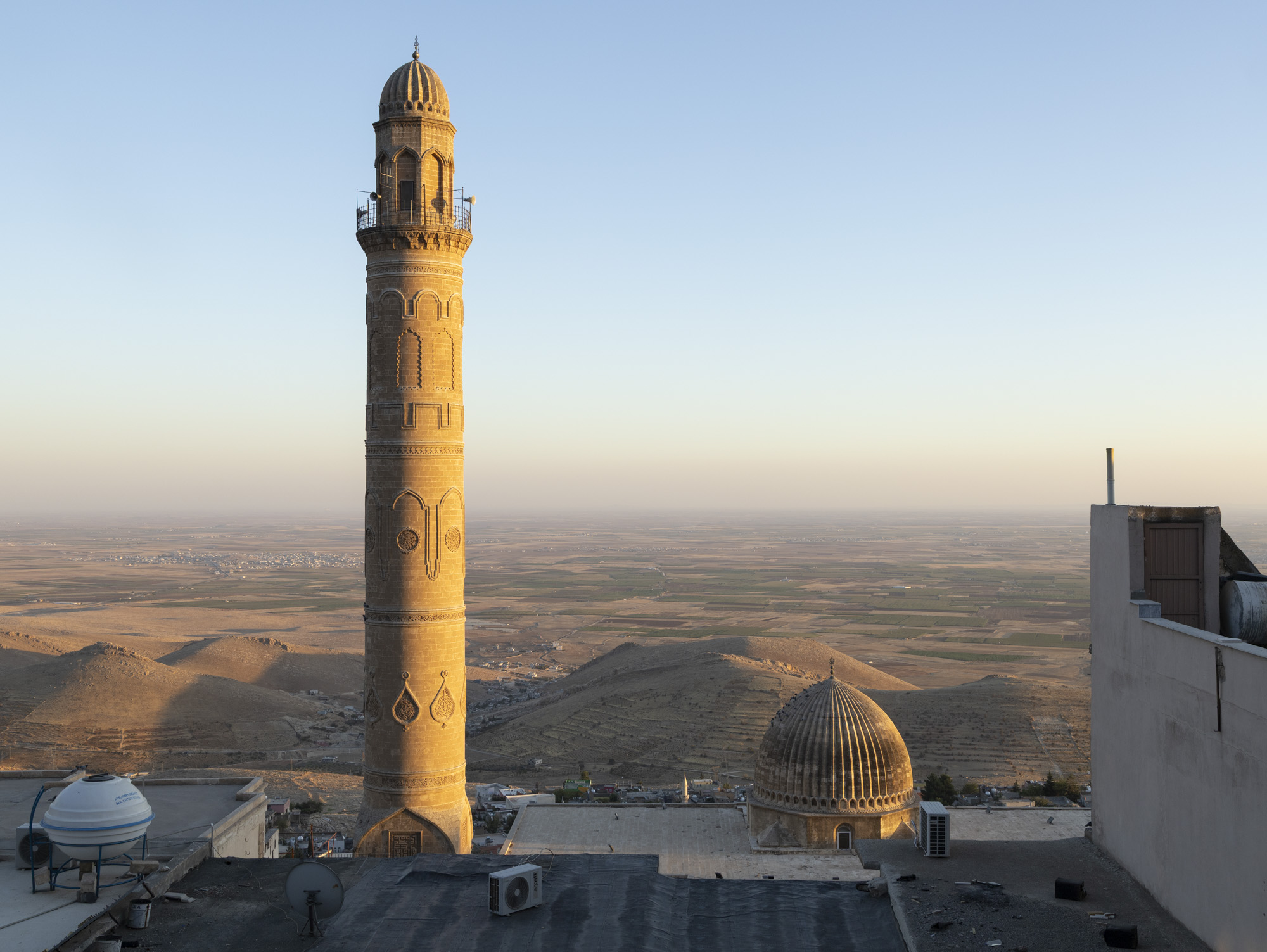
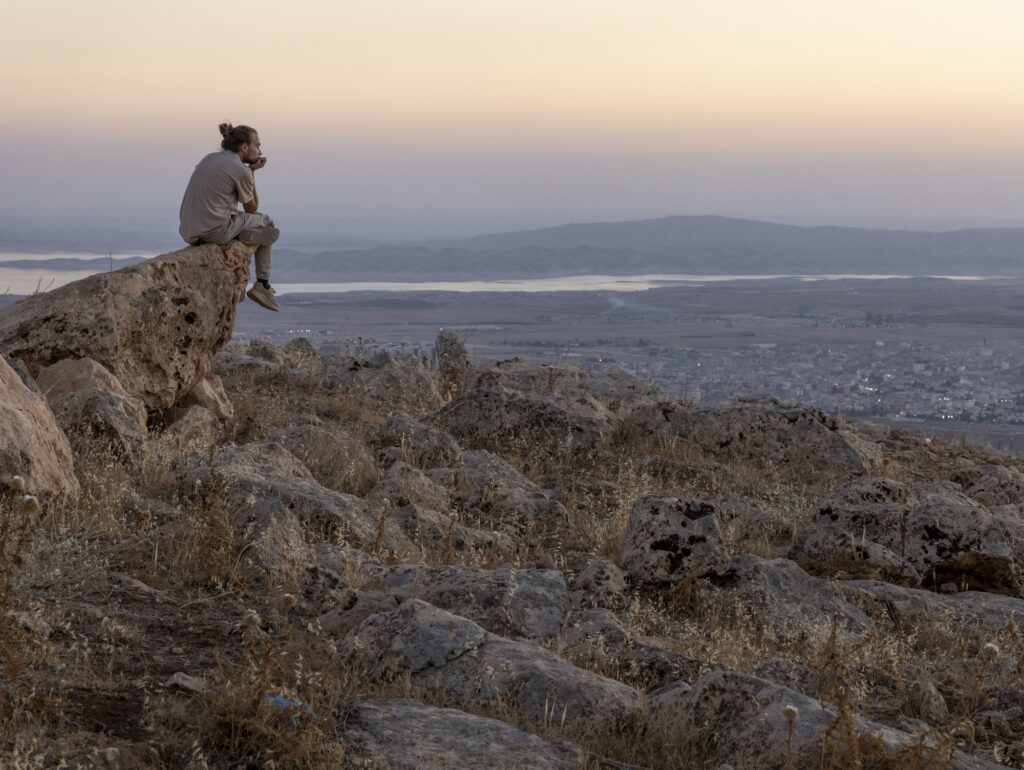
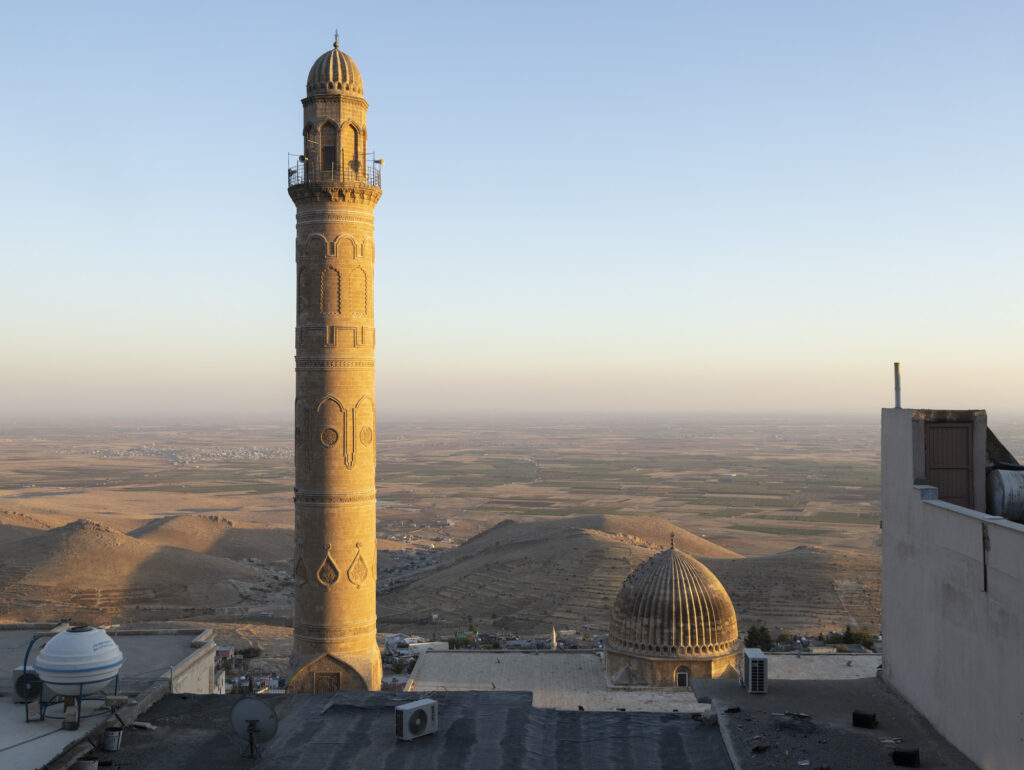
The city of Mardin, however, is a kind of candy, an architectural and historical confection, where tourists and the world around them seem to forget the geographical and social reality in which they are immersed. It climbs a mountain through alleys, stairs, and steep streets, looking down on the immense plain overlooking Mesopotamia and, a few kilometers away, Syria. At night, the contrast is clear: the orange lights of Turkey are abruptly interrupted, and where the white ones begin, Rojava rises. A long series of streetlights marks the wall dividing the two countries.
The streets of Mardin are lined with restaurants, shops, hotels, and cafes. Honey-colored limestone buildings rise in terraces to the ancient fortress at the top of the mountain, where today there is a NATO base, staffed by American and Turkish soldiers. To the east, about a hundred kilometers away, are the areas controlled by the PKK.
The face of Mardin today is largely due to the Artukids, a Turkmen dynasty, who built it between the 11th and 15th centuries. Its origins, however, are much older, presumably dating back to the Bronze Age. Its beauty, which today, however, has a certain artificiality, over-preparedness, reminiscent of ready-made food, doesn’t appeal to me. My birthday is on the day I’m staying, and after so many weeks, I’ve decided to pay for a hostel. I want to do what I want, and that’s it. So I spend my time reading and working on the computer, semi-isolated from the world. Much more interested in gazing at Syria from the nocturnal silence of the hostel roof than wandering among the tourists, in the confusion and superficiality that would require too much energy to overcome right now.
In the hostel, I share meals with the owners; each of us brings what we prepare, then I return to my bed. I enjoy chatting with the big cat who acts as “bouncer.” Huge and beautifully plump, he has a truly masterful manner, observing everyone who comes and goes. He becomes extremely violent as soon as another cat tries to cross the threshold. I rename him Piero Pelò, the fridge’s best friend, which as soon as I open it, whether I’m on the first or second floor, somehow, he sees appear within moments, ready to slip inside to inspect the bags.
On a very rare excursion through the streets of the city, which despite the boutiques is truly beautiful, I meet Ismail, my host in Sanlıurfa. He’s with a friend, and they invite me for a tea. We sit on a wonderful terrace, overlooking the infinite south. My friend tells me he’s a soldier in the Jandarma, one of the Turkish forces. He tells me that every two years they have to change sides of the country. Two years in the west, two years in the more complicated east. But above all, he tells me he fought for six months in Syria. With Assad’s soldiers, with the Americans, the Russians, with the PKK. “Bad, bad, bad.” And then that word I’ve heard so many times in this context: stress. In his eyes, you can see the shadow of what he’s experienced, what he’s seen, and what he’s probably done. We drink tea together, while Syria lies before us, trying to laugh.
Mardin is my last stop on this first leg of Turkey. In two days of cycling, I’ll reach Zakho, Iraq. The road I’m riding runs uninterruptedly along the border with Syria. Flat, shrouded in yellow soil, and with the cold continuity of a fence covered in barbed wire, acting as an additional barrier between me and the border wall. Military outposts and invitations to drink tea set the pace of my day, during which I find myself with so much caffeine in my system that I end up going much further than I imagined. I spend the night camped near a gas station a few kilometers from Cizre. From my tent, I observe the panorama during the twilight. A few steps away, I have Syria, I see the lights of the city of Al-Malikiya. Just a little further away, I can see those of Zakho, at the foot of the Iraqi mountains. To the east, the ones around Şırnak, in Turkey, rise, where I imagine PKK men hiding behind some rocky outcrop.
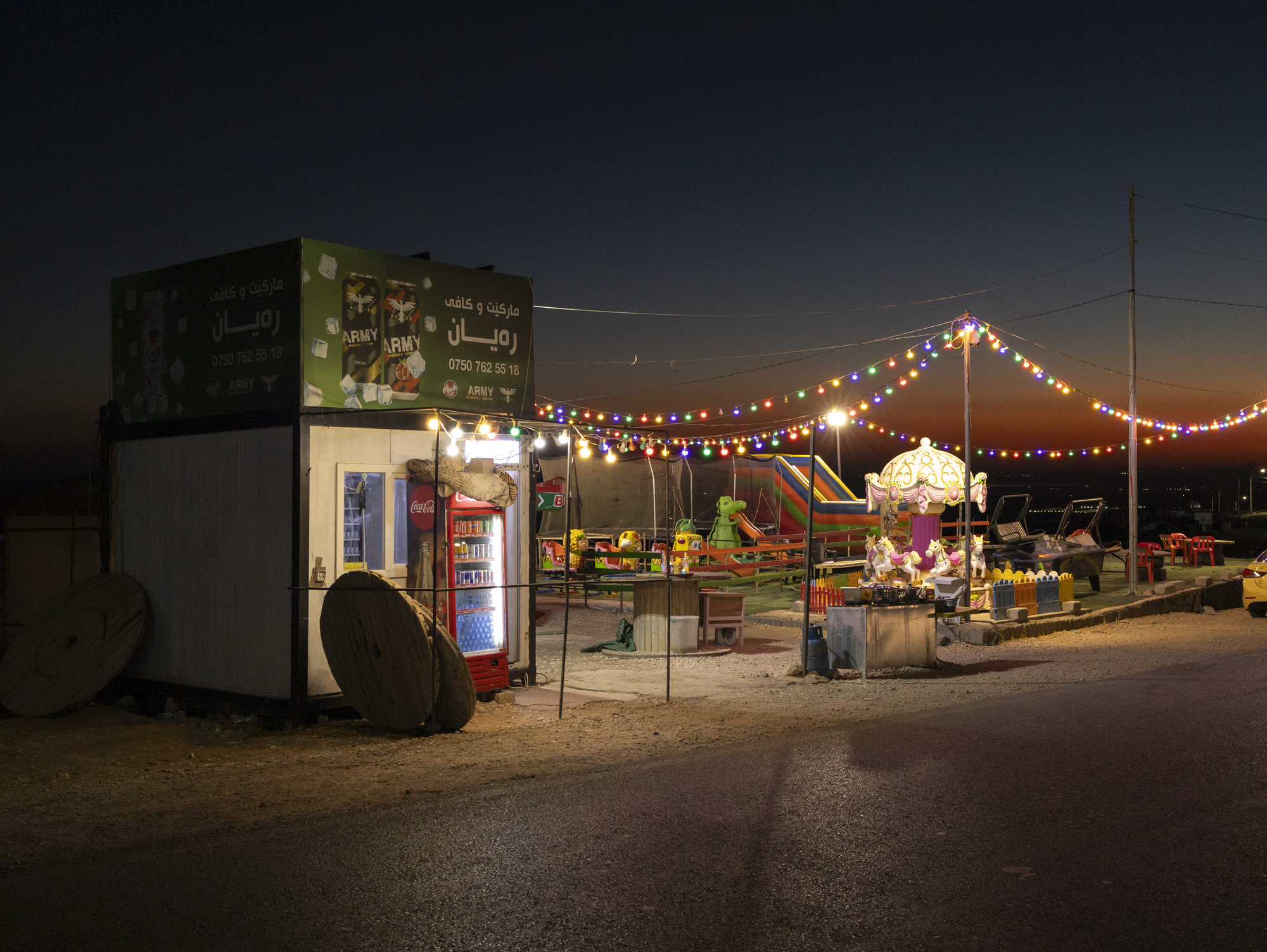
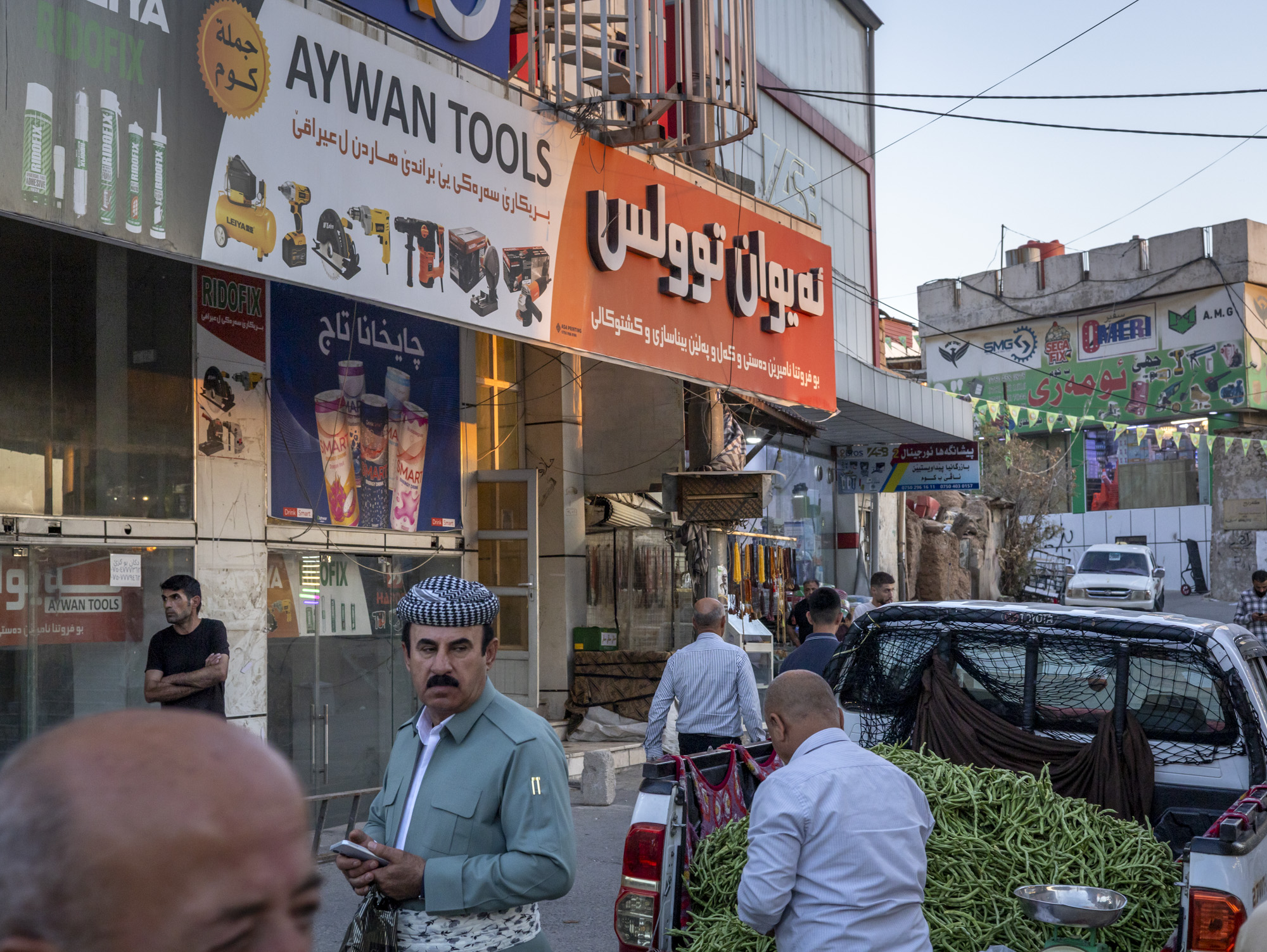
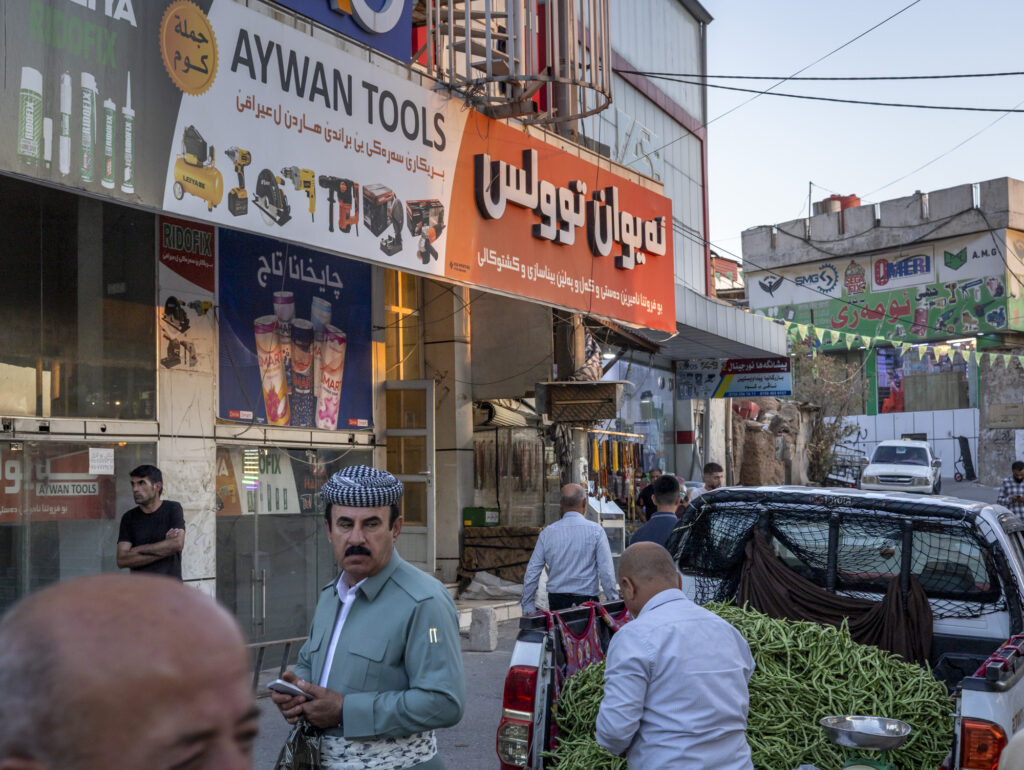
I confess I was a little apprehensive about going to Iraq, but in 2025, it’s pretty easy to connect with other travelers and stay up-to-date on everything happening around the world via WhatsApp groups. The cycling community is fantastic, a great group of “brothers and sisters” where advice and warnings are a daily occurrence. There’s always someone ready to offer information about any country. And there’s nothing better than the testimony of someone who is experiencing a place the way you are. So the day arrives. At the border, I pass the very long line of trucks, at what is one of the busiest border crossings in the world, and I don’t expect it to be quick or easy. After receiving the exit stamp, the officer calls me back: he wants to give me a lemon soda. A little further on, I’m stopped by two policemen: “Where are you from?” “Italy. Do you want your passport?” “Aaaah! No, no, go! And take these!” They give me two bottles of water and let me pass. I head towards the bridge that crosses from one village to the other, and as soon as I cross, I meet my first peshmerga. Mustache, red hat, machine gun. I stop in front of him, ready to hand over my documents. “Where are you from?” “Italy.” “And you came all the way here on a bike? Welcome to Kurdistan!” No documents. I move forward and finally reach the security checkpoint, where everyone stares at me. While I’m in line, tons of people come up to greet and welcome me. Someone leaves me their contact information: “If you need anything, you can call me!” The procedures are quick and easy, so I’m ready to go again. All that’s left is baggage checks, where the officers greet me and tell me to go. But before I’ve gotten two meters, I’m called back by an older, more serious soldier. “Come here! Give me your passport.” He pauses for a moment and then, with renewed cheerfulness, shouts: “Italy! Paolo Maldini!” But they don’t let me go. They invite me into the office, give me water upon water, and ask me to answer a phone call. It’s another officer stationed further out in the customs area; he speaks Italian, and they want me to say hello. Once that’s done, they decide I can go. A few minutes later, I meet Billy, whom I’d spoken to on the phone earlier, who very kindly gives me his number in case I need anything or assistance in official matters. “Where will you go? Just stay in Kurdistan. It’s not nice down there, the places are ugly, the Arabs are bastards who hate the Kurds.” He warns me. I finally cross the border and soon arrive in the city center. Khalida, a Kurdish businesswoman, will host me that evening, but I won’t be able to leave until 7 pm, and that’s three hours away. So I sit and wait, looking at the river and the people who live around it, in the city center. Soon, the first curious people start to stop, asking me who I am, what I’m doing. Among them is Yussuf, a 19-year-old who seems particularly excited by my presence and offers to show me around: “Leave your bike here, no one will touch it. Don’t worry.” I’m not entirely confident and convince him to move it, at least to the entrance of the fortress, where there are guards who can keep an eye on it. Yussuf takes me around for over two hours, making no effort to let him know I’ve been pedaling all day and am dead tired. He’s unstoppable. He tells me about the places he loves, what he does, takes me to the ancient Ottoman bridge, tells me how they’re rapidly rebuilding the entire city, and how many tourists will soon be arriving. He pays for my entrance to the fortress, which Saddam Hussein used as a prison for the Kurds, and then to the old bazaar, the new bazaar, the church, and the busiest square. Seven o’clock arrives. We say our goodbyes as we’d met, and I head to Khalida’s, but she’s not there yet. I discover that the place where I can sleep is a beauty salon, one of her various establishments, but I have to wait for them to finish work. While I wait, I sit down to eat something in the place next door, where a group of young people work. I order a pizza, which they make in the shape of a heart. And then everyone gathers around me, asking questions and taking photos, and then around the bike. In the end, almost feeling guilty, they tell me they have to charge me because the place isn’t theirs, but if I don’t know where to sleep, they offer to put me up at their place. Luckily, though, I have a beauty salon, where I wash myself to pieces in the hairdresser’s wash, and where I have a big sofa all to myself. I’m in Iraq.
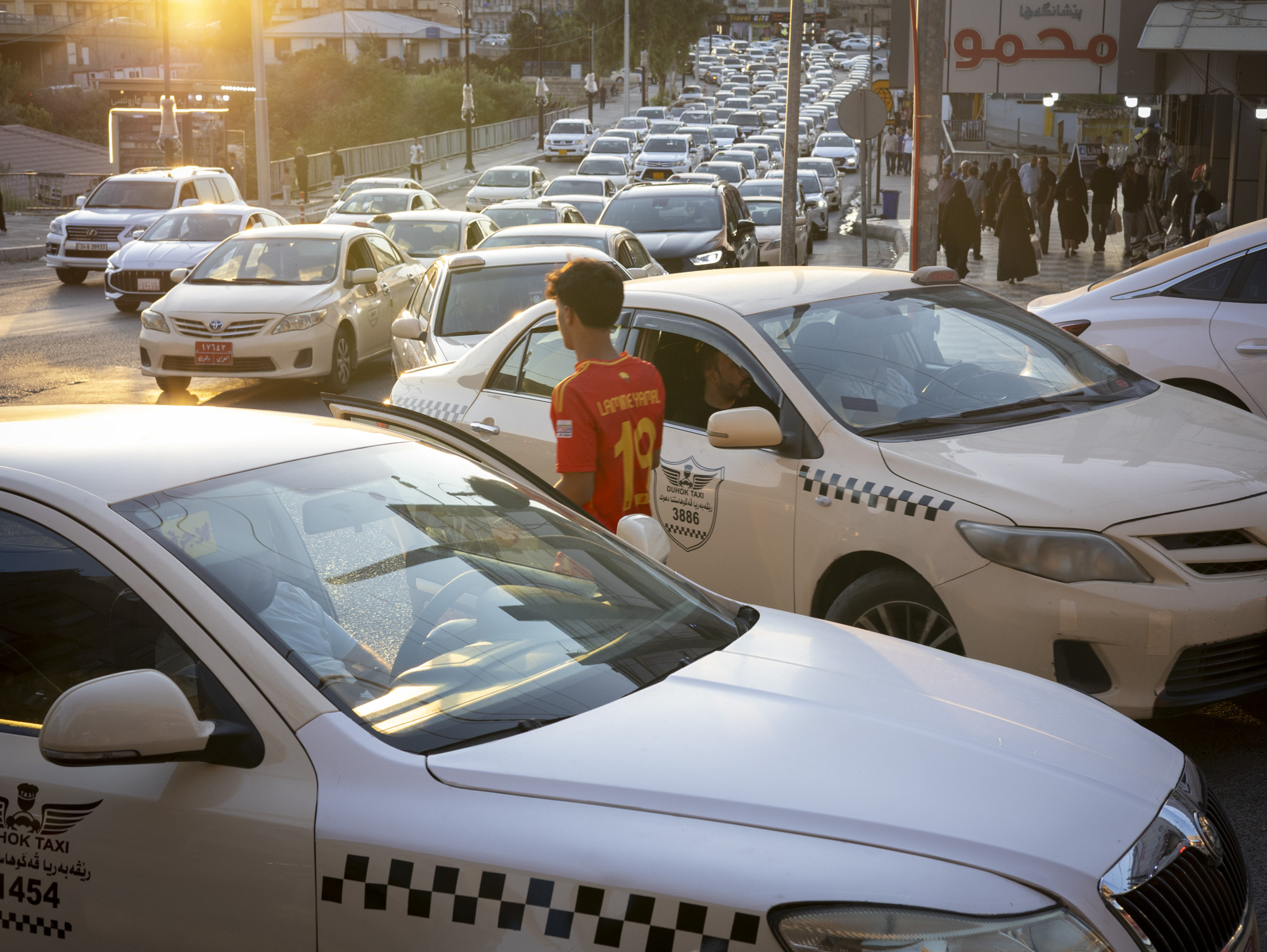
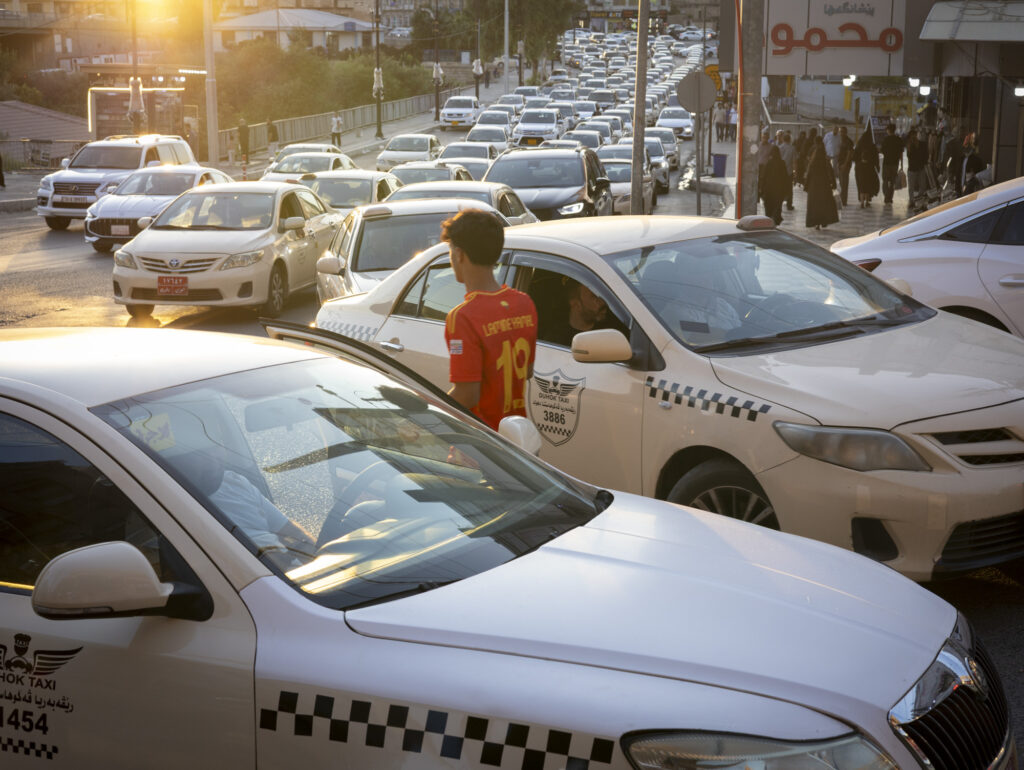
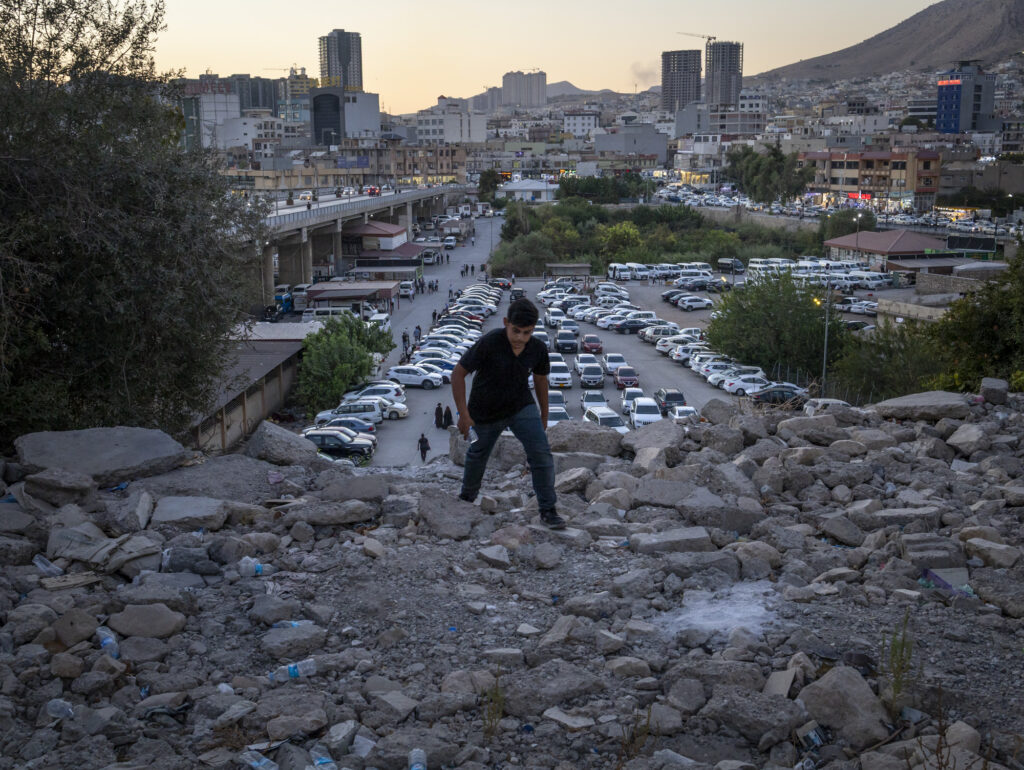
My first real ride in Iraq takes me straight into the desert. Once past the first mountain range, the landscape becomes an endless expanse of earth and dust. The first of many military checkpoints is surprising: the soldier who stops me doesn’t ask for my passport, he just wants to shake my hand and wish me a good trip. Soon, however, a strong wind picks up, making the bike difficult to handle as the gusts push harder, and above all, the sky becomes a swirl of sand. I have to stop to wait for it to calm down a bit, and find shelter at a gas station where a cat spies on the torment, sticking its head out of a drainage grate. It looks around for a while, then goes back to shelter. It’s like, “Why would I do this?” I get going again and finally reach Duhok, where Kathleen is waiting for me. I’ve been hearing about this woman for weeks; she’s something of a Couchsurfing institution in Iraqi Kurdistan. 68 years old, Canadian, an experience that would easily fill a book. The daughter of a diplomat, she grew up in Afghanistan, England, Iran, Rwanda, the USA, Canada, and Chile during the Pinochet coup. Since 2015, she has lived in Kurdistan, where she spent years in the Iraqi and Syrian regions of Rojava, working in refugee camp logistics, before dedicating herself to the victims of the genocide caused by ISIS. Today, Kathleen is a sort of aunt to many travelers; she has hosted over 300, and perhaps they are now uncountable. Just like the cats that arrive, which she cares for and vaccinates, before finding them new homes. When I arrive, there are 17 of them.
“Dust storm, not sandstorm! I was worried about you; I thought you wouldn’t be able to pedal. But trust me, if it had been a sandstorm, you would never have made it. Those are something else!”
In the living room is Kile, a young American who’s been there for a week. He’d been there a month earlier with Faizan, the Afghan-Anglo-Saxon guy I’d met in Gaziantep, and Davide Travelli, an Italian cyclist I’d been in touch with a few weeks earlier. Kathleen quickly explains the rules to me: “Don’t think of this house as a regular Couchsurfing spot, but more like a hostel. Come and go whenever you want. Sleep, cook, work, go, come back, stay a month or two, do whatever you want.” It seems more like a prediction than an invitation.
The days are starting to pass in Duhok. Kathleen’s house feels really good. There’s a good flow of people, it’s comfortable, and having a place where you can stay freely, without any financial or emotional burden, is a luxury that very rarely comes to a traveler. So it happens to me, like so many others passing through, that I really struggle to decide to leave again. Virtually everyone stays longer than they’d planned. Kathleen knows a lot about me, so I decide to ask her if she has any contacts for volunteering somewhere. As soon as I ask, she starts emailing me (she doesn’t have a smartphone), and before long, I have a first response. It’s a center that works with disabled children in the village of Sharia, about fifteen kilometers from Duhok. This village is predominantly inhabited by Yazidis, a people originally from Iraq who were victims of genocide by ISIS between 2014 and 2017. Numerous Yazidis have taken refuge in Kurdistan, and many of them still live in camps. Sharia is a mix of buildings, temporary homes, and tents, and is home to about twelve thousand people.
The idea of being useful to these people and learning about their history and culture fills me with energy, so I accept, and within a couple of days, I can already begin. The first day goes very well. The work is simple: we play a few games, try to teach the children to read and count, color, sing, and so on. The other workers are almost touchingly kind and speak good English. Before I leave, they give me some food in a plastic container: “You have to bring it back to us, so we can be sure it comes back!”
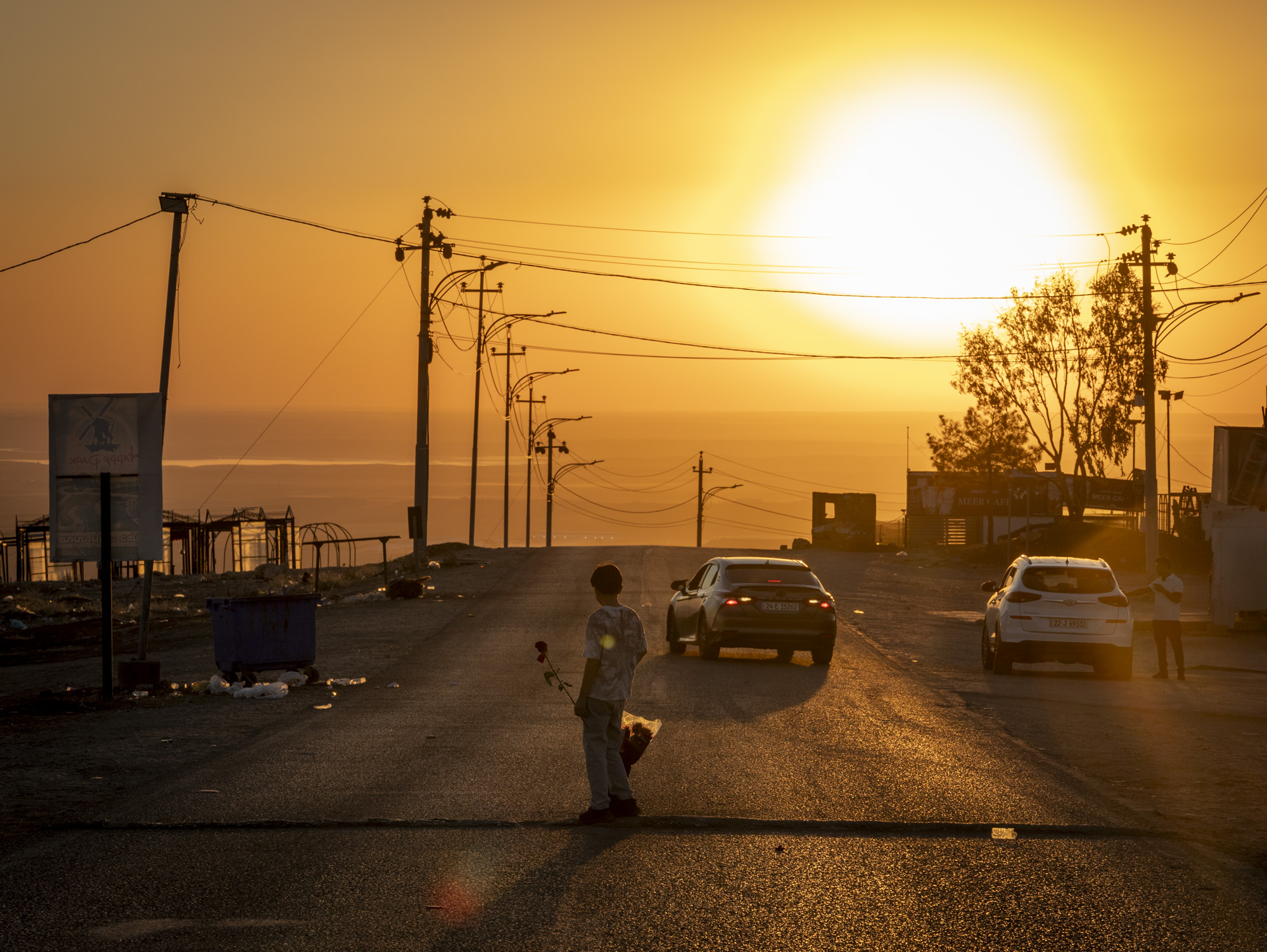
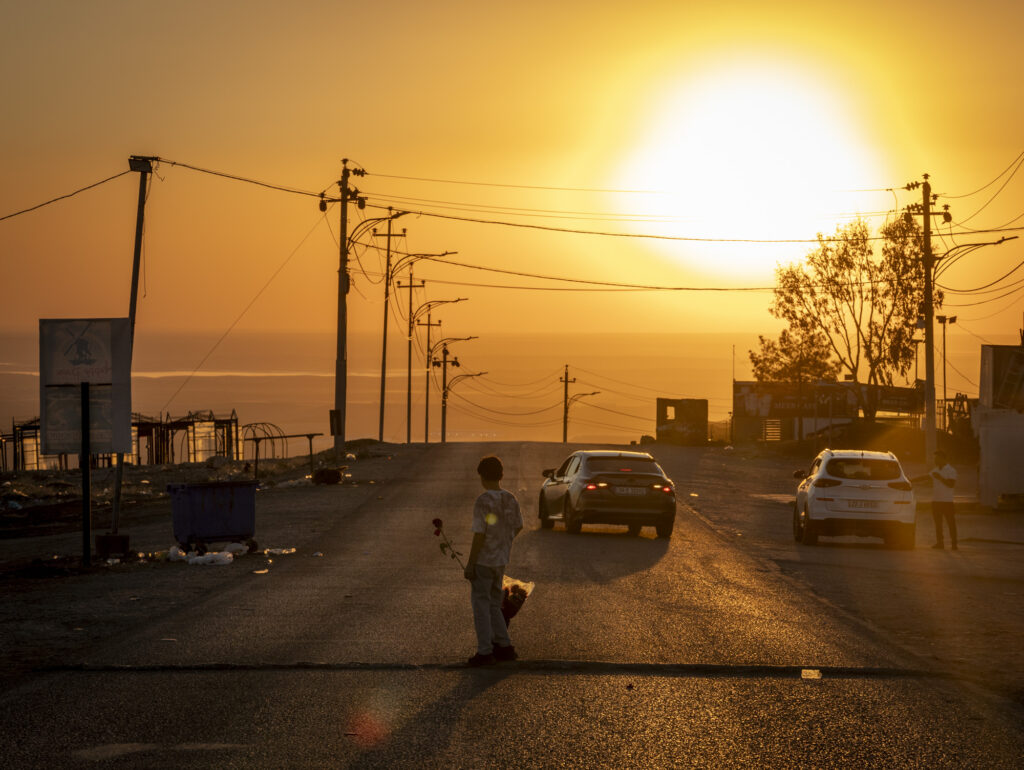
On the way back, the sun sets over the vast expanses of land and the mountain separating Sharia from Duhok. A huge pack of stray dogs, seventeen strong, crosses the road in front of me, fortunately unaware of my presence. I pedal as darkness falls, trying to savor the flavor of history in a place that has one of the darkest chapters of recent decades.
A few dozen meters from home, somehow, the bike chain gets stuck in the chainring. I get stuck on the uphill slope, so I pull over and try to free it from the overturned bike. It’s clear I’m unsuccessful, and soon a young man comes out of a house with some tools, along with an armed guard: “Don’t worry, I’ll take care of it! I’ll fix it in a second!” He arms himself with a hammer and screwdriver and begins his operation, which he seems to be able to carry out with ease, were it not for the fact that he’s carrying a huge machine gun that clatters to the ground with every movement he makes. In the end, he succeeds, without shooting anyone. A smug smile appears beneath his large mustache. “I’m here 24/7. If you need me, you can always find me!”
Meanwhile, Ludovico, a young Italian archaeologist, has arrived at Kathleen’s house, a pleasant surprise. It’s been a long time since I’ve spoken Italian to anyone.
In the morning, the cats are restless. They’re separated into groups, scattered throughout the various rooms of the house, and apart from the living room where we guests are, they’re scattered everywhere. Screams, meows, and hisses of arguments are repeated throughout the day. Not even 24 hours later, my volunteering has already fallen through. Classes will be canceled for a few weeks; there’s nothing I can do. So I decide it’s time to leave. Kathleen and I agree that I’ll stay around for a few weeks, while she contacts other people to find something useful to do. Before leaving, she fills me with directions and warnings: “The Kurds will invite you and shower you with gifts and food. Be prepared to talk to some women, too; here in the north they’re more open-minded and enterprising, and you’ll almost certainly be asked to marry one of their daughters. Oh, and on the road that runs along the mountains to the north, NEVER go off to the left, not even to pee: it’s full of unexploded mines.”
The first few hours of pedaling pass smoothly, without any major encounters. But as soon as I enter the large valley further north, the music suddenly changes: the requests for selfies begin, the first free waters. An entire family wants to photograph me with their youngest child in my arms (who cries in terror while the women of the family collapse with laughter). Another family, who have moved to Austria, stops me a little further ahead. A young man from his shop invites me over to buy me a cold drink. The confusion between Italy and Great Britain begins, a confusing association that will be repeated over and over again throughout my time in Iraq. “How long did it take you from Brittany? Is Brittany beautiful? Can you work in Brittany?” Italy! No, Brittany! The response is always blank stares, as if for them there were no difference at all.
Along a climb, a jeep comes alongside me, stopping a little further ahead. From the back of the truck, a group of young people, a mix of Kurds and Americans, whom I had met a few days earlier, climb out. They are an ultimate frisbee team. At the wheel was the mother of one of them, who had told me part of their story during our first meeting. Americans of Japanese origin, they had moved to Malaysia, but were kicked out because they spoke of Jesus. Once they were barred from entering the Southeast Asian country, they moved to Turkey, to the city of Diyarbakır. But even there, the experience was short-lived: they began studying Kurdish, and their husband was filmed speaking the “rebel” language on the street. The video went viral, so much so that practically everyone on the street recognized him. A foreigner who speaks Kurdish is frowned upon by the Turkish government, especially if he doesn’t speak Turkish: why Kurdish and Turkish? What are you hiding? What are your intentions? If the Kurdish language is already heavily discriminated against and in many areas of Turkish Kurdistan it is almost non-existent, the fact that a foreigner speaks it is suspicious, to say the least. Result: the family was expelled from Turkey. And so they arrived in Iraq, where the Americans were welcomed with great affection and recognition in the Kurdistan region. It doesn’t matter that the US’s deepest interests lay in the vast quantities of oil in the area; what matters is that they helped the Kurdish people free themselves from Arab oppression and stopped the extermination that was underway. In the eyes of the Kurds, they were, in effect, saviors. A little further on, I’m stopped again, this time by a family picnicking among the trees on the side of the road. Ozcan has lived in Italy for three years, and for once it’s nice to hear someone from far away say, “The Italian people are fantastic! I love them. Wonderful people!” The children speak English, the wife doesn’t wear the veil, but the mother does, and the father is the first older man in many weeks who isn’t extremely serious. He laughs and jokes constantly. I think of Ludovico and how he told me the atmosphere in Iraq is much lighter than in Turkey. And indeed, it’s clear how much freer the Kurds feel and how proud they are to open their arms and proclaim their culture here, in what is effectively the only recognized Kurdish area. The Kurds are divided between four countries: Turkey, Iran, Syria, and Iraq. In Iraq, they’ve had an autonomous region since the 1990s, but it’s cost them blood and suffering, and it’s still precariously balanced today.
I’m filled with sweets and fruit to take home. Countless smiles burst out along the street as I pass. Dozens of boys and girls emerge from cars, their torsos hanging out of the windows or looking out from the open roofs, like lookouts. Women appear with loose hair and high heels.
Near Amedi, my first destination, Kathleen recommended some ruins nestled in the valley floor, where I could pitch a tent and sleep. As I descend the very steep road to reach them, I’m stopped by a man who invites me in for an orangeade. He’s a literature professor and knows the excavations well, having helped clean them. We walk down together. It’s a former school, of French origin, from what he tells me, but several questions remain. Amedi is a very ancient village, inhabited by many different peoples over time: Assyrians, Persians, Arabs, Kurds, Jews, and Ottomans, among others, have written pages of its history. Built atop a conical mountain, it watches over the valley from its 1,400-meter height, protected by an ancient wall.
The professor doesn’t want me to sleep among the ruins, so after sending some children to help me push my bike up the hill, he helps me find a place to sleep. Soon, I’m greeted by a shopkeeper, who lets me sleep on the floor inside his shop. Needless to say, as soon as I arrived, he offered me a tray of fruit, a little later he brought me dinner, and the next morning, breakfast and some food to take away.
From Amedi, I continue east, now crossing the valley, which on the north side displays signs warning people not to walk in the fields: mined areas. Just beyond the mountains lies Turkey, and some of the areas with the greatest PKK presence.
Shortly after leaving, I’m stopped at one of the many Peshmerga checkpoints, where I’m pulled over and invited into their small barracks. After a document check, I’m offered tea, and shortly thereafter, they try to buy me lunch, amidst jokes and laughter. The Peshmerga, a word meaning “those who face death,” are now the official armed forces of the Iraqi Kurdistan Region. However, they began as a partisan guerrilla movement, engaged in the Kurdish resistance against Iraq’s central government to gain autonomy and national rights.
Around lunchtime, I’m stopped at another checkpoint, and this time, after the document check, I can’t refuse the invitation to lunch. While I eat my bean and potato soup, I observe these men, their eyes, their hands. I wonder what they saw, what they recorded. In what situations those hands performed gestures that saved, or, conversely, took, lives. Which of them would I go into battle with and feel safer? The road is rather tiring, and I advance slowly. The landscapes are magnificent, and every village is practically a celebration. Every time I pass through one, I’m greeted, invited to stop, welcomed. In one of them, I’m chased by a swarm of kids; one accompanies me on a scooter, another rides alongside me for several hundred meters, others cling to my bicycle in an attempt to hold me back for a while. I spend the night surrounded by the mysterious howls of that animal I still don’t recognize, the echo of the cries of tormented souls.
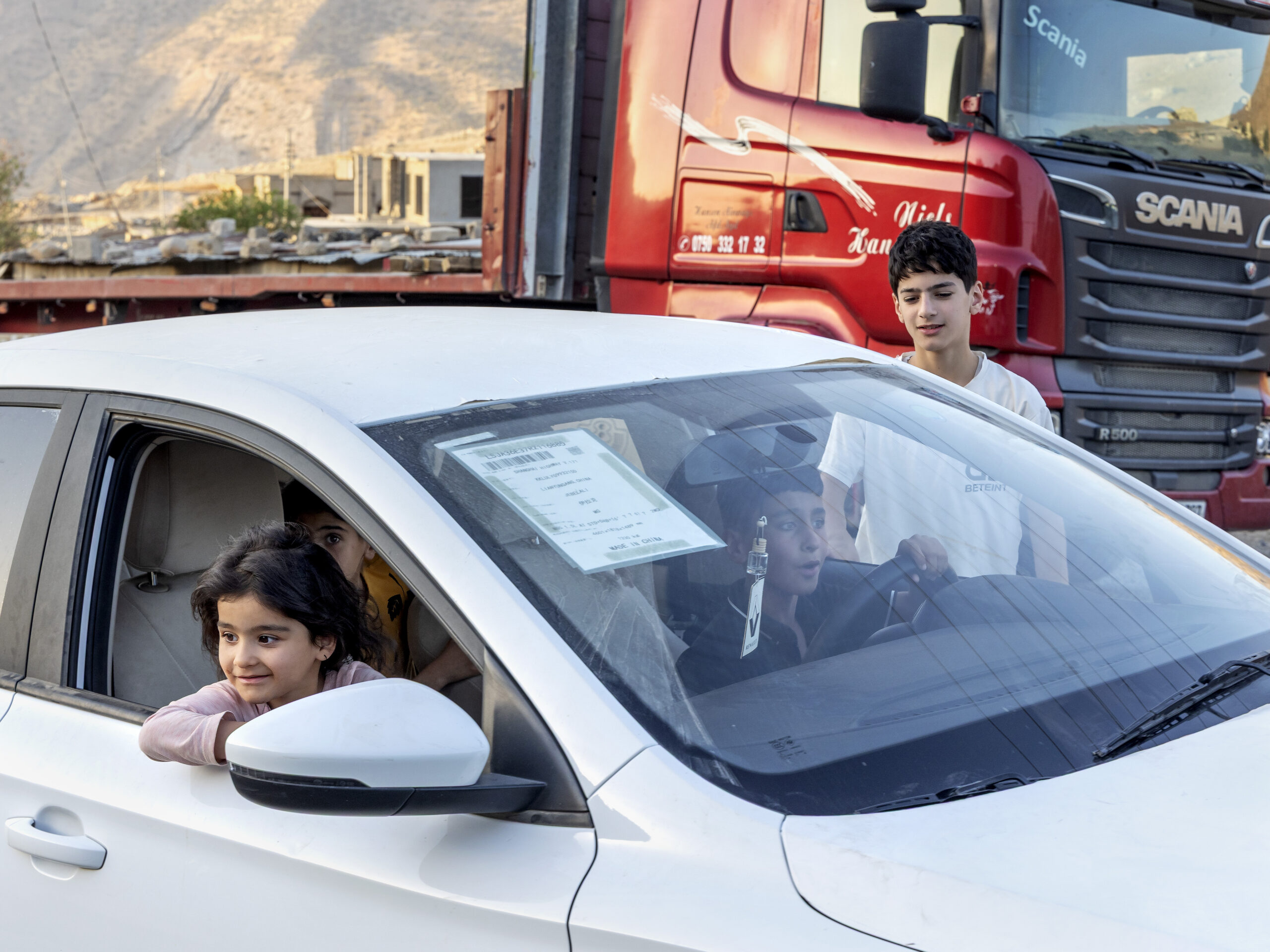
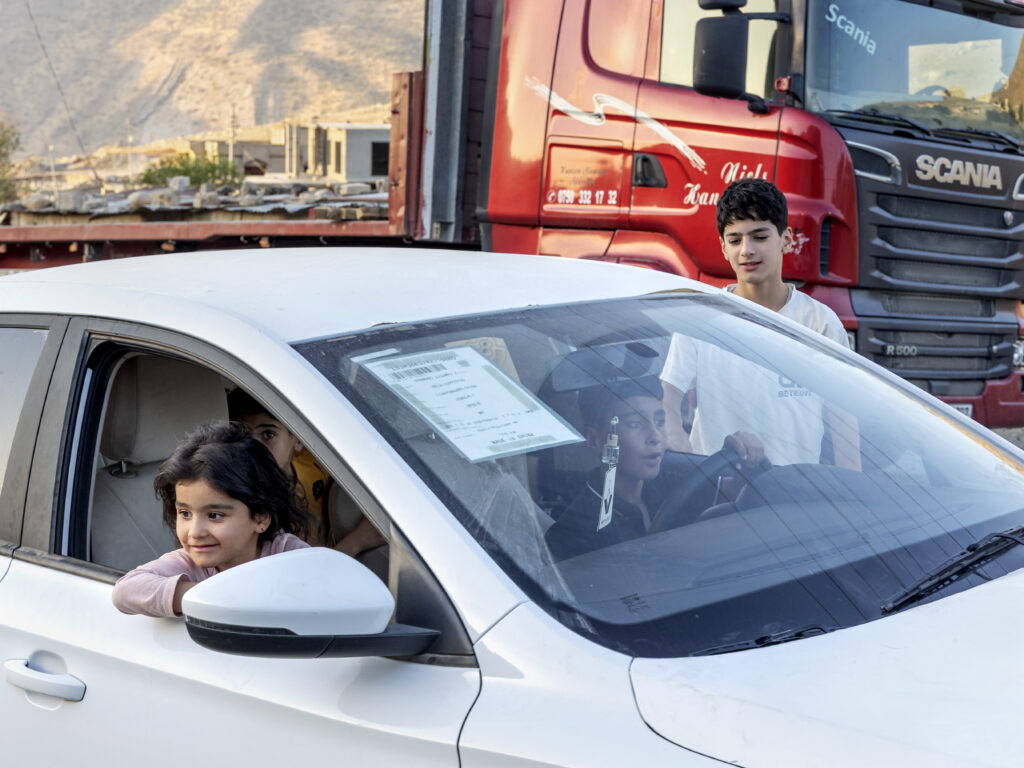
The next day begins exactly as it ended: cars pull over to offer me water and cold drinks or to take a photo or video. People invite me into their homes to eat and sleep. Peshmerga stop me for a chat and to hear stories from their journey. The climax, however, comes in the village of Sreshma, where I arrive just before sunset: at the entrance, I’m greeted by four children who shyly wave at me. A car pulls up alongside me, but instead of a man, the driver is a boy of 12 or 13. The children begin to gather, screaming excitedly, and another car pulls up alongside me: this time the driver is no older than 10 or 11, and he’s carrying two more younger children. Within a few dozen meters, I find myself surrounded by children, teenagers, and a few adults, and I’m invited to stop at a convenience store. They let me in. “Take whatever you want!” I can’t refuse; it’s not a choice. Chips, chocolate, soft drinks. I sit down on the side of the road and am completely surrounded: I count forty people, while more continue to arrive. A barrage of questions overwhelms me, a general elation. After about twenty minutes, I manage to set off again; the sun is about to set, and no one has managed to tell me where I can sleep. But I can’t get more than three hundred meters before I’m surrounded by other people. People on the rooftops, on the balconies, from the steps, from the shops: everyone’s looking at me, everyone wanting to know where I’m from, what I do, why. Photos, videos, hugs: it’s a frenzy. “Jesus Christ has arrived,” I think to myself, completely shocked by such a reception. Finally, someone who speaks English arrives. Up until that point, it had been incredibly difficult to converse, especially since the phone’s Italian/English-Kurdish translator is more of a detriment than a help. He manages to make up incredible stories that make anyone who reads them think I’m completely out of my mind. The English-speaking guy informs me that they’re building the first park in town, and that I can pitch my tent there. By now it’s dark and it’s my only option. Between greetings and the usual flurry of photos and videos, I cross the last part of town and reach the clearing. It takes me an hour to walk two kilometers. My jaw is cramping from smiling so much. The park is still a stretch of land with streetlights, just off the main road. The whole town can see me, but I have no choice. I set up my tent. I say hello to a few passersby until a boy approaches me: “Hi! I saw you on Snapchat and saw you were here at the park. My family wants to invite you to dinner; we live nearby.” I accept. We sit on the rugs around the food. There are two other brothers, a sister, and their mother, who is quite elderly and dressed all in black. My portions are bigger than all the others’ combined, so I try every way to get them to eat from there too, with little success. The guest must be honored to the fullest. On a large television, we watch videos of Bologna on YouTube; they want to see where I’m from. Then they show me the places they love most about their homeland and Hawler (or Erbil in Arabic), their capital.
I return to my tent, exhausted. I stretch and go to bed, hoping God will let me sleep. But God won’t. The procession begins. First, a group of young people shout, “Hey Mister! Hello!” I leave the tent, “chat” (with the translator) for about ten minutes, and then I bid them farewell, bidding them goodnight. Social media is flooding in; everyone knows I’m there. A moment later, more voices appear, and then more, and more, and more. For almost two hours, people keep coming nonstop to greet me, to see me. But I’ve been closing the doors for a while now, pretending to be asleep and staying holed up inside. It’s all wonderful, but I can’t take it anymore. Then, when I’ve finally let go of hope so as not to suffer too much from the wait, finally, silence. It lasts a couple of hours, until a large dog decides to spend the night barking right next to my tent: his barking echoes throughout the valley, with a chorus of dogs responding. I don’t sleep a wink.
Welcome to the avalanche of Kurdish love. How will tomorrow begin?
______________
- If you’d like to support my project and read more stories, articles, and see photos, send me a contribution here!
If you have any stories, situations, or places you’d like me to share, please write to me! –> emibarbieriphoto@gmail.com
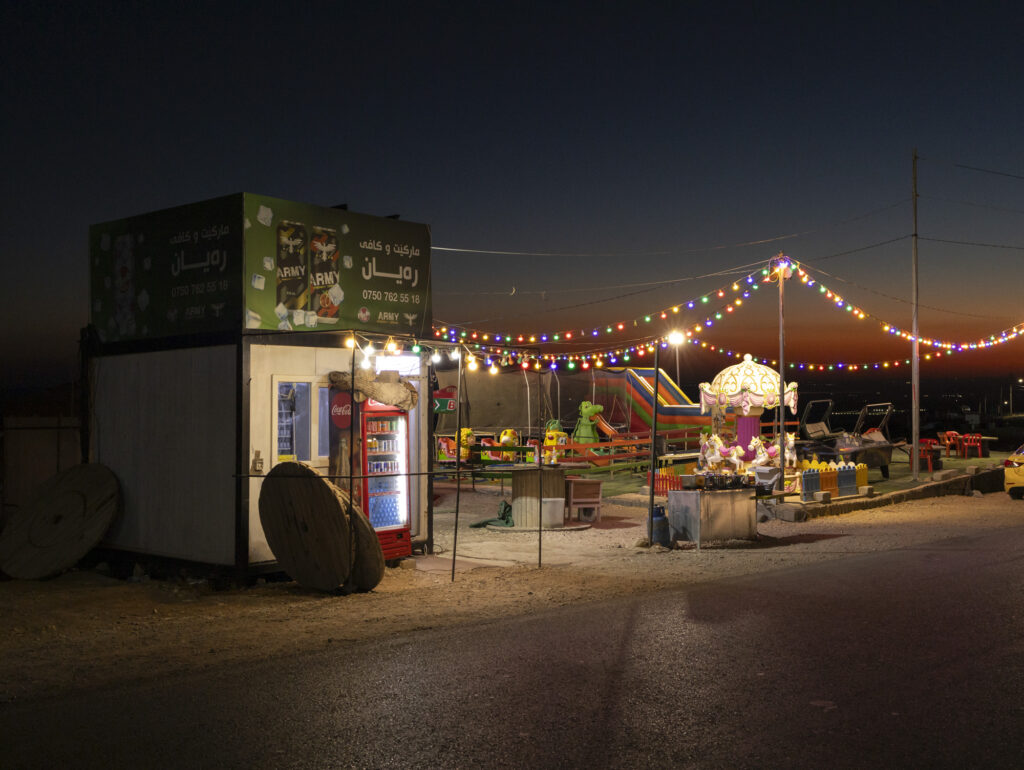
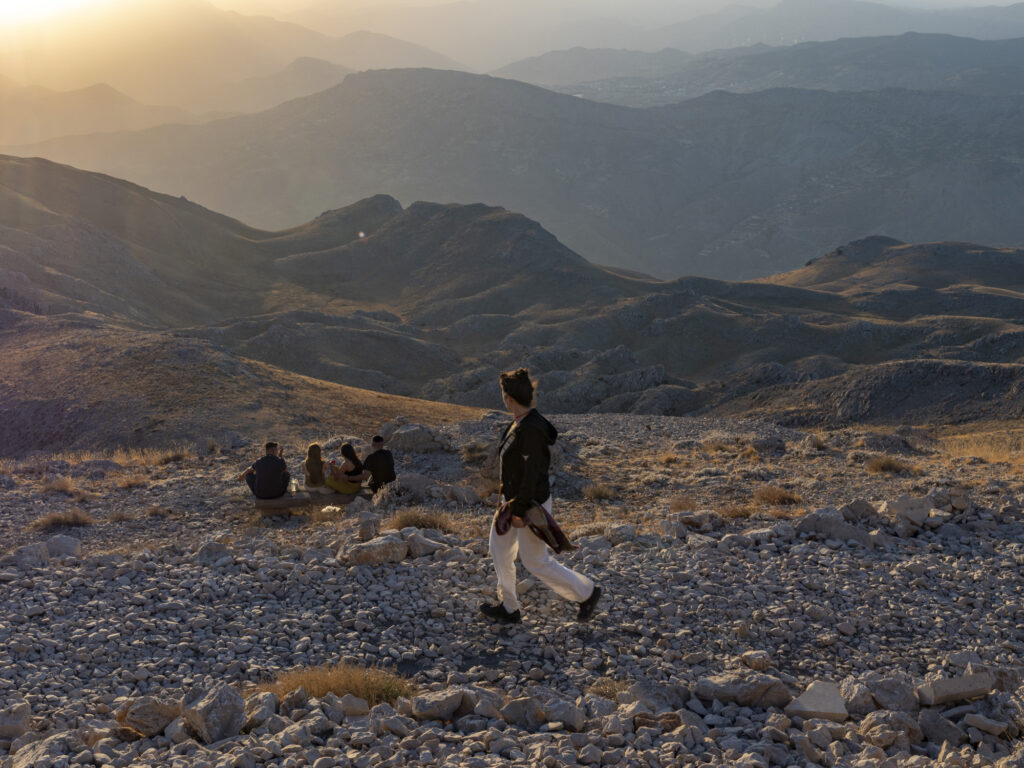
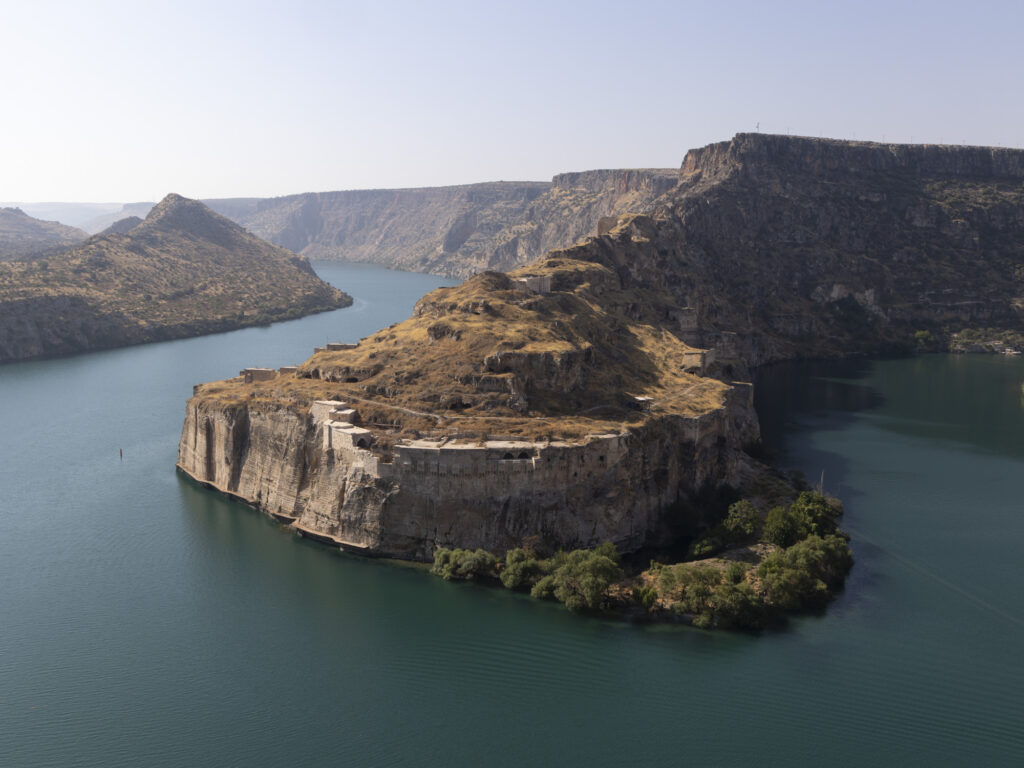
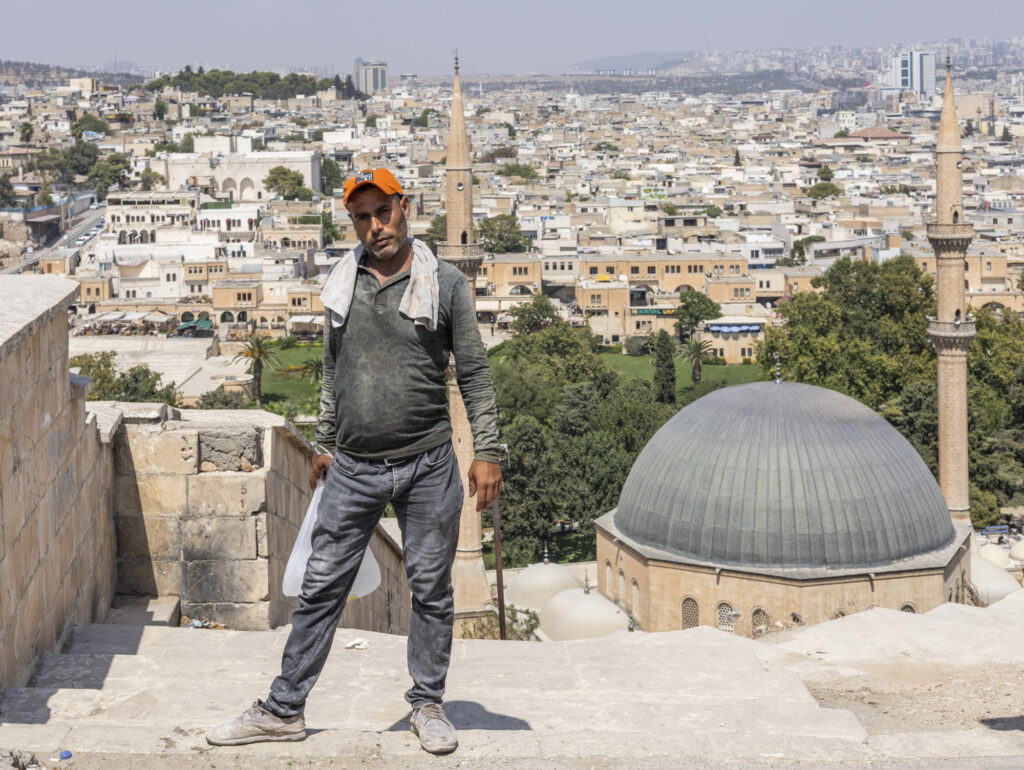
The Images
1 – Mount Nemrut, Türkiye
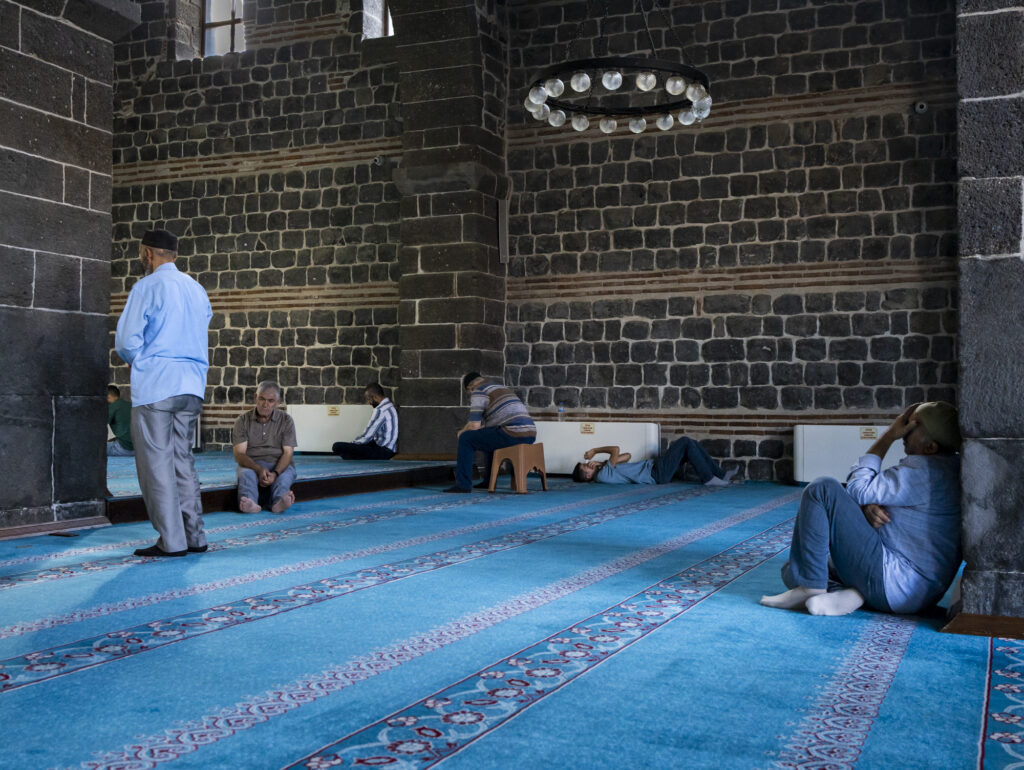
2 – Diyarbakır, Türkiye
3 – Diyarbakır, Türkiye
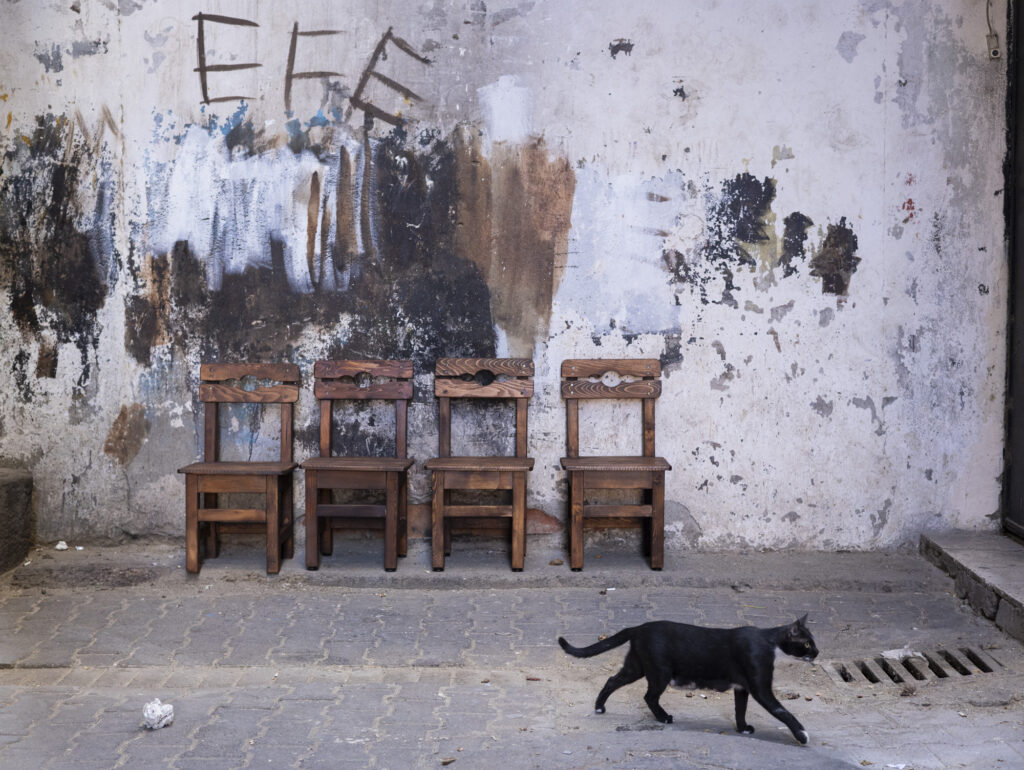
4 – Gaziantep, Türkiye
5 – Mount Nemrut, Türkiye
6 – Mount Nemrut, Türkiye
7 – Şanlıurfa, Türkiye
8 – Duhok, Iraq
9 – Mount Nemrut, Türkiye
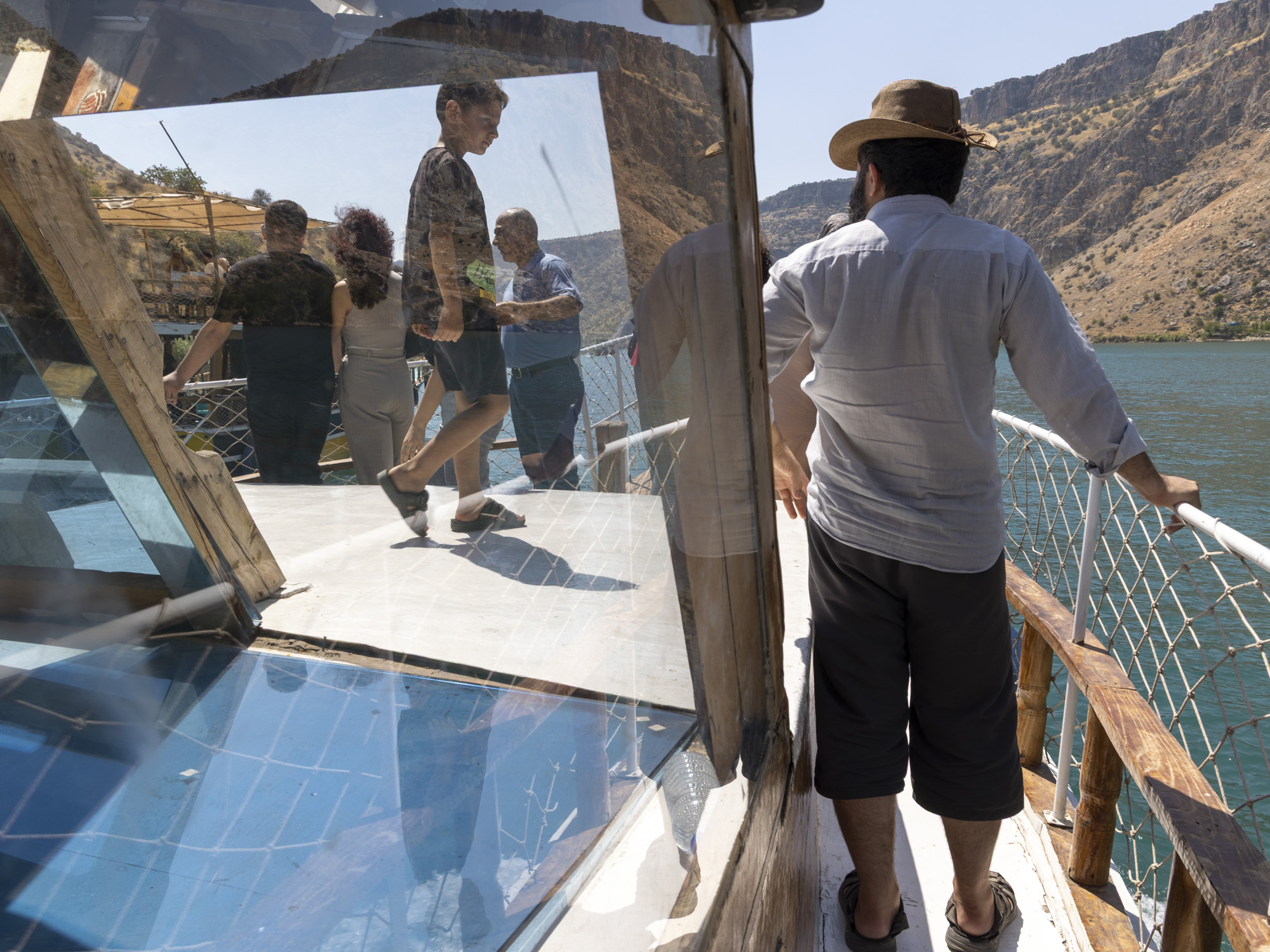
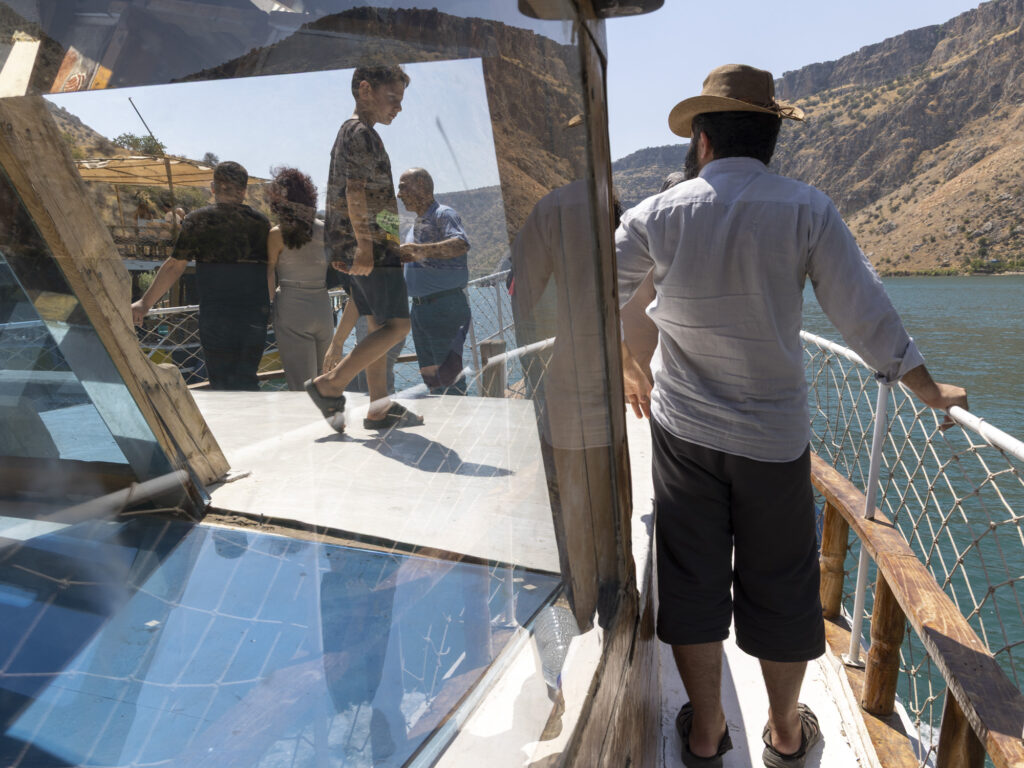
10 – Rumkale (Euphrates River), Türkiye
11 – Şanlıurfa, Türkiye
12 – Sreshma, Iraq
13 – Birecik, Türkiye
14 – Mount Nemrut, Türkiye
15 – Duhok, Iraq
16 – Euphrates River, Türkiye
17 – Şanlıurfa, Türkiye
18 – Duhok, Iraq
19 – Keçikuyusu, Türkiye
20 – Şanlıurfa, Türkiye
21 – Give in, Türkiye
22 – Mount Nemrut, Türkiye
23 – Eski Kahta, Türkiye
24 – Mardin, Türkiye
25 – Şanlıurfa, Türkiye
26 – Diyarbakır, Türkiye
27 – Şanlıurfa, Türkiye
28 – Duhok, Iraq
29 – Şanlıurfa, Türkiye
30 – Duhok, Iraq
31 – Duhok, Iraq