Silence has just enveloped me when the alarm goes off. For Sreshma, life has resumed its routine, and in the bare park where I finally slept, now I’m alone.
Enjoying the calm morning, I slowly prepare my things until, just as I’m almost ready to leave, the spell breaks: Zana arrives, a policeman who wants to invite me to his home for breakfast. I gladly accept. I am welcomed into his modern home—he is very proud of it—by him and his wife. I stay briefly, just long enough to eat and exchange a few words, a sparse dialogue due to the obvious language barriers. I’m somewhat in a hurry to leave; I know the day will be very long.
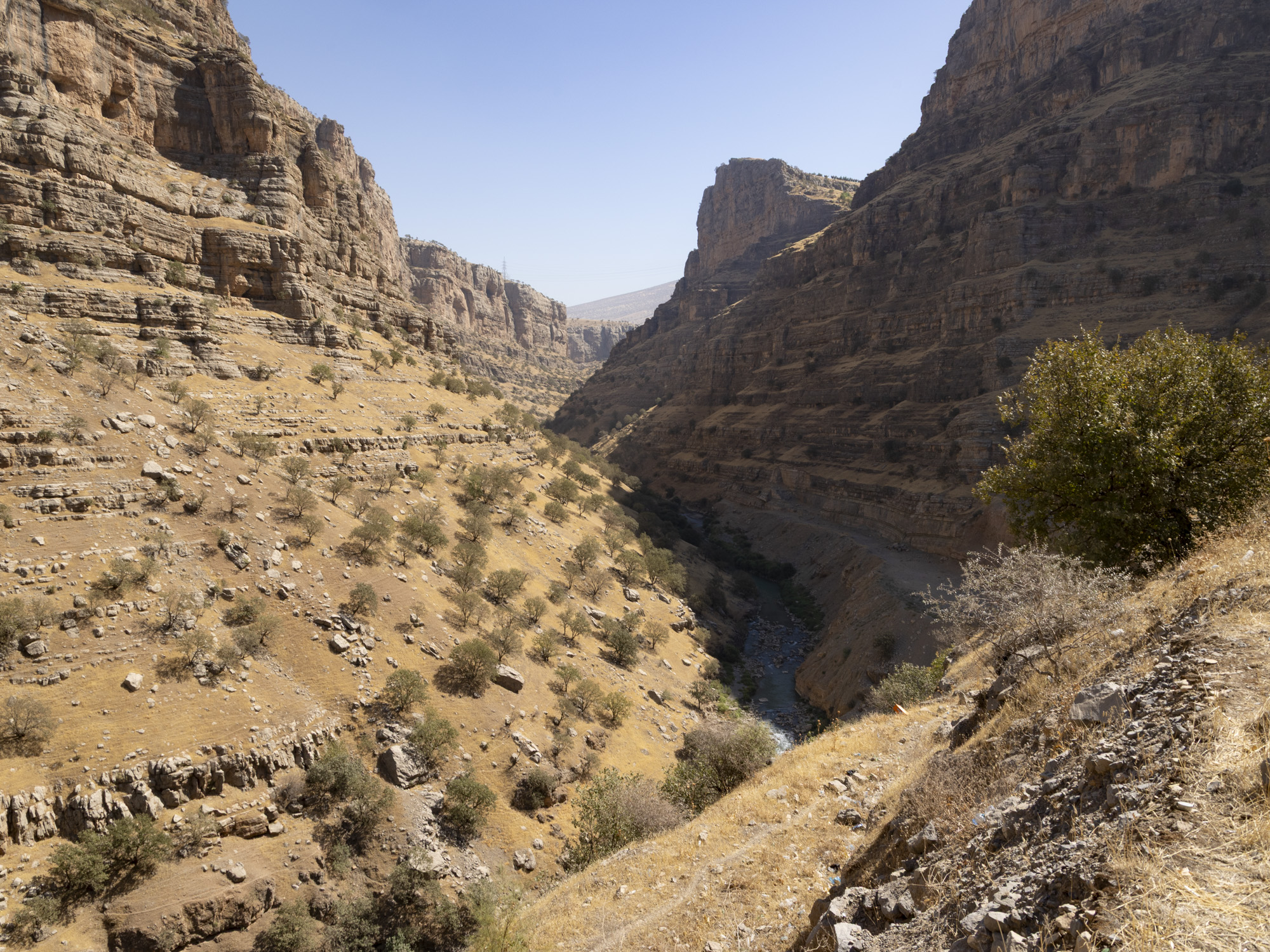
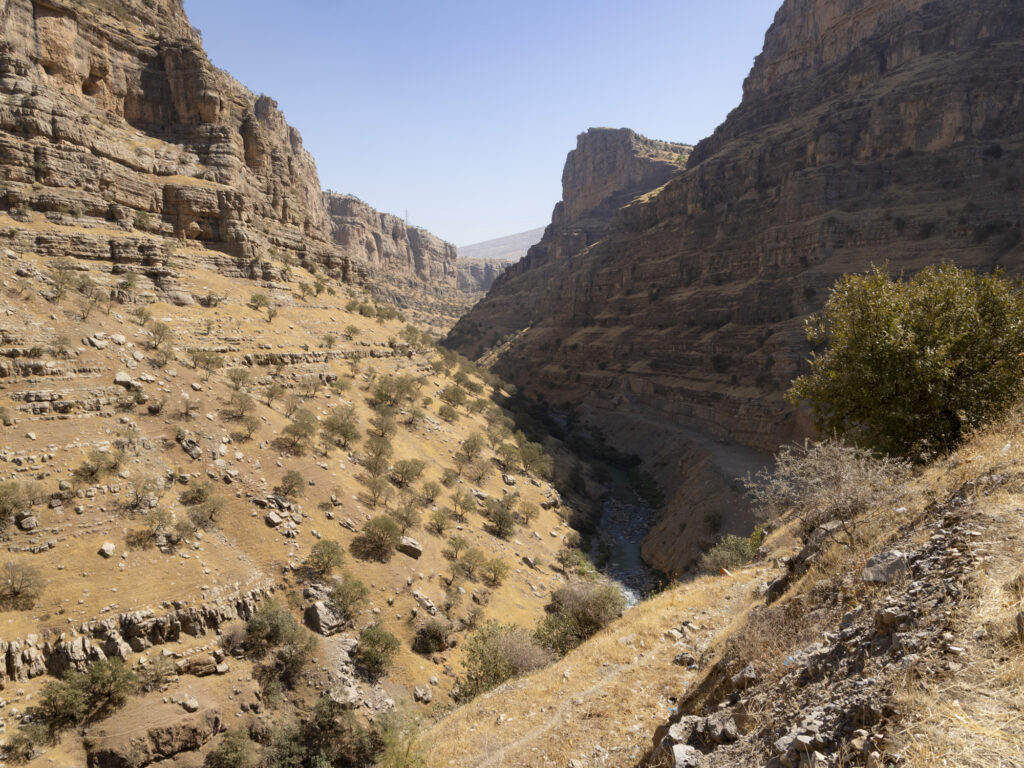
Barely fifteen minutes pass and I’m stopped again. A policeman waves me over to the side of the road. His work shift seems extremely relaxing, so he wants to chat a bit to ward off boredom. Twenty minutes later, the story repeats itself with a group of workers, and then once more as I reach Bekhal, near the end of the magnificent Rawandiz canyon. From there onward, I head into the mountains, going up the valley that leads towards Choman, among the highest peaks in Iraq. Time and distance suggest I can make it in a day, but the endless series of invitations and greetings forces me to end the day in Rashakall, a small village on the valley floor, immersed deep in a wild gorge, among mountains controlled by the PKK. The eleventh and final stop of the day brings me to Amet and Ismail. I had just “escaped” from an ambiguous situation, where a girl by the riverbank, tending a flock of sheep I had stopped to photograph, had run away upon seeing me, only to reappear shortly after armed with a rifle. In doubt… better to stop at Ismail’s.
Father of 9 children, he lost his legs during the war in the 80s, in the carnage between Iraq and Iran (80-88). Since then, he has started a family, run a farm, and opened a small tourist spot where people can stop for a picnic and bathe in the river. Ismail sells pomegranates from his trees by the road and invites me to stay the night in a small house by the roadside, open at the back onto a small bridge over the river. His grandson is tasked with bringing me dinner, as well as breakfast the next morning. I spread my groundsheet and mat on the floor, in a night of moonlight and frog melodies, and let myself be carried by the sound of the current towards my dreams.
In Choman, I am hosted by the sister of Maruf, a man who had stopped me the day before. My only real request would be a place to spend the night, but misunderstandings and perhaps a hospitality driven more by the brother’s phone calls than by the family itself, hinder the day. It ends with me being accompanied up the mountains and left there, with all my things. “Go up, it’s not far. Up there it’s beautiful! You can pitch your tent wherever you want.” Too bad I’m exhausted and the only thing I had asked was “don’t make me pedal today.” Getting to the top is more than two hours of climbing, no way. A mutter of anger mingles with gratitude for the lunch offered, as I head back down to find a place to pitch the tent.
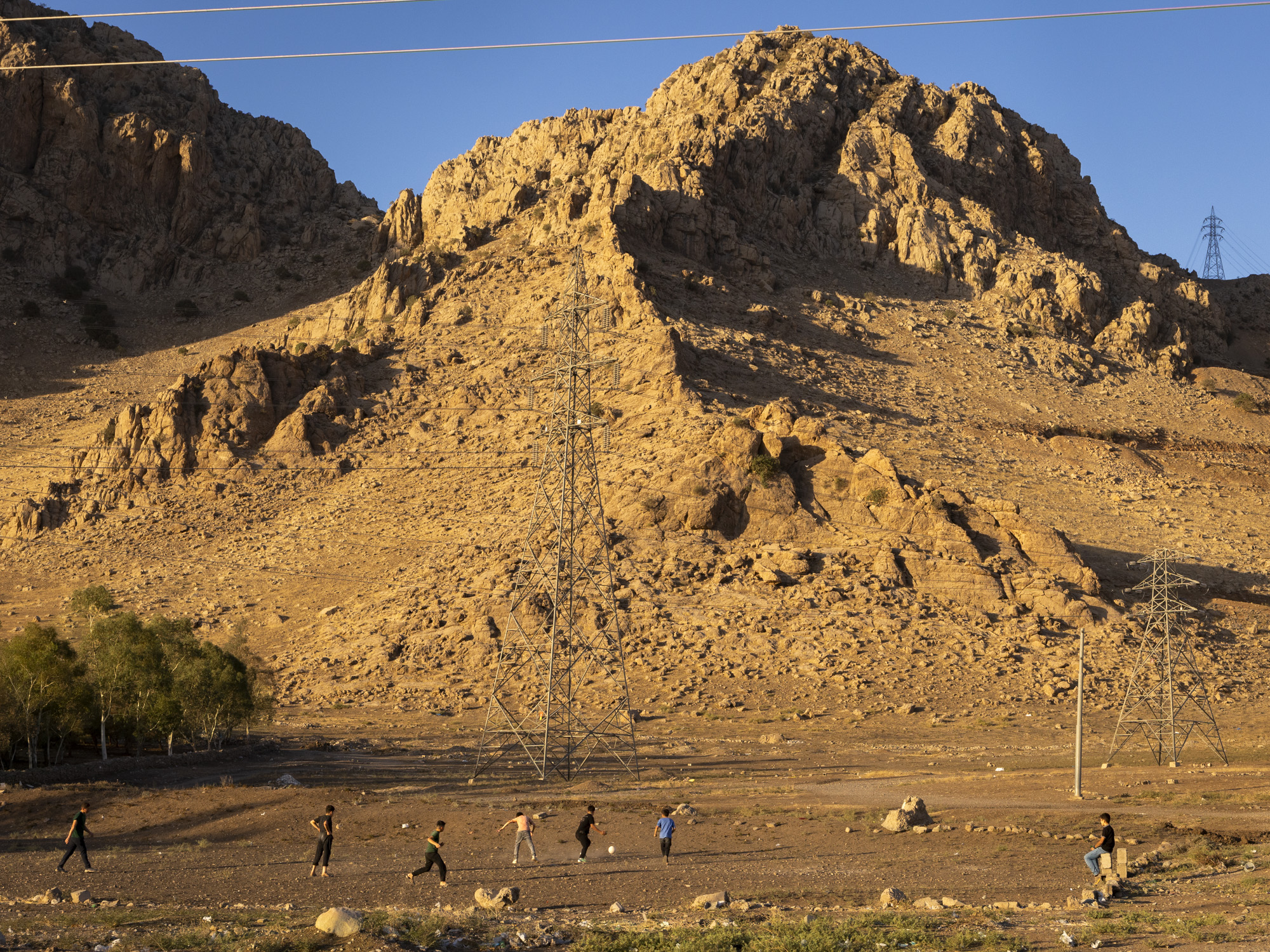
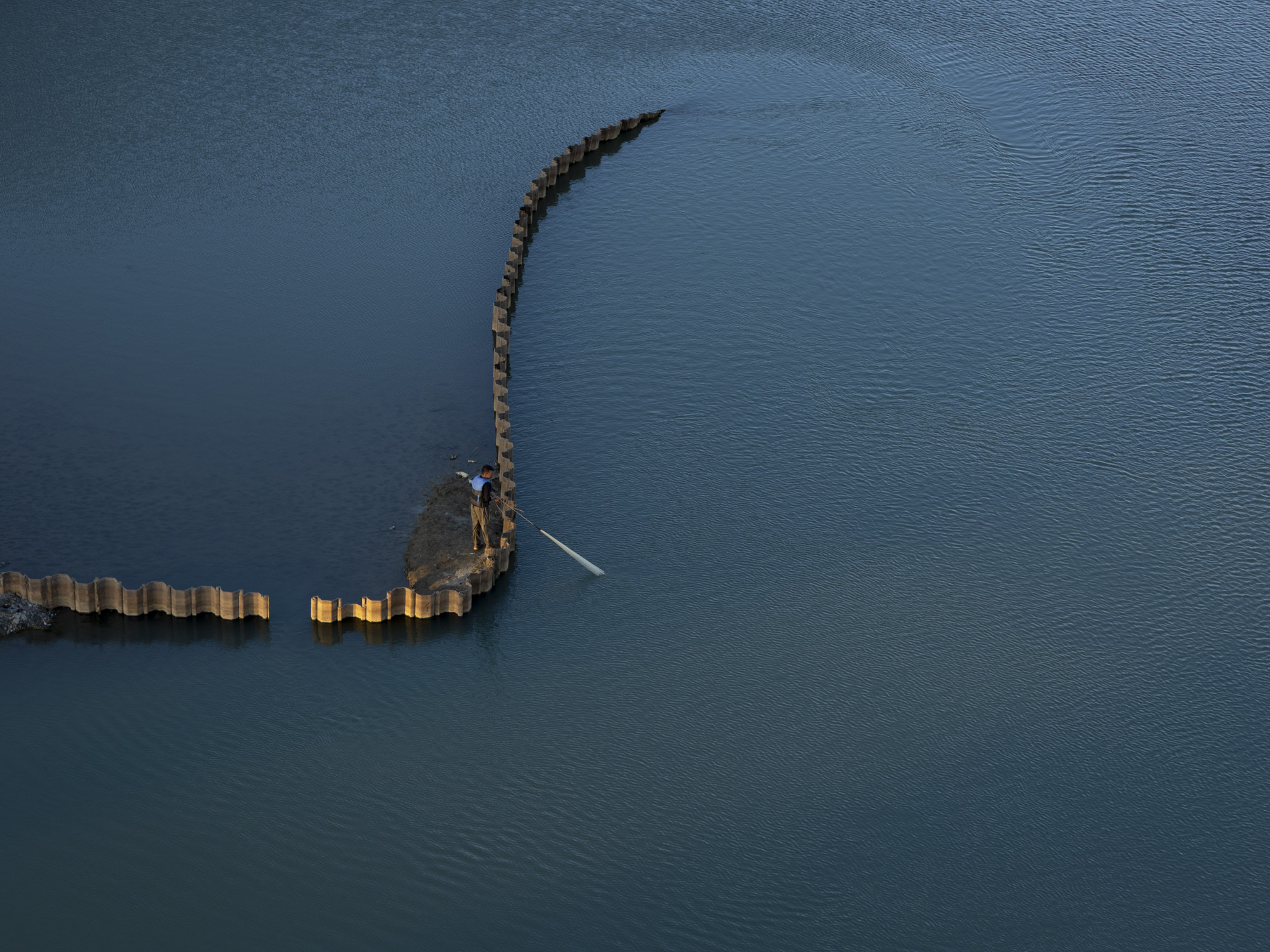
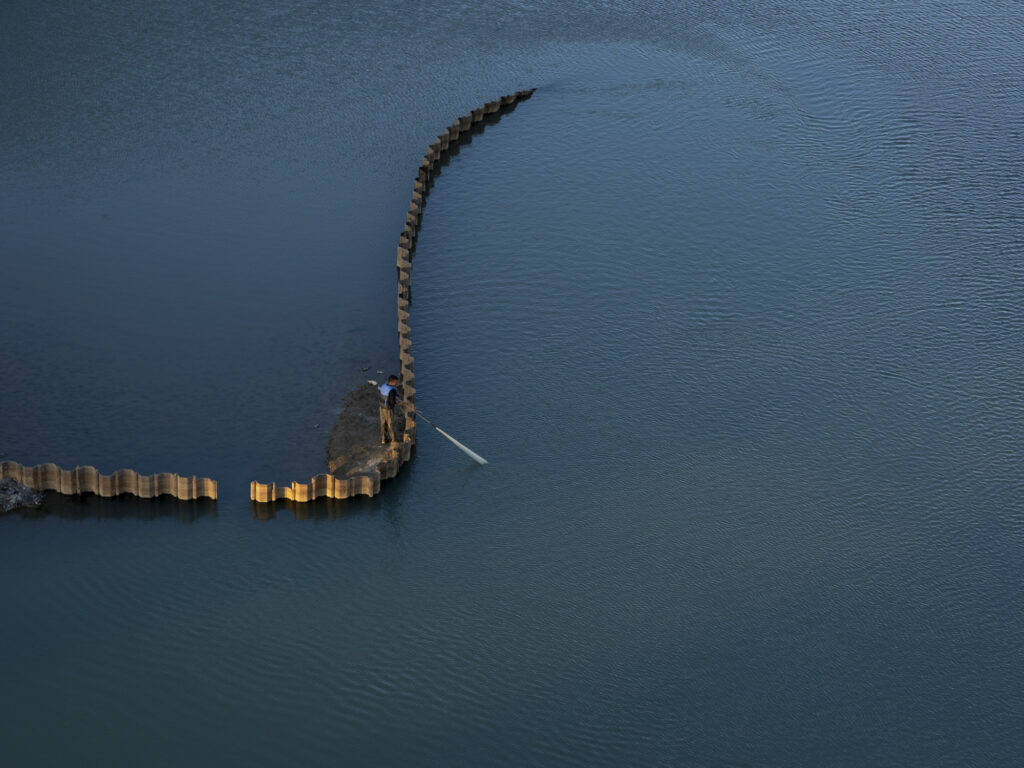
The next day, not having a proper place to rest, I leave the Iraqi 4,000-meter peaks behind, without a trace of snow, and where the summits, in white, only have the border control outposts with Iran. I head further south, towards Sulaymaniyah. The day is a constant series of stops at Peshmerga checkpoints, which twice force me to change my route. “You can’t go over there, it’s PKK area, it’s dangerous.” Every small intersection is a checkpoint, every peak has a small control castle overlooking the valleys. The only road I’m allowed to take is the one through Warta. “It’s for your safety,” they tell me, making my day several hours longer. The valleys are wonderful, though, and even if the road is often traveled by cars and military armored vehicles, there is no shortage of invitations for tea or something to eat. The small villages are almost deserted, cows and geese patrol the streets, the roadsides covered in dung. I reach Lake Dukan, a large reservoir where I pitch my tent, surrounded by stray dogs as the mountains turn pink and fishermen emerge from the waters towing small white nets. Inevitably, a small family who sees me from not too far away approaches to greet me and give me dinner.
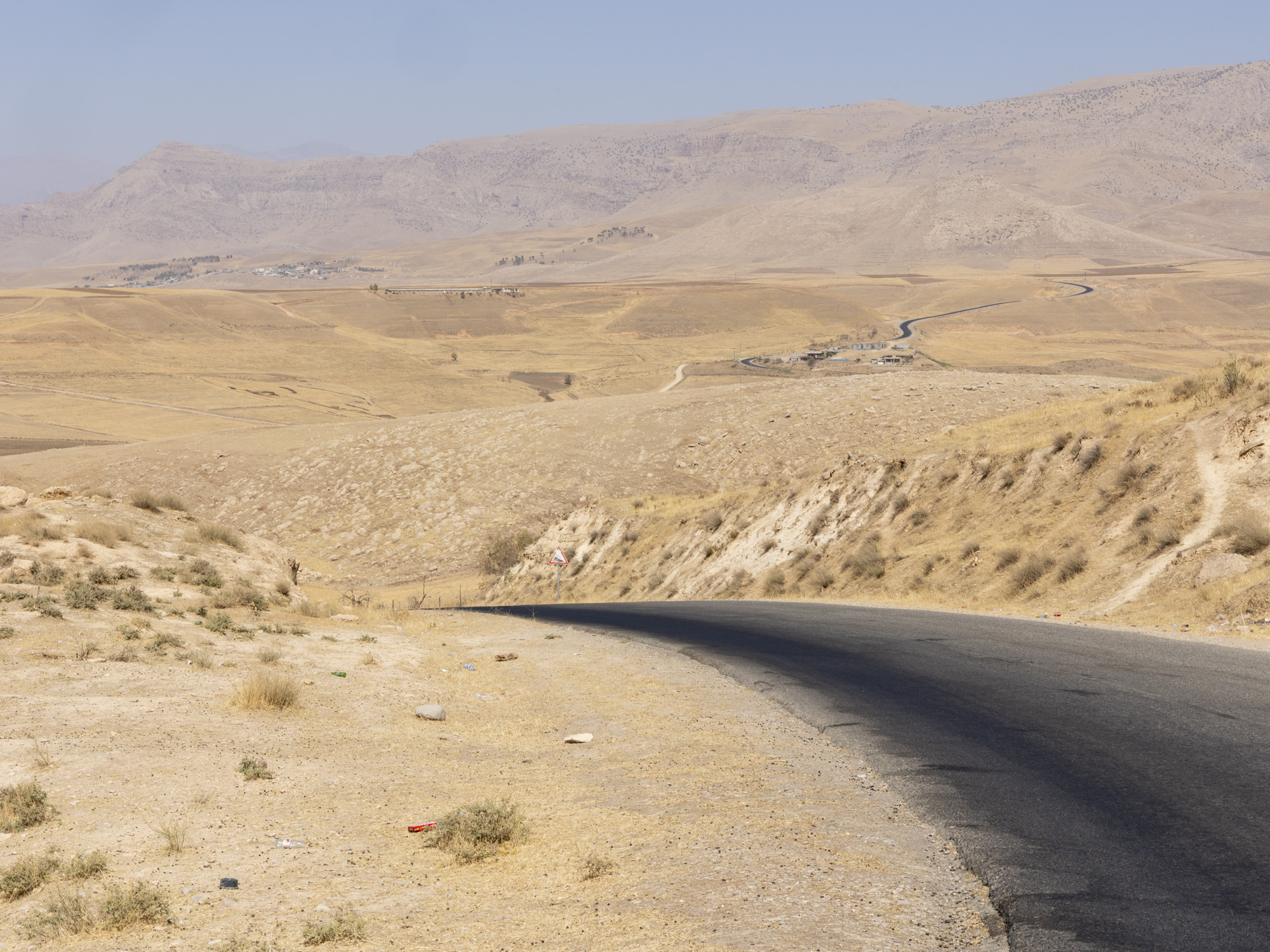
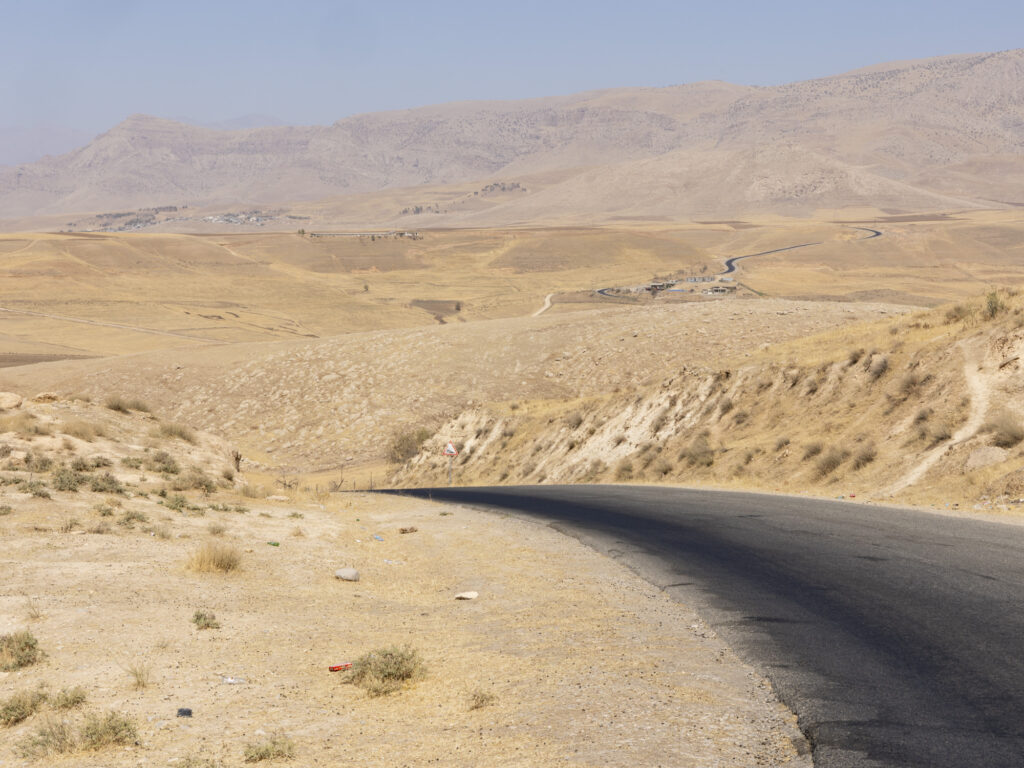
The following day is terrible. I’m back in semi-desert areas. Dry expanses of yellowish grass mix with the lake’s inlets, waving all the way to the mountains that loom threateningly in the distance. From afar I can already see the climb awaiting me; the anticipation makes my spirits sink. My legs won’t work, my head neither. Frustration grows inside me as the curves zigzag up among the rocks. Sweat drips from my nose, I only think of finding a tree. I wish I could stop.
A man in a large truck stops to ask how I am: he gives me water and sweets. He tries to give me money, which I categorically refuse, and then decides to fill me up with biscuits. A little further on, some guys stop; they’re from Baghdad: they get out while already filming me with their phones. One of them approaches and starts touching me in a creepy way. I push him away without any politeness. I am at the mercy of events. Every encounter plays with my mood, my energy. I arrive at a small mosque with a small restaurant next to it, a combo that appears almost like a vision to my eyes. A family comes out of the mosque’s bathrooms; at first, they look at me with suspicion, almost disgust, as I’m still dripping with the water I just poured over my head. But then they see the bicycle, and their inscrutable eyes turn into smiles. Sweets arrive, gifts, and shortly after, from other gentlemen, I’m even offered lunch. I discover that the murderous climb I saw from afar is not even on my route: I have to turn left, onto a road full of potholes but decidedly gentler. I’ve recovered. I go up a wonderful valley: some trees reappear, long-haired goats and dozens of cows patrol the fields, dung covers the crumbled asphalt. Children stop me at a small crossroads: they run the mini-market. They invite me to stop, then ask me questions about football while trying to convert me to Islam. People greet me from the few stone houses I pass, where sheet metal roofs are covered with blue tarps held down by stones and tires. Kids on motorbikes much bigger than them chase me and warn me when I look for a place to pitch the tent: “Watch out, it’s full of snakes!”.
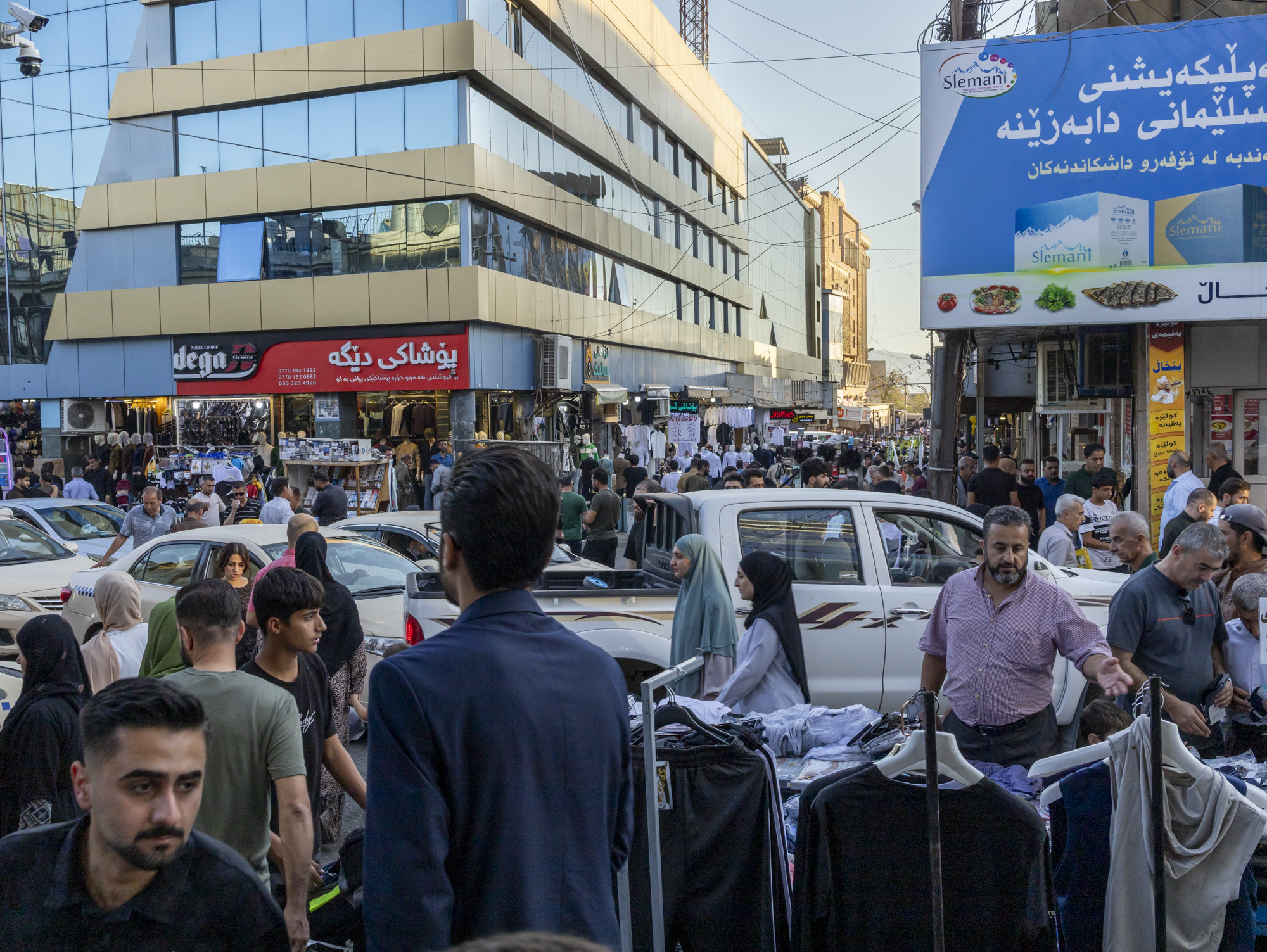
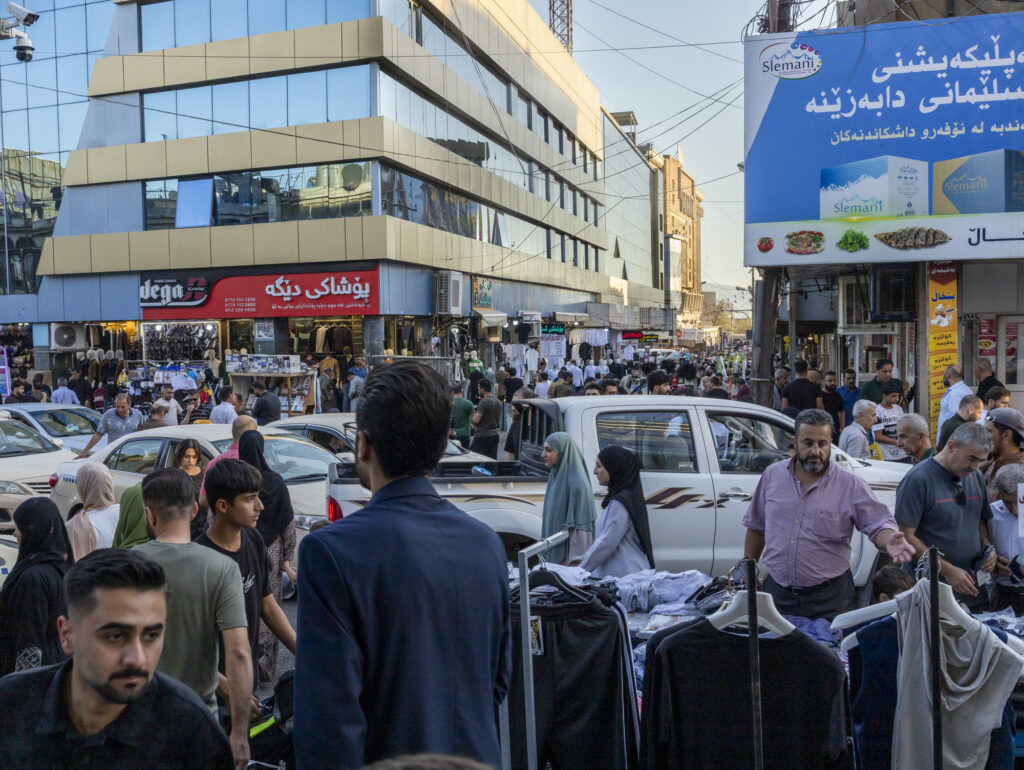
Three days after Choman, I finally arrive in Sulaymaniyah, considered the cultural capital of Kurdistan, the most alternative city. Getting to the hotel is an ordeal: the central streets are one immense market. Thousands of people jam between stalls and cars that get trapped for endless periods. It’s Friday, and the central mosque teems with worshippers. I laugh as I get stuck in the crowd and curious glances, amidst the fumes of grilled meat, phone charging cables, clothes, watches, and every kind of fruit.
Through the market streets, where in the morning geese, turkeys, and chickens run, and where in the afternoon there’s only an exhibition of plucked food hanging on hooks, one treads upon the freshest scars of Iraqi Kurdistan. We are near the cities of Halabja and Kirkuk. The former was the site of one of the most terrible massacres at the hands of the Arabs, during the repression by Saddam Hussein’s regime. There, on March 16, 1988, a campaign of extermination known as Anfal culminated in a chemical weapons attack: 5,000 civilians died in a few hours. Kirkuk, on the other hand, is even today the place with the highest tension and frequent armed clashes between the Arab and Kurdish worlds. The area is extremely rich in oil, both governments claim it as their own, and it is periodically lost and recaptured by one of the two sides: since 2017 it has been back under Baghdad’s control. In Sulaymaniyah, there is also Amna Suraka, a former prison for Kurdish dissidents, where they were interrogated, tortured, and killed. Today it’s a museum that hides nothing, from the bullet holes of machine guns to the bloodstains on the walls. Only the screams are missing, although their echo is still trapped in the silence of the barbed wire and the gray reinforced concrete walls.
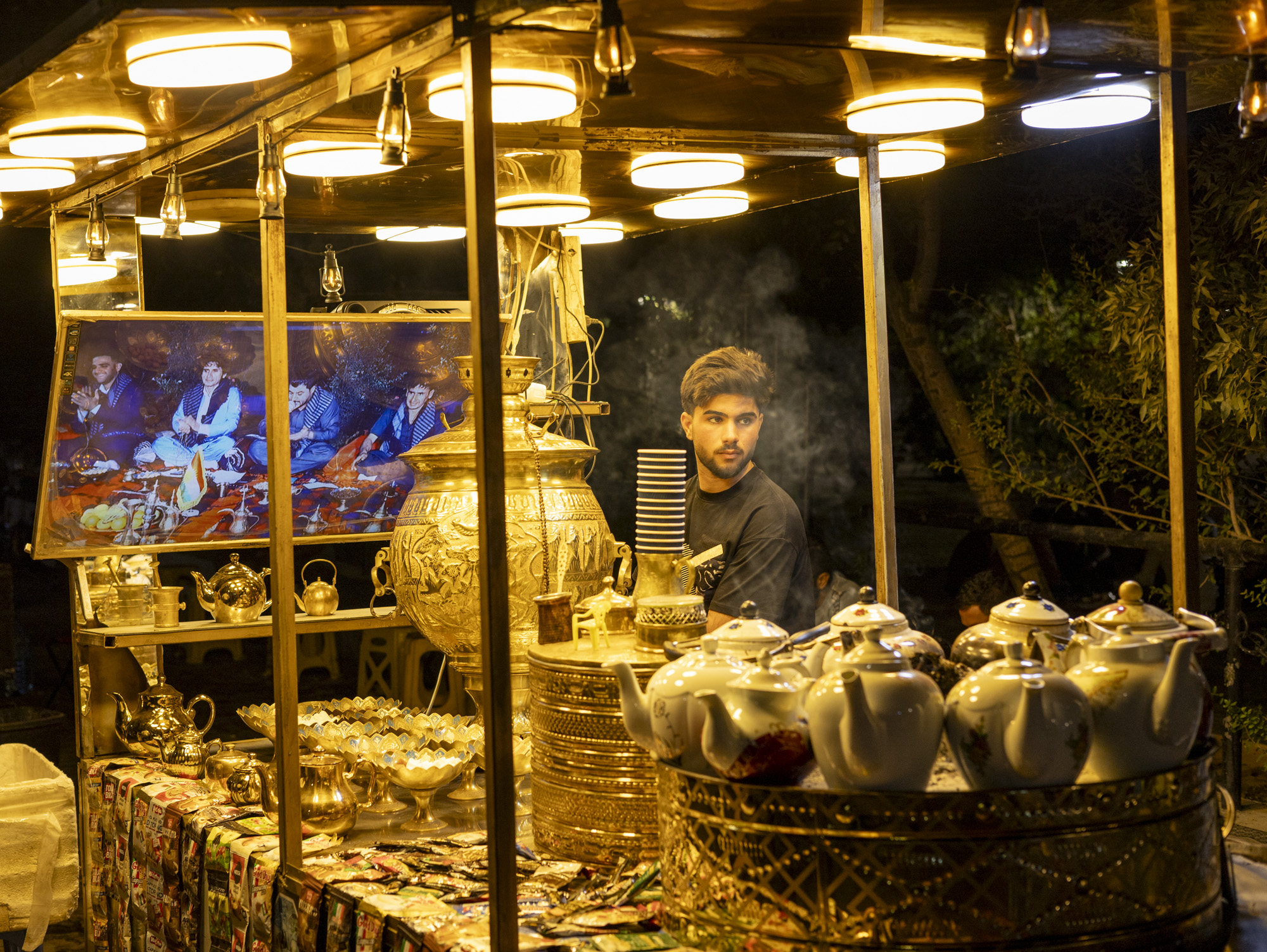
Walking through the streets, I am welcomed by three old friends. They offer me a fresh juice, then show me their shop selling plates and kitchen utensils in the market, and finally take me to see the city at night from above, to their favorite spot, where they meet almost every evening to smoke marijuana, away from the urban world, from judgments, and from the daily struggle. The future, however, chases them even there. Ozhman is about to leave for Canada, Saram is waiting for his papers to go to Germany, the third friend will stay here. “We’ve known each other for eight years,” says Ozhman, restless. “Here I have my friends, my family, my world, everything. I don’t want to leave. But salaries arrive with a 2-3 month delay. The Arabs punish us because we don’t let the oil reach them. I’m looking for a better life.” In his eyes, however, there is no emotion towards the new adventure; he is disillusioned.
Below us, Sulaymaniyah shines on the wide roads of the new luxury neighborhoods financed by the Americans, while darkness consumes the mountains full of minefields that surround it, where only the flames of black gold light up the night here and there.
By day, dust covers the sky, continuing to hide part of the city. I pedal towards Erbil, the capital of Kurdistan.
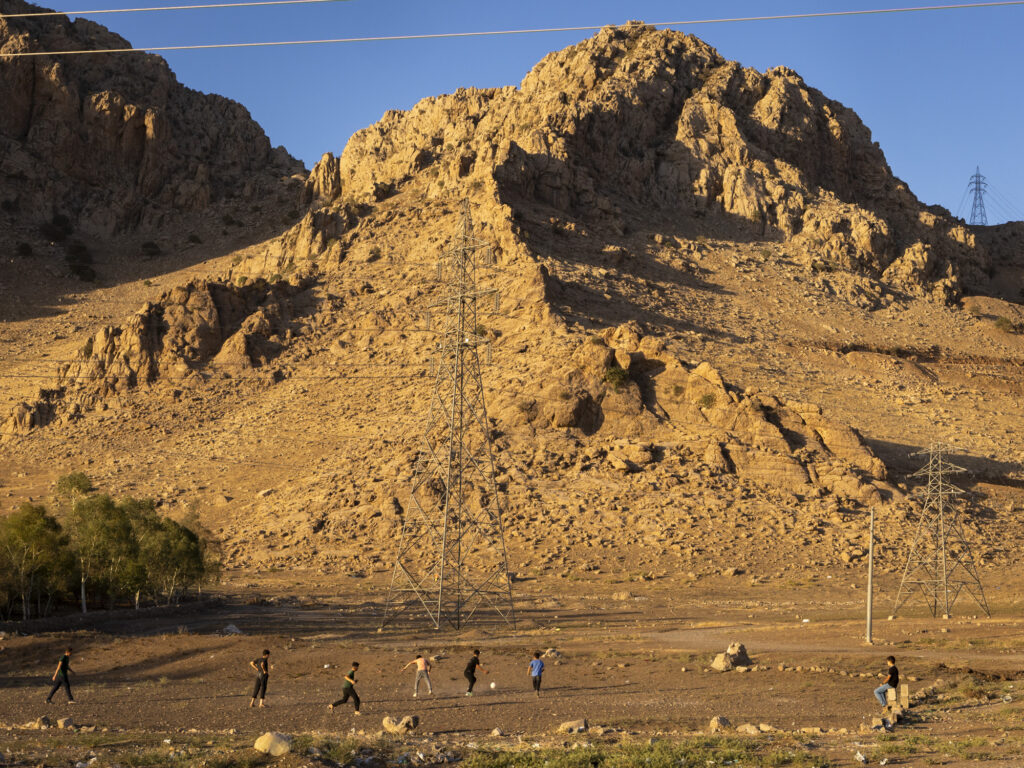
Three days of travel await me, where I lengthen the route a bit to venture along a dirt road that skirts Lake Dukan on the opposite side from the one I had already crossed. The landscape is so wonderful that it’s worth seeing again from a different perspective. I imagine it in spring, when the desert hues are gently covered in green.
The moon shines full; I’m a few dozen meters from the road, the tent pitched slightly downhill. The sky is already dark when a flashlight appears not far off. Then the headlights of a car, and in front of it a shepherd dragging a sheep and a goat. They had escaped together. So it is possible to leave the flock.
The following morning, I continue. I’m out of water, since algaes have grown in one of the bottles and I don’t dare drink. I aim to reach Koya, where I’d gladly look for a room. Along the way, I stumble upon a scene somewhere between tragicomic and surreal. Two cars had an accident; one of them has even overturned in a ditch. There are about thirty men around, serious and busy. As I pass, however, they all turn and greet me enthusiastically. Among them, I notice one with a large bruise on his forehead and blood seeping from his head. He gives me a big smile and greets me happily.
In Koya, there is no hotel. Between those who stop me on the street and those I ask, everyone answers negatively. “You can sleep in the park.” But the sleepless memories of the last time’s enthusiasm make me lean towards leaving the city and finding a more secluded place. I get back on the saddle and after about ten kilometers find a picnic area, run-down and covered in bird droppings, but still with some shade and tables. I’m on a small side road a few dozen meters from a factory, which has several guard dogs that soon come to visit me. They surround me and bark for a while, until they get bored and leave, only to return later. They patrol. A car coming from there stops to ask who I am and to warn me: “Watch out for the dogs! There’s a very big white one. If you see him, run straight into the tent. If you need anything at all, let me know, no problem.” Thanks a lot. I’ll use telepathy if needed, since he leaves me no contact info.
Night falls; the dogs reappear as expected. From the six there were in the afternoon, now they’ve become nine, and the biggest, most fearsome one is with them. They come back three or four times, circling the tent and barking until tiredness overcomes suspicion. Suddenly, however, the silence of the night is cut by human shouts. It takes me a while to realize it’s not a dream, but then I notice a flashlight pointed at the tent. They keep shouting. They’re after me. I take out my earplugs and, completely dazed, try to answer something. “Italy! Italy!” I shout. “Passport!” I exit the tent and find three men pointing a machine gun at me. The flashlight is in my face, making it hard to see them, but I understand they’re approaching. They take my passport and once sure it’s really Italian, they lower the light and the weapon. “Do you need anything? Food? Water?” No, I just need to sleep without a gun pointed at me, and maybe take the dogs away. Which doesn’t happen, because a moment later they’re around me again.
The morning is calm. An older man comes from the factory, sits next to me, and starts talking at length, as if I easily understood him. I don’t understand anything obviously, except that I should travel with company and that the area is full of snakes. He’s giving me a lecture. Shortly after, though, he showers me with gifts: biscuits, iced tea, water, fruit. He inaugurates the day. A little later, I’m invited to lunch, until the final descent brings me to Erbil. Here, I’m hosted by Youssef, an Egyptian guy I found on Couchsurfing. Youssef lives on the outskirts of the city, in a peripheral area filled with brand-new, private compounds with an exaggerated organization. I pass through Korean Village, Spanish Village, American Village, finally arriving at Ganjan City, where I’m expected. The welcome is almost comical: so many people work there, with the idea of being cutting-edge and extremely efficient and organized, that in reality, it’s all a mess. To get authorization to put my bike in the garage, I ask the armed guard at the entrance, who refers me to a superior guard. That one sends me to an office, where they call the area chief, who finally gives permission to lock up the bike. The building’s door opens with facial recognition, but then I get stuck inside the elevator because the power goes out.
In Erbil, I do little. The accommodation I’m in is 18 km from the center; the roads to reach it are a 4/5-lane hell, amidst desert dust and a thick smog blanket. On the outer parts of the city, besides the compounds, liquor stores pop up, red-light venues, and large private buildings for meetings and parties of various kinds. The closer you get to the center, the more you return to an Islamic world, less distorted. The neon lights and skyscrapers disappear; mosques and lower houses reappear.
Youssef is a Catholic Christian priest. I decline his invitation to a meeting of believers, but I accept to go to the evening he organized with the parish in a small art gallery. Here I find myself among faces from different worlds: Arabs, Kurds, Europeans, Americans. All Catholic Christians. The welcome is warm, particularly from a large Arab man named Eiffel, who is enthusiastic that I’m Italian. He approaches me several times to say something, until at one point he asks me if Prime Minister Meloni is right-wing or left-wing. “Right-wing,” I reply. “Well, you’re lucky to have her. She is blessed by God. She supports Israel, and whoever supports Israel and the chosen people is blessed by God.” The evening flows with some readings and a buffet, then dissolves into free time to relax and chat. I explore the structure a bit and find myself going out into the courtyard, where suddenly I hear someone shout “Benito Mussolini!”. Eiffel looks at me: “A great man! I like him!”. I shudder. I realize, though, that something doesn’t add up. Does Eiffel know what Mussolini did to the chosen people he so adores? I sit down with him and we start talking, and so he tells me a bit of his story. “On April 1st, 1999, I was recruited by Saddam Hussein’s Iraqi army. But I escaped. When I was little, I remember being stopped by a soldier: he was hatless, wearing a beige military jacket and olive green pants. Two different shoes, civilian ones. I decided that for 3,000 dinars a month, I would never take part in that army of poor wretches. Taking orders and being punished if I don’t execute them, to earn a pittance?” So, the decision to work for the Americans as a translator. “I don’t see them as invaders, but as those who liberated us from Saddam Hussein. I know they didn’t do it because they cared about us, but for their own advantage. But I don’t care, they freed us.” He then starts talking disjointedly about Hamas and Israel, a country with which Iraqi Kurdistan has excellent relations, especially linked to the war with the Arab world: “Anyway, the Palestinian Arabs have sided with the IDF. They did well. There they have money, a privileged position, they lack nothing. They’re first-class citizens. I would do it too. For money, I would shoot at Arabs, shoot at my own people. I’m a mercenary. As a translator, I had everything: gym, video games, the best restaurants, jazz music. If I wanted weapons, just put an X on my translator ID. Palestinians and Hamas, when they see an Arab in the IDF, they look at him badly and at checkpoints feel insulted to be checked by him. But he did well.” Meanwhile, Obaida has joined our conversation, a 22-year-old of Druze ethnicity from Suwayda, in southern Syria. He fled his land when he was 17, otherwise he would have been recruited into the army. His whole family fled to Iraq. Later, his house was confiscated and set on fire. He spent his childhood shooting rifles and machine guns. One of his older brothers, fighting in the Druze army, was his teacher and taught him how to be a soldier.
But he cannot return to Syria, nor can any of his family. If he returned, he would be recognized as a traitor as soon as he handed over his documents, and would be executed. In this context, Israel is the protector of the Druze, in the eternal war against the Arabs. But Obaida doesn’t support it, and finds himself deeply opposed to Eiffel’s thesis that for a better life with more money, security, and privileges, it’s worth leaving your own people and turning against them. “Better to keep your dignity than to sell out and go against your own origins.” Ismail then poses another doubt to us: “If God tells me I must protect my soul, but Jesus tells me to turn the other cheek and not fight… I’m confused. Should I defend myself or not? If someone comes with a machine gun, I’ll kill him, that’s clear!”.
Among the people in the courtyard, I also meet Ahmet, a young Arab from Baghdad who has lived in Kurdistan for years now, despite the historical conflicts between the two sides. “In 2007, we moved to Rawanduz, in the Kurdish mountains. My family and I took a house. We weren’t poor, we could afford to buy the necessary things to live, but we didn’t have to. The neighbors brought us gifts every day as a welcome: furniture, utensils, beds, a fridge. They filled our house, did the furnishing. It was incredible.” The evening draws to a close; I go out onto the street in front of the cultural center and meet Eiffel again. He’s going home and rides a red bicycle. He stops and enthusiastically asks me: “Can you sing Bella Ciao for me?”
From Erbil, I continue my journey back to Kathleen’s home in Duhok. In my zigzag, I stop in Akre after yet another day of greetings and gifts. Here I take some time to rest and chat with Tariq, a former ambassador of Kurdistan to Austria. Now he is elderly and can finally be in his own land, without suffering or fear.
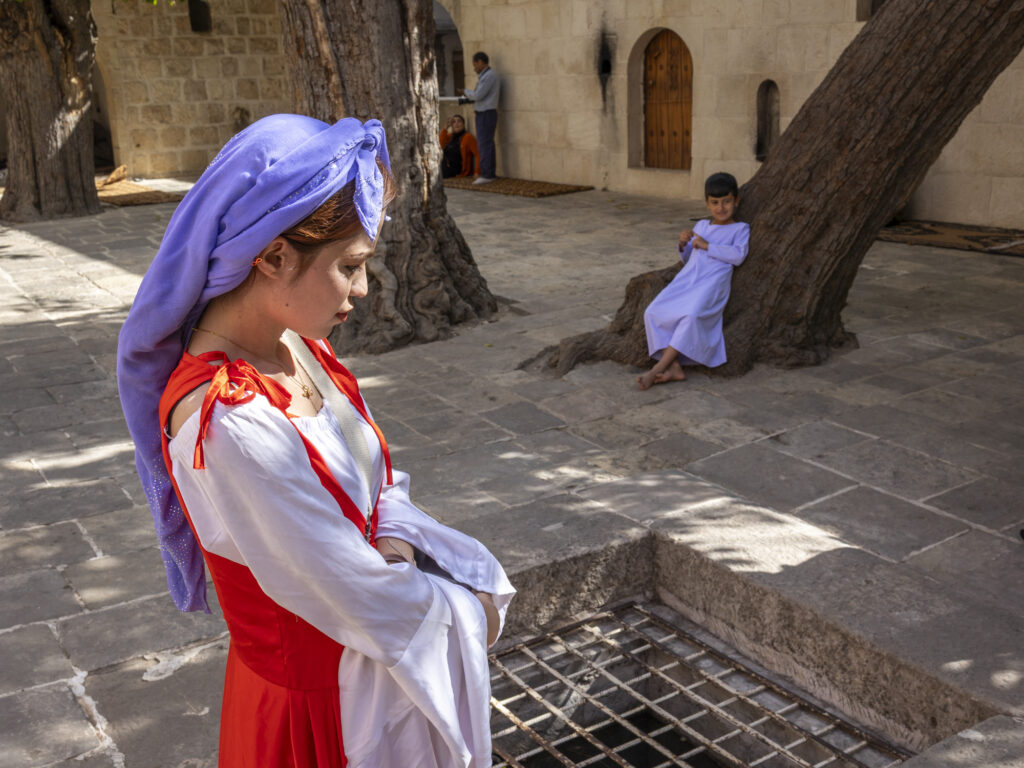
The road, however, leads me towards the temples of Lalish, the holiest place, the Mecca of the Yazidi people. Along the way, the number of stops and calls is already pressing. Invitations to sleep, invitations to lunch, photos, videos. I manage to refuse almost all of them. Approaching Lalish, I unexpectedly run into a crowd that fills the road already from the junction on the main road, about two km from the village. Dozens of cars coming and going, the first assaults by curious onlookers. The Peshmerga let me use their bathroom to change and be appropriately dressed. Really, just a pair of long trousers suffices. A small group of blonde-haired kids accompanies me as I slowly pedal up the slope leading to the temples. Questions I don’t understand, dozens of greetings. I’m literally inside a river of people and cars. What’s happening? Why are there so many people? It’s October 12th, and I discover we are in the last two days of Cejna Cemayê, the most important and solemn celebration of the Yazidi calendar, lasting seven days, usually from October 6th to 13th. It honors and celebrates Sheikh Adi ibn Musafir, a Sufi mystic of Arab origin who came from Syria (c. 1073-1162) and who, with the establishment of his Sufi order (the ‘Adawiyya’), provided an organizational structure and an infusion of Islamic mysticism to a pre-existing set of local, Zoroastrian, Mesopotamian, and probably also Christian and Jewish beliefs, effectively giving birth to Yazidism. From this syncretism was born a rigorous monotheism that entrusted the governance of the world to a council of seven Holy Angels.
The first and most important is Tawusî Melek, the Peacock Angel, a central and misunderstood figure. A symbol of light, knowledge, and rebirth, whose emblem, the peacock, adorns every sacred place.
The Yazidis have since been one of the most persecuted peoples in Mesopotamia. Their history counts seventy-four genocides suffered, the last of which, still bleeding, at the hands of ISIS, in the period between 2014 and 2017. The most persistent and devastating reason for the persecutions has been a profound misunderstanding of their faith, resulting in the accusation of “devil worship” by neighboring Muslims and other monotheistic groups. The crux of this misunderstanding is the figure of Tawusî Melek, the primordial angel who, according to their theology, refused to prostrate before Adam. The Yazidis interpret this act not as disobedience, but as the supreme act of monotheistic devotion: only God deserves worship. For this reason, Tawusî Melek is considered the regent of the world, a figure of redemption, not evil. In other Abrahamic religions, however, the same episode is associated with the fall of Lucifer, transforming the angel into a demon and the Yazidis into “Satan worshippers.” This distorted interpretation has for centuries provided a religious justification to label them as infidels, subject to forced conversion or extermination according to the more extremist currents of Islamic law.
I am taken into custody by Serekan, a young man with dark hair who, without speaking a word of English, decides to accompany me through the temples. I leave my shoes and bicycle outside. Throughout the village, you can only walk barefoot. We enter the main temple where I am invited to perform various sacred rituals: untie the knot of a rope, retie it, and kiss it. Walk three times around a large rock and then kiss it. An elderly man burns some string for me before letting me enter the deepest hall of the temple, in the belly of the mountain. No windows, the electricity constantly cutting out: dozens of people in the throes of their emotions, overwhelmed by the spiritual force of the celebrations, enveloped in darkness. Exiting the deepest grotto, I am made to throw a wet rag with my eyes closed; it must land on a rocky ledge protruding high on the wall: I succeed on the first try. The people around me get emotional and applaud. A man caressing a viper awaits us again at the exit. He comes from a village where people coexist with snakes, many of them extremely venomous. We visit other temples and I perform other rituals, until Serekan says goodbye. Not a moment passes and I meet Haji, a man in his fifties, enlisted in the Peshmerga army. First, he invites me to his family’s tent, to meet his wife and children and drink tea. They’ve been camped there for a week, like many other families. We plunge back into the crowd, and Haji takes me to meet various people, including the most important: Babashir, a sort of Yazidi Pope. Dressed in white with a long black beard, he poses for photographs with all the faithful and non-faithful alike. We return to the tent for dinner: on this occasion, the men eat separately from the rest of the family (on other occasions we would all be together). I find myself sitting eating with Haji’s friends and relatives, all enlisted in law enforcement: a Kurdish policeman, an Iraqi policeman, a federal army soldier, various Peshmerga. Enlisting, for the Yazidis who remained in Iraq, is one of the very few ways to have a decent salary, to support their families. Many of them harbor deep resentment towards the Peshmerga of the Erbil region (there are effectively two Peshmerga armies, linked to the two main Kurdish parties), because in 2014, when ISIS threatened to conquer Sinjar, the lands inhabited by the Yazidis, the Kurdish armed forces protecting it left, leaving them completely defenseless, and opening the doors for the Islamic State to carry out the massacre and atrocities of the following years. The army, however, is their only path to salvation.
As soon as dinner is finished, we head back to the main temple, where ceremonies are about to begin. Sitting among dozens of people, I look around: the people are an incredible mix of features and colors. Brunettes, blondes, redheads, green eyes, dark, blue. Curly hair, freckles, aquiline or straight noses. An impressive genetic diversity considering that the syncretic Yazidi religion makes them a distinct and closed group. The faith, in fact, is transmitted patrilineally, but with the fundamental rule that both parents must be Yazidi. They can therefore marry exclusively within their own community and religious caste, a custom that has maintained the purity of their bloodline and traditions, but has also created social barriers with neighbors, limiting integration and mutual understanding.
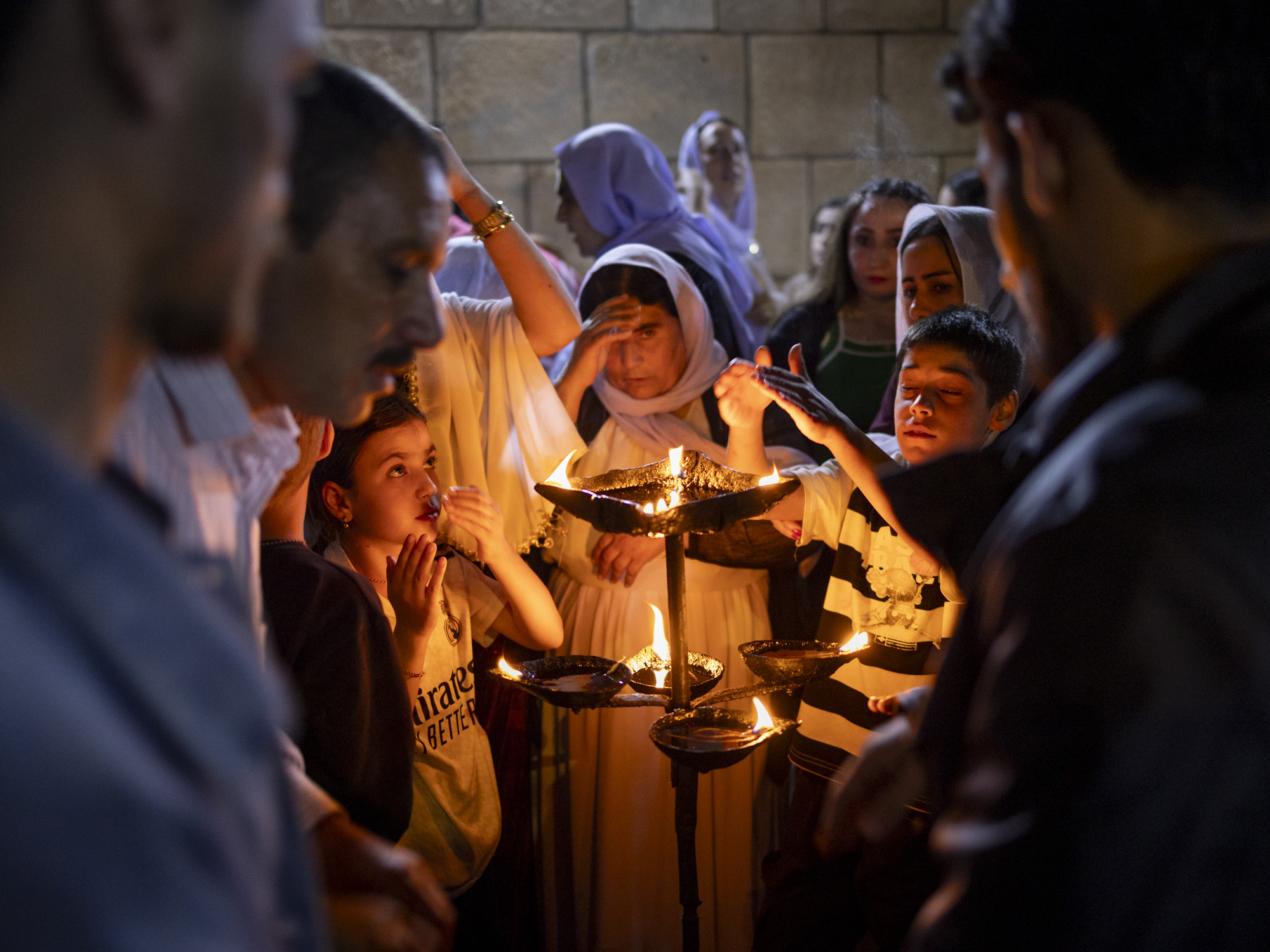
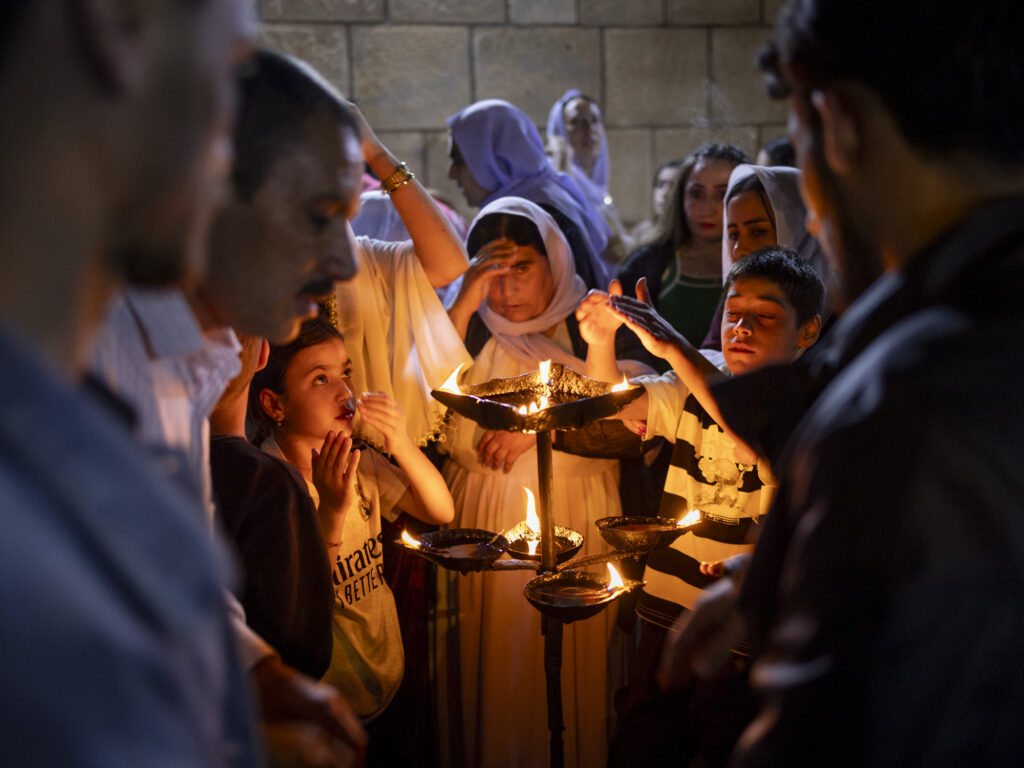
The temple doors close; the sound of a flute hisses: the ceremony begins. Taking photographs and videos is strictly forbidden, so much so that a substantial number of guards are tasked with carefully controlling the large mass of people who, besides filling the temple’s sacred courtyard, are perched on roofs, ladders, and every kind of surrounding protrusion. Someone tries, but is immediately glared at and then scolded with an accusing finger pointed at them: phones disappear quickly. From the music and chanting, the ritual dissolves, leaving people free again to move and approach the “monks,” to take videos and photos: but the people are mainly attracted to the Sanjaq, a sacred iron standard on which, on multiple levels, sacred flames burn. The faithful pass their hands over it, then touch their faces, as if gathering a warmth that comes from the depths of their history, a purifying fire representing the divine light of the Holy Angels.
Outside the temple, the celebration explodes, and, swept along by Haji, I find myself immersed in a current of hundreds of people dancing, singing, playing music, laughing. Within a short time, I lose my Peshmerga friend, being literally overwhelmed by handshakes, hugs, and welcomes. Lalish has now entrusted me to Amanda, a girl of about ten who takes me by the hand and doesn’t let go, becoming my guide and companion in a whirlwind of encounters. In the next two hours, I think I shook something like two hundred hands. They offer me water, coffee, sunflower seeds; we exchange phone numbers; I receive invitations; we take endless photographs. All without anyone, except Haji, able to speak a word of English. With a group of children, we go to see the bicycle; another group had practically had to be “torn” away from me, because caught up in the euphoria, they had perhaps crossed the line of manageability. Up, down, stairs, doorways, new encounters, new welcomes. I find myself again in the middle of the dancing, dragged into a whirlwind of tambourines and smiles, until Amanda hugs me and goes to sleep, and in her place comes Rezan. About twenty years old, he dreams of being an interpreter: he knows English! So it’s his turn to accompany me, while my jaw begins to seriously ache, victim of those cramps I had first experienced only a few days earlier, caused by an excess of smiling.
At midnight, the guards and soldiers rigidly chase us away. The dream shatters. It feels like being abruptly brought back to reality. The military literally kick me out of the village, saying I cannot spend the night there. Three friends then step in to soften the “awakening”: Zydan, Jovan, and Saadi. They witnessed the scene with the soldiers and decided they wouldn’t let me go away alone. We’ll go look for a place to sleep together: I just have to wait a moment, the time it takes for them to take down their tent and gather their things. So we descend together towards the entrance, down to the Peshmerga house, where we set up camp on a small lawn lit up like day by the immense flame of an oil well. Sauron’s eye watches over us, while my new friends tell me about themselves. Jovan and Saadi, fortunately for them, were in Kurdistan in 2014. Zydan wasn’t; he was in Sinjar, in his land. The arrival of ISIS was brutal. The men of his village were executed on the spot, the elderly women killed shortly after, the younger ones kidnapped and turned into sex slaves. The youngest turned into child soldiers. Zydan, with some family and friends, managed to escape to Mount Sinjar, a place sacred to the Yazidis, but at the same time arid and torrid: “I was on the mountain for seven days,” he tells me. “Without food and without water. It was terrible. Then the PKK opened a corridor to Syria and we managed to escape to Zakho, in Iraqi Kurdistan. I don’t want to remember anything from those moments.” Today he lives with his two friends in a student hostel in Mosul, which was the capital of the Islamic State in Iraq, the center of control for the carnage suffered by the Yazidi people and others. They live in an apartment shared with many other boys, where privacy is practically non-existent. The housing emergency, however, is something that binds almost all the Yazidis who remained in Iraq. The majority of them, like Haji, still live in refugee camps, among tents and prefabs, suffocating in summer and freezing in winter, when humidity soaks the walls and mold eats the sheets and furniture.
In the morning, I spend time with my new friends, sharing breakfast. The time spent with them, however, makes me miss the last ceremonies of the week, for which I curse myself, at least partly. Although officially nothing more happens, I still decide to spend the day among the temples, curious to see how hundreds of people dismantle what has been their home for a week, prepare to leave, and bid farewell to the place that in their hearts is the most important in the world, the one that, as long as it exists, will give them hope to fight and survive.
In the main temple, I meet Helin, a girl I had danced with the night before. Now there is calm and silence around us, so we have a chance to chat. Helin, like Zydan, comes from Sinjar, the main city of the territory of the same name, a place that, following the years under ISIS (2014-17), has been practically abandoned to its fate: to enter the area, special permits issued by the Iraqi government are required, which is why it is very difficult for foreign NGOs to intervene and bring aid. The city lacks primary services: there are no schools or hospitals, no drinking water, and electricity is often absent. “I would like to come to Europe and study, study, study. I want to study so much. We Yazidis are worth nothing to anyone. We have no rights. Our city is half destroyed. Only a lot of journalists come, always to talk about the genocide. It’s a sad life.” She stares into space for a while. “Will you come to Sinjar?” She is 21 years old. On August 3rd, 2014, Black Saturday, the day ISIS first overwhelmed the lives of her people, she had just turned 10. She doesn’t tell me anything else about herself, leaving me only to imagine which of the various possible fates led her to still be alive and free. “Do you want to have lunch with me and my family afterwards?”
I won’t find her again, but the steps of Lalish lead me into the arms of another large family. So I find myself sitting eating with thirty people, among uncles, grandparents, cousins, and brothers. “In our family, everyone likes you!” Overwhelmed by questions, I am stuffed with food and drinks, covered by a large white and red tent, sitting on beautiful rugs. With the younger guys, after finishing eating even what was left in the trays of the older relatives, we are about to get up. They want to take me to see the corners of Lalish I haven’t discovered yet. We’re about to move when the grandmother’s peremptory order arrives: “Oh no! The çay!” The afternoon passes watching people leave, with my latest very young guide, little Sipan, just nine years old, and then with yet another snack invitation, which almost says to me “Don’t go. Not yet.”
The sun has set; in the now dark sky, the flame of black oil blazes violently again. Lalish is now empty, although the silence still vibrates with the heavy echo of the energy and movement of the last seven days of festivals and ceremonies. Slowly I head towards the exit, where I will put my sandals back on and go down to the tent for the night. I stop at the small mini-market at the entrance to buy something to snack on, reluctant to leave this overwhelming place. I’m about to pay, but the man next to me stops me. He pays. I thank him. I reach my footwear and, with a melancholic heart, take the first steps towards the outside world. But before I even have time to think of the first memory I’m taking away, a little girl comes running: she brings me a handful of sunflower seeds. She fills my hand with a smile and runs back to her grandmother, under the tree where they’ve been sleeping for days. I bow. I feel like crying. I have fallen in love with a people.
After a few weeks, I’m finally back in Duhok, at Kathleen’s house. In the living room, two other cyclists are waiting for me: Jakob, German, and Burak, Turkish. Kath says she’s particularly excited; she’s never had two cycle travelers as guests at the same time; now there are even three of us. She’s thrilled to create encounters, foster friendships, and circulate advice and information. It’s nice for me too, after so long, to meet other cyclists, cousins from distant worlds. Our intersection soon opens up an interesting topic, one that concerns us long-term travelers a lot, but certainly has broader meanings. In the three of us, we represent three very different ways of relating to the world of social media, of narrating and transmitting what we are experiencing. Jakob wants nothing to do with it. He posts a few things, a few “stories” on Instagram, but he is deeply opposed to the idea of making videos of what he does and putting himself on display. Burak is the exact opposite; he travels with a small camera that can shoot 360°, he keeps it on constantly to not miss a single moment, including while talking to us. I find myself perhaps in the middle. I gather a lot of information, seek out stories, take photographs, but I limit my narration to less “expansive” modes, less instantaneous and daily compared to Burak.
There would be much to think and reflect on this subject. On one hand, it’s understandable that one might seek a way to gain visibility and consequently possible economic gain; on the other hand, there is the risk of decisively influencing one’s own experience and lived reality. Burak is gaining hundreds of followers every week, thousands every month; in Turkey, he is quickly becoming very well known. But he has the obsession of filming everything, with the risk of creating fake situations and ruining the spontaneity of the people he meets. How will a Kurdish or Indian family react, finding a camera pointed at their faces while talking to us? Will they be able to be spontaneous, or will they try, even unconsciously, to sell themselves to produce a “positive” video? How would Jakob and I have been, at the moment of saying goodbye to Burak, if he hadn’t explicitly asked us to hug in front of the bike and say certain words? How much, then, can we believe, when following someone’s journey, in the reality of what we see? Of course, we can only trust and dream. Perhaps it makes little difference for those watching from afar. But for the one living it? How high is the risk of gaining fame and money at the expense of purer, unrepeatable human experiences, and perhaps being left with a question that will remain permanently unresolved: were those people I met really like that, or were they responding to the performance demanded by the mainstream live? And even ourselves, are we real? If, perhaps, in a journey of such difficulty and silence, the most precious things are the discovery and understanding of ourselves, how high is the risk of limiting this “journey” from the moment we know we are always being filmed, watched, and therefore judged? Are we ourselves if we know we are selling out? And so, how worthwhile is it to potentially become known and earn money, if we then risk compromising the deepest aspects of our experience?
At the same time, however, some say: better to “sell out” partially but be able to continue traveling, than to give up, with the consequence that money will eventually run out and I’ll have to return to a sedentary life to earn more. All correct. So the question remains: what’s the point of risking losing such fragile and precious sides of the experience, in order to stay on the road longer? Is quality or quantity more important?
Answer: I don’t know. It’s probably extremely subjective. And it’s right that everyone does as they feel. There’s no right way and no wrong way, and perhaps there’s no true and no false.
At Kathleen’s house, Leo also shows up, a bit late. I had met him in Lalish, where he participated in the entire week of ceremonies. We meet again here, in the travelers’ hub of Iraqi Kurdistan. Leonid Plotkin, American, is a little over 50 and has been traveling continuously since 2006 (almost 20 years). Backpack, photography, trekking. He travels the world seeking out and documenting minor, little-known religious events, then creates reports destined for book projects. “Photography gives meaning to everything I do. If you don’t find something to do, something to turn everything you experience into, a meaning, then the risk is that traveling becomes ‘scrolling.’ After a while, nothing would surprise you anymore, or would lose value. So you find your way, you find what interests you and what you can discard. You can’t experience everything in a world that is infinite. There’s an infinite diversity of aesthetics, philosophy, and history.” He speaks at length and slowly. We three cyclists listen in silence. “I follow the flow and doors open. You just have to be able to see them, and then the path comes by itself, automatically. It’s my life, my only life. It’s not that I travel and then go home. No. I go back to say hello, but this is my life.”
The next day, Leo leaves for Nepal. Burak heads towards Iran, but aims for distant Japan. Jakob is a bit sick and waits another day to move, but has no plans, except to go down towards Jordan and Saudi Arabia for the winter. Then we’ll see. Kathleen, meanwhile, has found a few more ideas for me and puts me in touch with Bazaar, a Yazidi who lives in Sharia (where I had already gone in an attempt at volunteering a month earlier) and who heads an NGO. Kathleen tells me he works in the Yazidi refugee camps and does some things with sports, and might need photos and videos for new documentation. When I meet him and visit the headquarters of his organization, however, I discover something else entirely. Bazaar’s mission is one of the most complicated imaginable. Since 2016, with the founding of KINYAT, Bazaar has been searching for the people, mainly girls and children, who have been kidnapped by ISIS since 2014. To date, there are still about 2,700 missing (an estimated 60% of whom are still alive). In nine years, they have freed 56 people. Their method operates undercover: operatives with false identities infiltrate digital markets and the clandestine human trafficking networks of ISIS to trace victims and negotiate ransoms. Bazaar shows me images of Islamic State chats, where the buying and selling of women and children takes place. Prices, offers, descriptions of the “merchandise.” Because that’s how they are considered. The walls are a collage of faces, some still without news, others whose location has been discovered. Finding the exact place where these people are hidden is complicated, as is proving their Yazidi identity (some are in prison with members of the Islamic State). Many are children who were kidnapped when they were barely one or two years old and are now teenagers. Raised in jihadist families, Arabized and Islamized, they often have no memory of their Yazidi origin.
A group of photographs shows mothers who are still together with their children, probably linked to another silent tragedy: that of children born from the sexual violence suffered during captivity. For these ‘children of the Caliphate,’ life remains suspended in limbo. The strict Yazidi doctrine, which requires birth from both parents to belong to the faith, has placed the community before an atrocious dilemma. Despite the openings of the Yazidi Spiritual Council in welcoming back survivors, these children technically remain outcasts: they are not recognized as Yazidis by their own people and, according to Iraqi law, they are officially registered as Muslims as children of fathers (even if rapists) of the Islamic faith. Many mothers have thus been faced with an inhuman choice: abandon their children in orphanages to be welcomed back into the villages, or stay with them, living on the margins of society, in a forced exile that adds trauma to trauma.
We move between his office and the operations room. From the top of the building, I can see the refugee camp, which is now so large that it has overflowed the fences initially placed around it. The tents and prefabs snake like a water flow even among the “normal” houses of the village, in every free space where it’s possible to put something up.
The walls of the NGO headquarters are also full of other faces: those of the kidnappers. Among the long black beards, blond tufts and blue eyes appear. In ISIS, there were recruits from at least a hundred different nations, thirsty for money and violent power.
Parallel to the search work for missing persons, KINYAT also meticulously compiles archives to identify the perpetrators. Analyzing hours of propaganda videos and internal ISIS documents, they have created a database of thousands of faces.
Bazaar, however, doesn’t need my help. In terms of documentation, they have already worked extensively in previous years, and for what they are currently working on, my skills are useless. So we go down to the ground floor, where Bazaar has his other business: a shop importing and selling alcohol, further emphasizing the distance from the Arab world.
With this possibility also falling through, I return to Duhok to figure out what the next day’s path will be. I definitely need to fix Novella, the bicycle, which has shown the very first minor issues of the trip in recent days; then I think of heading towards Baghdad. Iran continues to pollute my thoughts, making me unsure about my choices: continue southwards too, for a warm winter and being on the move, but with the risk of not being able to cross Iran and getting stuck down in the Emirates, or go back up towards the Caucasus, to be ready by the end of winter to cross the Caspian Sea towards Central Asia?
Nirari, an Assyrian guy (they still exist), offers to fix the bike. We fix a few small problems together and clean it, only to realize at some point that the front rack is broken. Not in one place, not in two, but in three places. I can’t pedal. Within a few minutes, my brain is already creating plans and possibilities, but the priority is to fix Novella. What to do in the meantime? Nirari, yet another character of supreme kindness, offers a solution: “Go down through federal Iraq by hitchhiking/minibus, I’ll keep your rack and have it fixed for you when you get back.” For free. Impossible to offer him anything in return; he doesn’t accept.
Another event comes as if to dispel any doubt about which way to go: two young doctors from Baghdad have arrived as guests at Kathleen’s house. From there, they will leave again for the Arab capital and offer me a ride. I accept all offers.
Thus, after a long day in the flat and torrid desert, where every few kilometers a military checkpoint forced me to pull out my passport, to look into severe eyes, machine gunners, and rifles of all kinds, I arrive in Baghdad. Thinking about the 500 km just covered, I don’t miss having pedaled them too much.
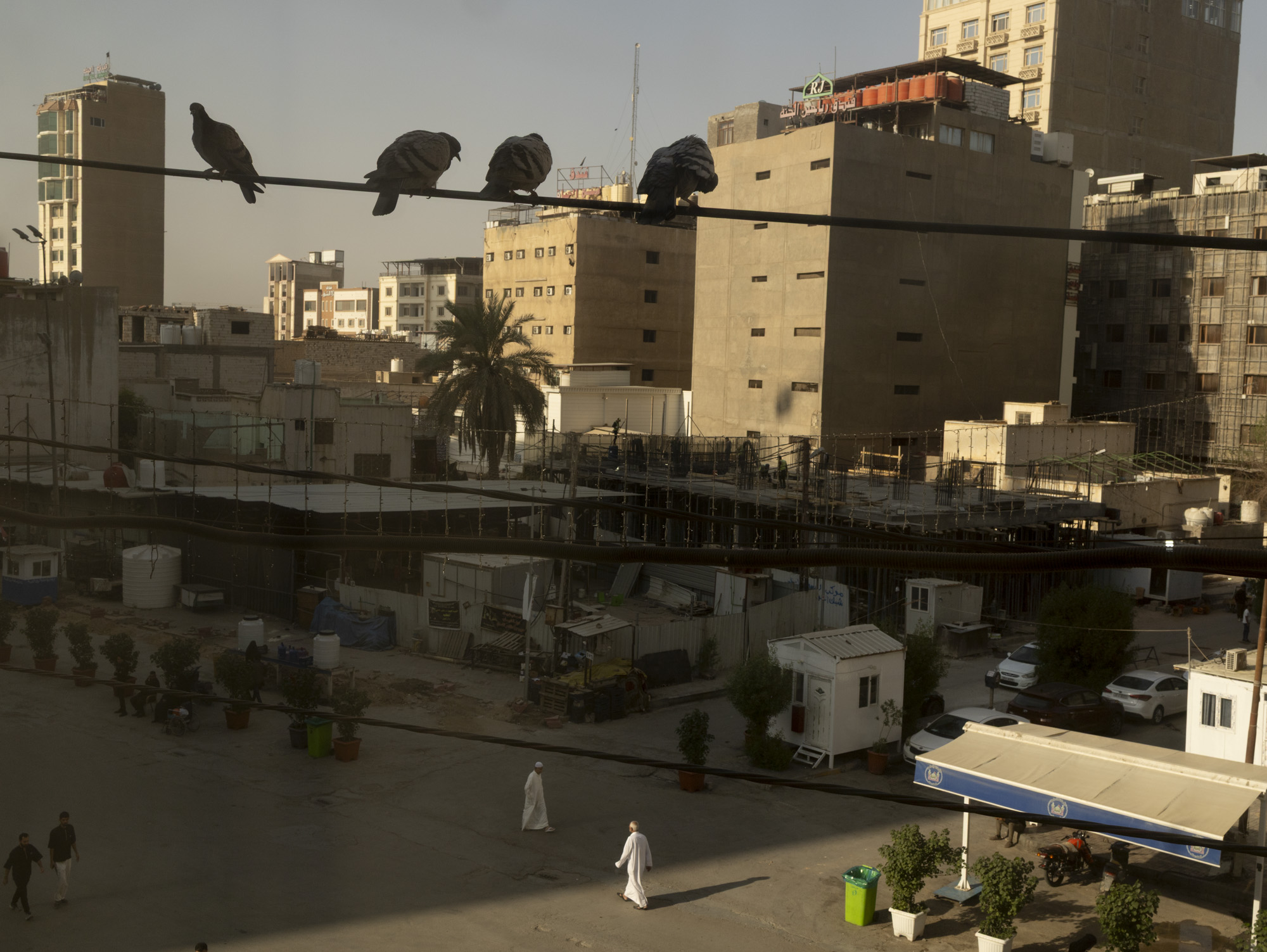
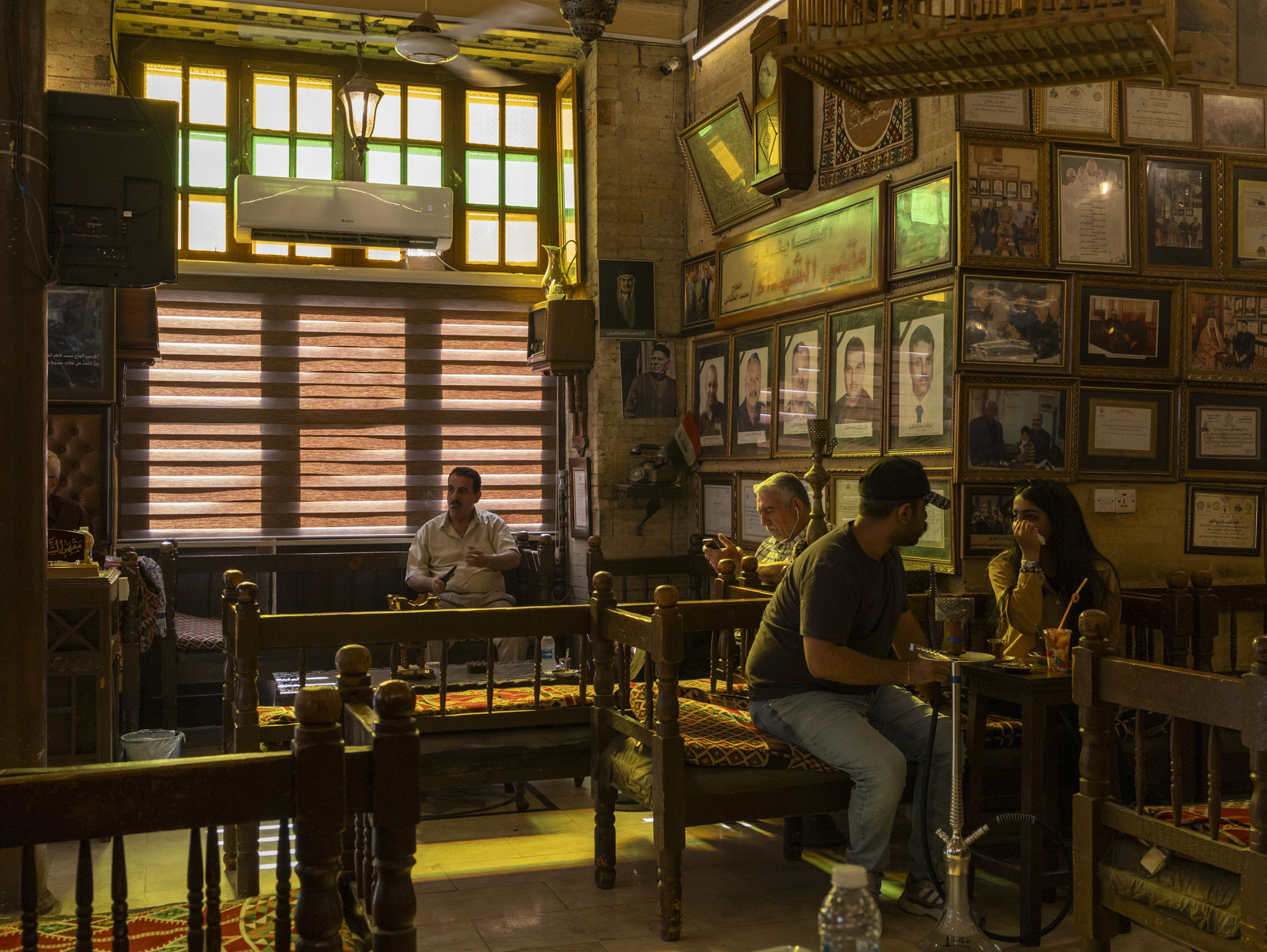
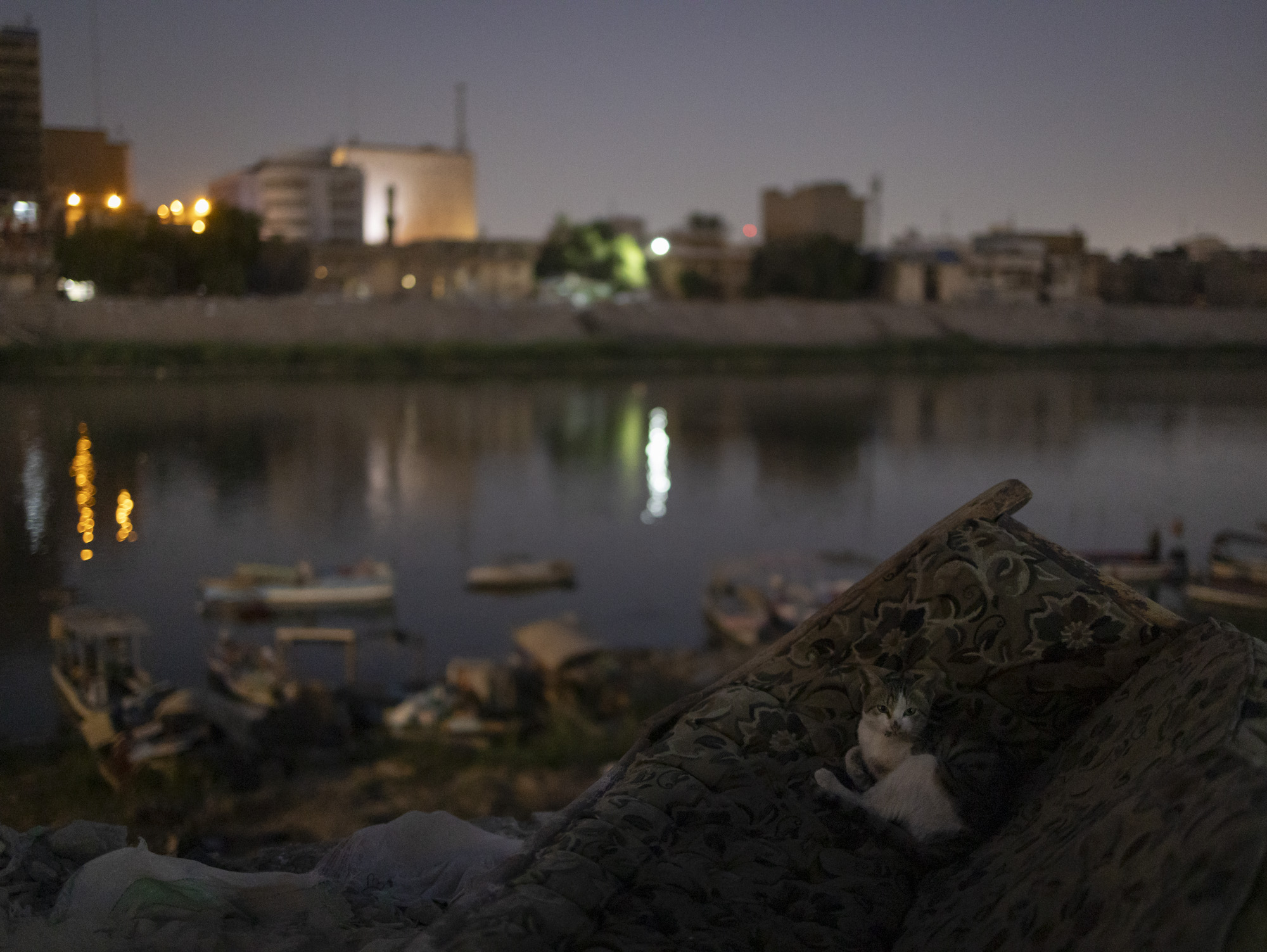
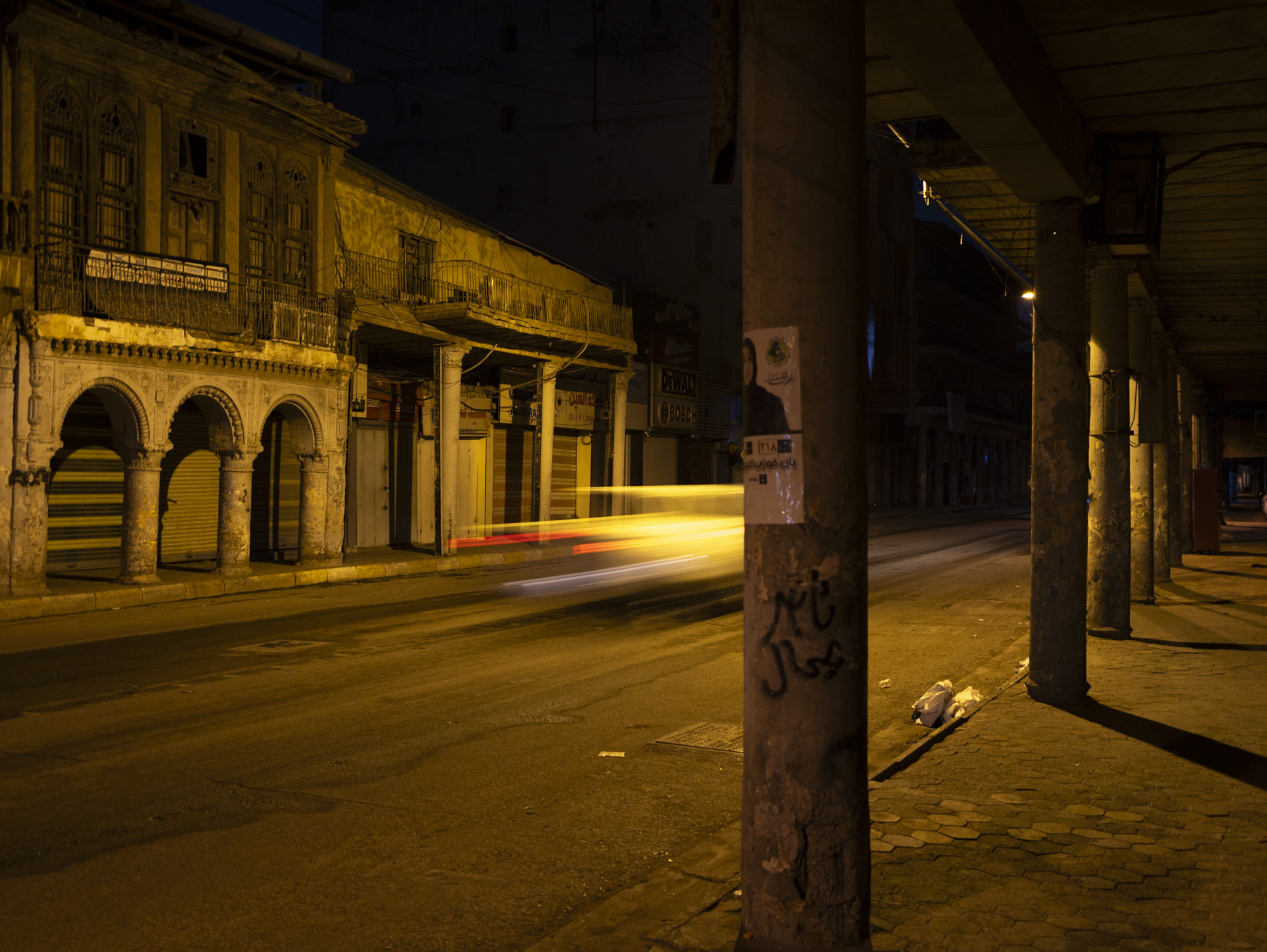
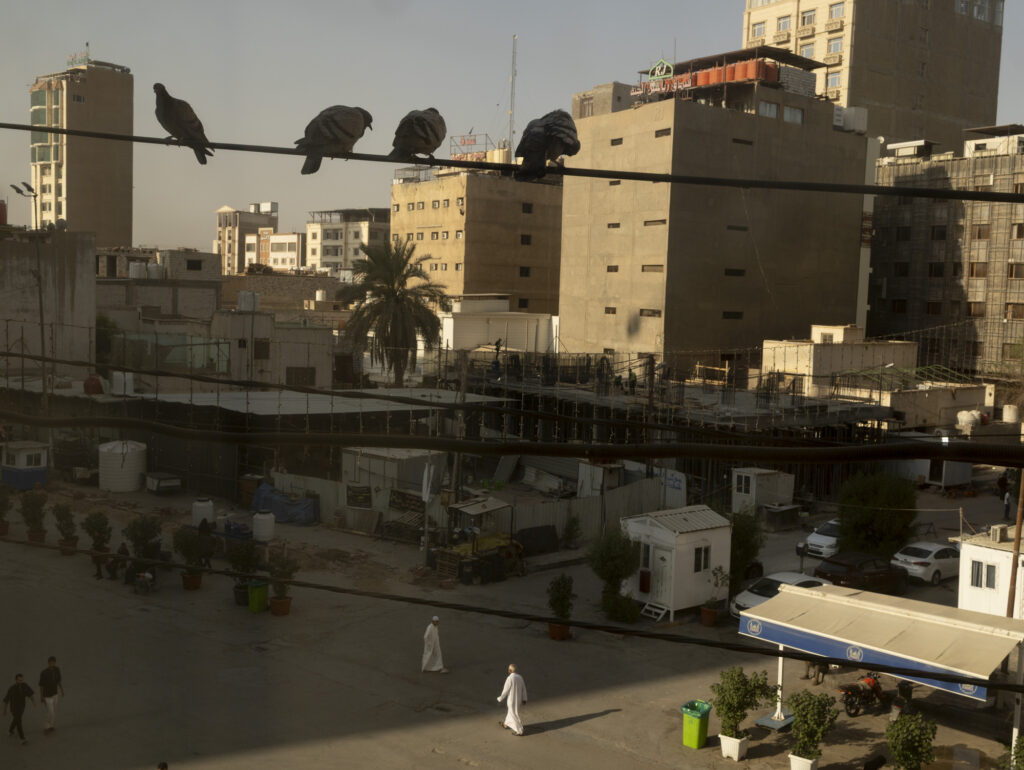
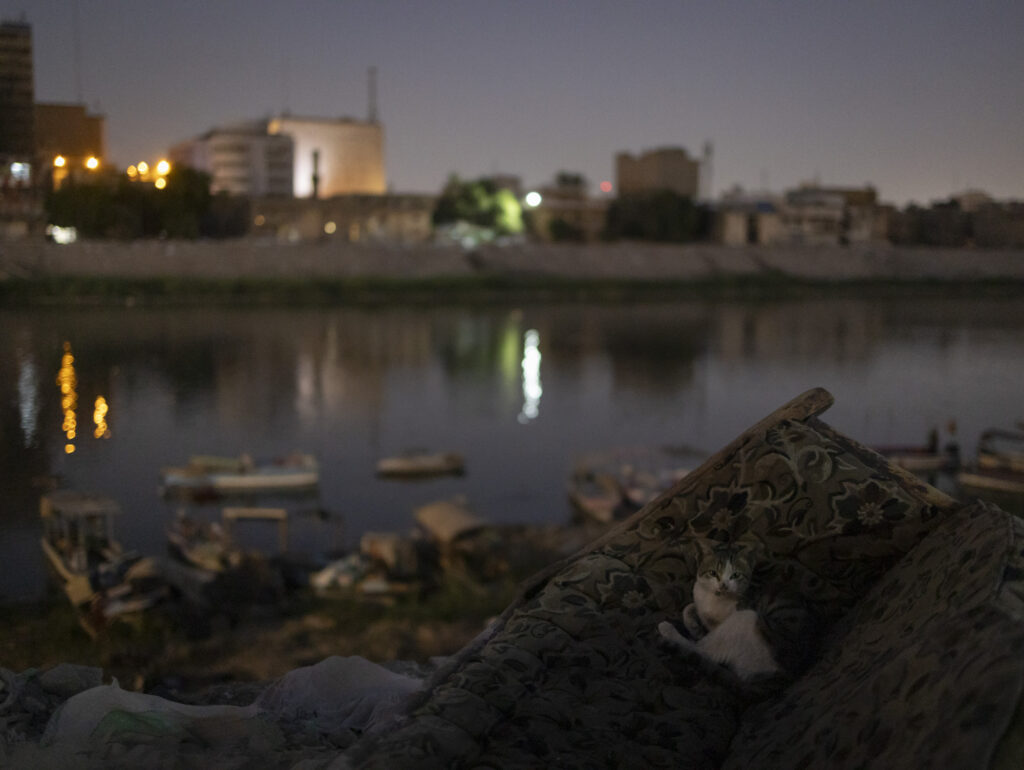
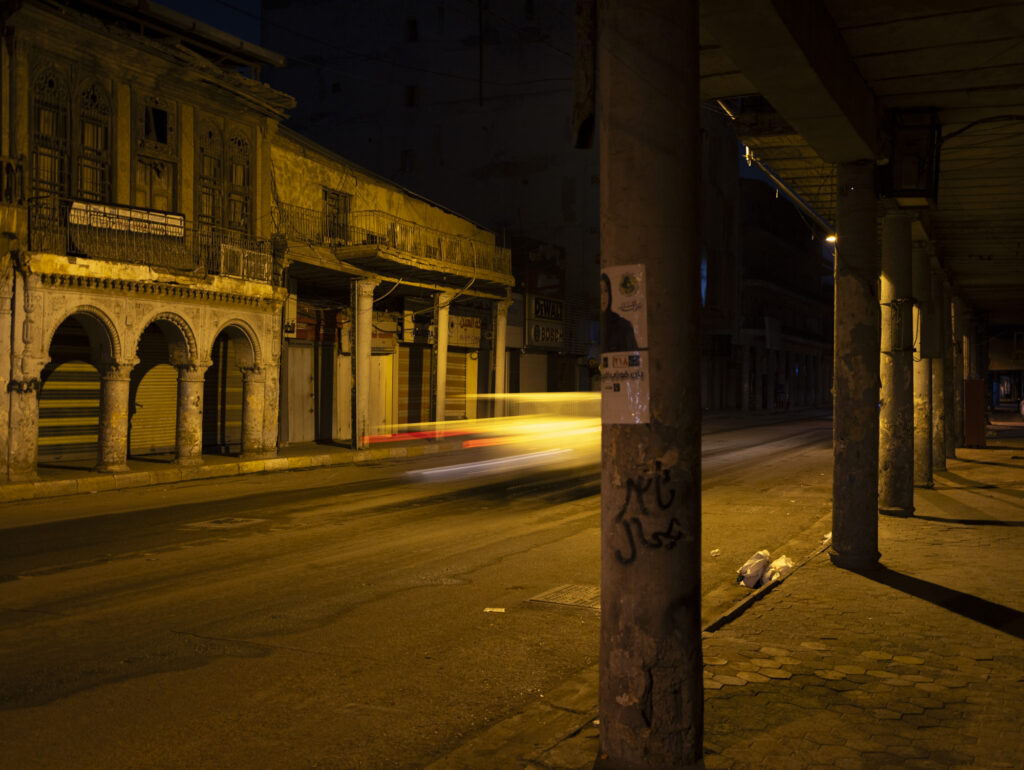
The Iraqi capital is a slap in the face, delivered by a heavy hand. Huge, extremely congested, noisy: alive. Dogs, carts, horses, a chaotic world broken only by the great Tigris River, enveloped in a dusty sky. Some ships run aground on the banks serve as a springboard for a few brave boys, who dive into the earth-colored water and swim with wide strokes. Perhaps unaware, perhaps simply not caring. It’s October 18th and it’s 36 degrees. The areas around the center appear fairly orderly, with larger buildings, wide roads, and relatively new concrete pours. The older part, however, tells thousands of stories even to the most superficial glance: collapsed or burnt buildings, broken windows, shattered balconies, bullet holes, cannon shots, mortars. “Dead” buildings from which laundry hangs. In between, no one stops; there’s not a meter that hasn’t been reborn, or that has continued to live. Stalls and vendors on every corner, people doing everything and people doing nothing, just there making up the numbers. Despite feeling the big city stress, people are welcoming and kind here too. A European walking is under everyone’s watchful eye, and many stop me to ask who I am. Some guys take me around on their horse-drawn cart while they go to a warehouse area to pick up sacks they need to load onto trucks, in another part of the center. A group of children drags me through the alleys of their neighborhood, where, surrounded by a wall crumbling from bullet impacts, an elderly man waters the concrete in front of him, perhaps hopeful for a bit more coolness. Where the shadow looms intimidating, you often find an interested smile, someone coming out of a faded door and asking you to take a photograph. During the evening, the power often goes out; there are major blackouts that plunge entire neighborhoods into darkness. I wander through streets where a few phosphorescent neon lights continue to shine, amidst the noise of life going on. A group of Syrian children stop me and ask: “What are you doing here? Iraq is a bad place, go back to Europe, don’t stay here.” It’s easy to be fascinated by a place like this if you’re not the one who has to live there.
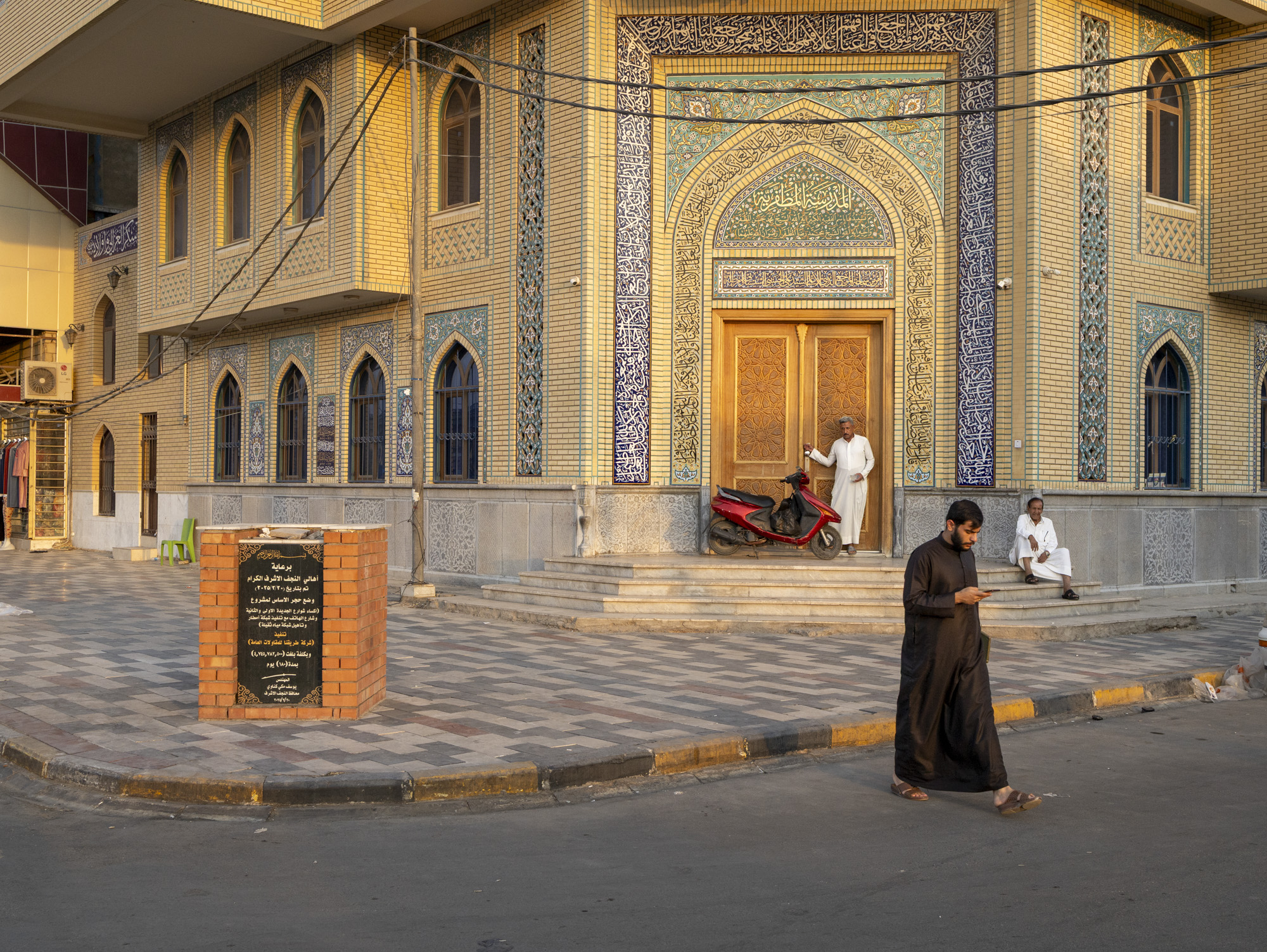
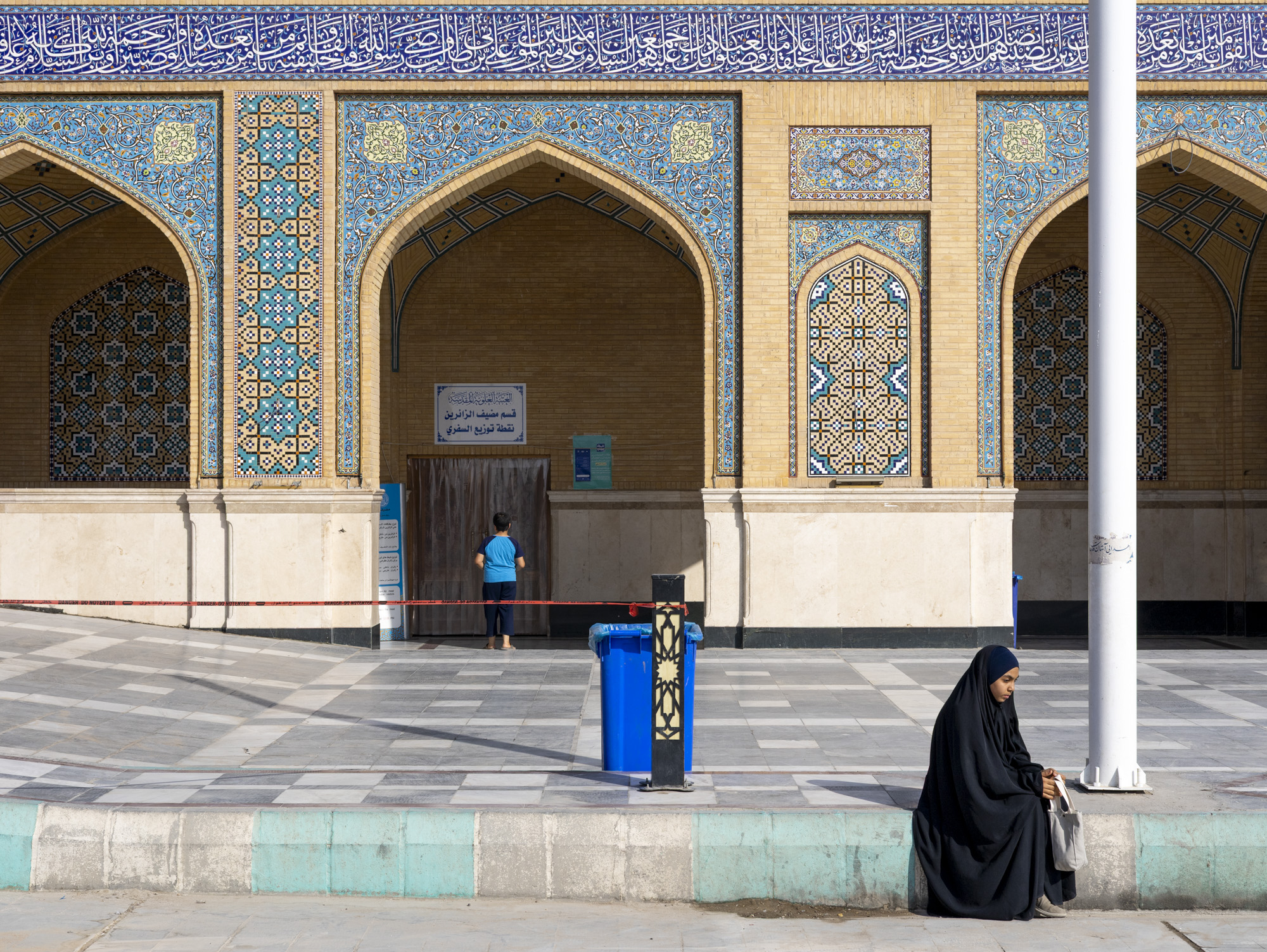
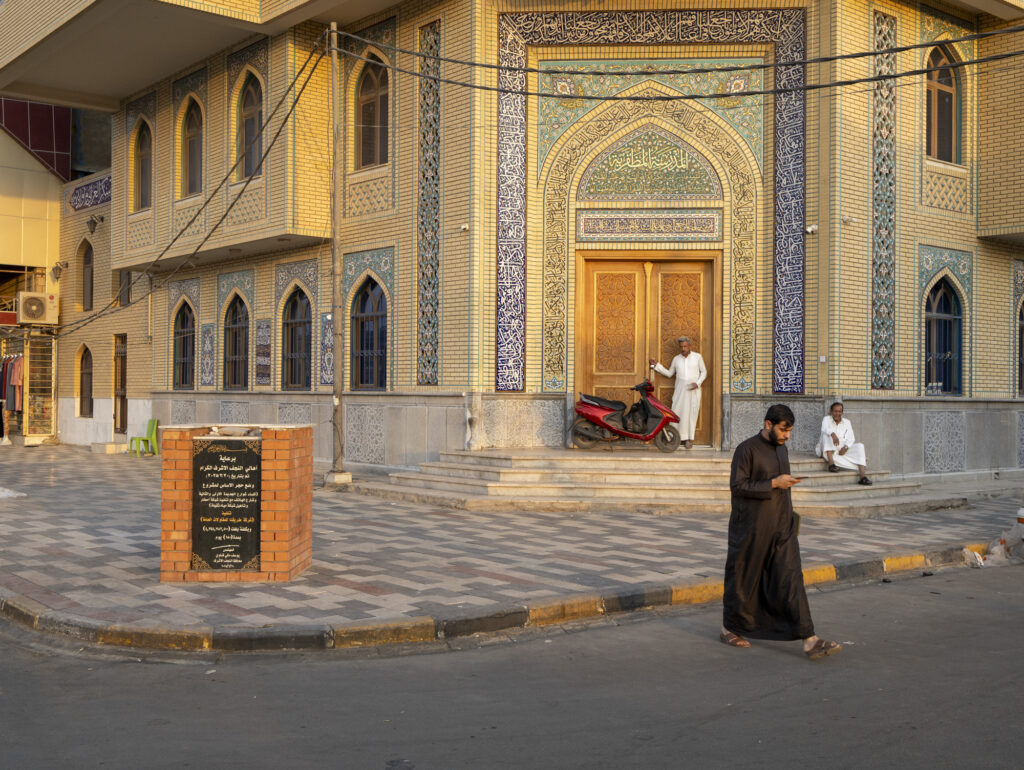
I get lost in the streets and enjoy doing so; places that seem a stone’s throw away on the map actually hide hours of walking. I’m running out of cash, and in Iraq credit cards don’t work for payment or withdrawal, except in lucky cases. In the south, they won’t exchange the Turkish lira I’ve stocked up on. I have to hope for Couchsurfing. I reach the transport terminal, and after refusing offers from taxi drivers asking for sums worthy of John Lennon’s wallet, I find a minibus that costs ten times less. I go to Najaf, the most important holy city in all of Iraq for Shiite Muslims, the third in the entire world after Mecca and Medina. Here rests Alī ibn Abī Ṭālib, first Imam for the Shiites, surrounded by an immense sanctuary adorned with decorations, gold, and mirrors that refract light into a million fragments. Entering the Imam Ali Shrine is like being swallowed by a divine kaleidoscope. Pilgrims move slowly, touch the silver bars of the Zarih, pray in a collective whisper that rises towards the domes like a single breath. Some cry, others hold children up so they can look inside, even closer to the tomb.
I let myself be carried by the current of the faithful, but when I approach the prayer areas, I step aside and observe. The air is dense with something that eludes the senses, that cannot be seen or touched, yet is perceived with absolute clarity. The sunset prayer begins. There are hundreds of faithful. The gold of the great dome mingles with the increasingly dark blue of the sky, broken by the light of the sanctuary. The men move in sync, a huge square where everyone repeats the same gesture at the same instant, guided by the words and chants of the Muezzin. I am with Kapo, a French cycle traveler I had been in touch with for a few days but had lost hope of meeting, thinking he was somewhere else entirely. He appeared instead in front of the entrance to the Sahn, the courtyard around the mosque, while security was detaining me for the second time after a policeman caught me photographing with my camera. Twice it was confiscated, twice returned by the shrine guards, complete with: “Sorry, he doesn’t know the rules. We apologize, go ahead.” A paradox: if it’s permitted in the courtyard area, inside the mosque it is strictly forbidden. With your phone, however, it is allowed.
Mystery.
Silent, we leave that magical place, briskly accompanied by security men equipped with dusters, which they use to move the flow and shift those in unsuitable positions.
With Kapo, we go to eat something; I delay, waiting for the man who accepted me on Couchsurfing to show signs of life. For two days, he has been replying extremely slowly, and although he already said yes, he still hasn’t told me where he lives or when I can come. I end up sharing a hotel room with the French friend.
In the morning, the fourth floor of the hotel pounds with the rhythm of Eros Ramazzotti and Ricchi e Poveri. Kapo is in love with all that genre of Italian music and has no problem blasting it at full volume from his speaker while preparing breakfast. The door and walls are thin, and the music easily spreads outside, audible even from inside the elevator. Kapo heads back south by bicycle; I, after a visit to the enormous mosque in nearby Kufa, return to getting lost in Najaf, rediscovering the labyrinth of the old city, where I finally find the underground bookshops, wedged between stone masses of buildings held up by iron poles and by who knows what divine grace. Among the dense shelves and wooden tables, piles of sacred books withstand time like ancient columns, enclosing the strength of knowledge, philosophy, and spirituality, of which the city is a transmitter. Najaf indeed hosts the Hawza, the most prestigious theological university in the Shiite world, founded around the year 430 of the Islamic calendar (11th century AD) and today led by Ayatollah Ali al-Sistani.
Leaving the shadow of the labyrinthine streets of knowledge, I return to the blinding light of the Shrine of Ali. Crossing the imposing entrance on the west side, I find myself in the courtyard dedicated to Fatima al-Zahra, daughter of Muhammad. It’s an immense complex, a true citadel within the city, designed to welcome and serve the pilgrims. And like one of them, I am immediately directed to the canteen for lunch.
Najaf, however, is not only the Shrine and the university. The city extends around like a gray and dusty cloak, but as soon as you turn the corner, you find Wadi-us-Salaam, the Valley of Peace: the largest cemetery in the world. For kilometers, as far as the eye can see, graves. Not the orderly ones of our Western cemeteries, but a dense tangle of slabs, bricks, small domes, some decorated with green and gold tiles, others cracked, forgotten. Here, Shiites from all over the world come to rest, to rise again near Ali on Judgment Day. Occasionally, someone prays in solitude beside a fresh grave, or a family gathers for the anniversary of a distant death. It seems like an inhabited city, but the living here are only passing through. It is estimated that more than six million faithful are buried here, while between 50,000 and 100,000 are added each year.
I continue to dive in and out of the old city, where I regularly receive sweets and fruit juices in exchange for some photos.
Walking, I cross paths with the black turbans of the Sayyid, the descendants of the Prophet, crossing the alleys of the covered bazaar. In the shop windows, next to ritual sweets and tea, necklaces with the effigy of Imam Khomeini, Iran’s supreme leader, and Ali al-Sistani stand out. His serious, almost severe face peeks out from every religious bookshop.
In the evening, when the sun sets over the desert and the dome of the shrine lights up first in pink, then gold, you understand why this place is magnetic. The air fills with the call to prayer, amplified by loudspeakers chasing each other from one minaret to another. The faithful wash their feet and hands at the fountains, then lose themselves in that sea of light. I slowly move away, heading for the minibus that will take me to Karbala, the second holiest Iraqi city.
As I walk on the still-hot asphalt, I am stopped by several people for greetings and a photo. I arrive at one of the largest and most chaotic intersections in the city, so confusing it requires the presence of traffic police to direct it. Yet even they, as soon as they see me, abandon their post to come take selfies with me and offer their greetings, leaving the cars in a dusty anarchy.
In the blue shades of the sky, I run along the 80 kilometers separating the two cities, a distance traversed every year by about 20-25 million pilgrims, during the sacred pilgrimage of Arba’in, the largest religious event in the world.
I arrive when a wave of colorful lights and honking, smells of food and smog, bursts from the darkness of the night: I am in Karbala. I pass the first level of checks, the one that, like in Najaf, allows me to enter the old city. Both cities require continuous passes through metal detectors and searches, divided into three steps, each increasingly severe and restrictive: one for the old city, one for the area surrounding the Shrines, and finally one for entering the mosques. Tension and fear of terrorist attacks are always high, so much so that even on the streets, a substantial number of people circulating are plainclothes policemen.
I arrive at my hotel, where the wifi only works in the entrance hall, forcing me to stop there for a while to reply to various messages. As minutes pass, more and more people start gathering, until at some point I find myself completely surrounded by elderly women. I immediately understand they are not Iraqi, because despite the hijab, they look at me, and after a while, they even start talking to me. Without a common language, we manage to understand that I am Italian and they are Iranian. They are a group of pilgrims visiting the holy cities. Within a few minutes, other women and men join. I get up to make room for them, but they invite me to sit on the floor on the carpets among them. Equipped with a microphone and amplifier, just over a meter from me, the Imam begins the prayer. The volume is extremely high, striking the eardrums so hard it makes the whole body vibrate. The people around me begin to follow the chants, rhythmically beating their hands on their chests. Suddenly, one after another, they begin to sob, then collapse into desperate weeping. The women hide their faces behind their veils, the men in their hands. Curled up in a small space between these people, I remain motionless, almost holding my breath, not understanding a word of what the Imam says, but at the mercy of the spiritual storm. When the men and women around me stop crying, without being able to say why at all, I also burst into silent tears.
The pilgrims invite me to dinner. Talking is very complicated, but courtesy often needs no common language. Two girls from the group keep looking at me, flashing smiles and giggles. A sort of flirtation, something that hadn’t happened to me for two months, and which I certainly didn’t expect to experience here.
The history of Karbala dates back to 680 AD, when al-Ḥusayn, grandson of the Prophet Muhammad and son of Ali, clashed with the army of the Umayyad caliph Yazid. Husayn was killed along with his loyal followers in a massacre that for Shiites represents the eternal symbol of the struggle against injustice. Here stand his Shrine and the one dedicated to Al-Abbas ibn Ali, his half-brother and loyal standard-bearer. In these places, I am guided by Hussein, a guy I contacted on Couchsurfing, who cannot host me but offers to show me around the city. In the mosques, he leaves me in the hands of another man: the director of the entire Shrine area. One of the most important and deeply knowledgeable figures in all of Karbala. Followed by other organizational figures and a photographer, he accompanies me through the museum where precious gifts brought to the shrine over the centuries by kings, princes, and important people have been collected. Gifts for Allah: swords, rifles, candlestands, plates, necklaces, fabrics. He told me about Saddam Hussein’s insane war, who in 1991, in a period of fury and repression against the Shiite world, had the mosques shelled. And then he accompanied me to the crypt of Al-Abbas, where he left me to get lost in the swarms of the faithful and the depths of that place of sanctity and marvelous architecture. Hussein then invited me home for lunch, where I met his wife Sarah, to whom, as a first instinct, I almost offered my hand. I quickly realized I had to pull it back, but not enough to avoid Hussein’s words: “Here, you don’t shake hands. Only I can touch my wife.”
For weeks, with my mother and sister, but also with people I met along the way, I had found myself discussing the role of women in Iraq. The shadows moving through Najaf, whose eyes were often not even visible through the burqa, had struck me deeply. Hussein’s words about his wife were another gust of wind on a fire of questions and reflections already burning since Turkey.
In the “Western world,” it is evident that we are less and less accustomed to spirituality, that the dynamics of faith and blind love for God are now something incomprehensible, distant. Concepts like renunciation, sacrifice, and devotion have lost their meaning and value when associated with religious faith. Obviously, this is not a discourse that applies to everyone, but probably to the majority of us. Conceiving, therefore, that someone can live in such an “extreme” way makes us fall into a short-circuit of misunderstandings, where in our eyes concepts of freedom and rights easily falter. But what does freedom mean? And what are rights? Who among us can claim to have absolute truth, to know the force that controls the world, to know the right way to live? Who among us knows exactly that God exists? And who knows the opposite? In every land and every culture, the answers will be different. It is therefore essential to stop and observe, to learn, to try to understand, long before reaching any conclusion.
As in all worlds, however, purity is only partial, stained without escape by the corruption that life itself brings. Faced with each of these worlds, moreover, if refraining from judgment is an essential part of knowledge itself, one cannot deprive oneself of asking questions. And in this case, I ask myself: where is the limit between divine love, and therefore the legitimate renunciation of many “freedoms,” and that which instead falls into the labyrinths of the human world, where the hunger for power dominates? That is: how much of the position of Muslim women (and men) is God, and how much is a comfortable position of control over them and their entire daily lives?
The flesh is weak, the mind too. All over the world, the craving for women is a driver of events; jealousy burns in the veins of cultures thousands of kilometers apart, with different deities and creeds. Possessiveness affects some more, some less: but how convenient it is not to have to confront, discuss, and possibly choose together what dynamics to have between husband and wife? Much more convenient, much easier, to have rigid pre-established rules and float on one’s privileges (a discourse that can be valid for many dynamics in every “world,” the Western one included. Even if in the negative, it’s always easier to judge others than ourselves).
In summary: probably the whole set of these customs fluctuates between two almost opposite worlds, which are however deeply mixed together, now in a way that is very difficult to discern. The answer lies in each individual person, in each family, in each village, city, and country. Only the woman knows how she feels, whether she is in love with God or suffering under the weight of society. The same goes for the man. The real obstacle is: how free is each person to tell themselves the reason why they live?
After being caught by a policeman yet again while taking a photograph, I give up on having images of Karbala and set off again northwards. Kapo, in Najaf, saved me from having a much more complicated adventure by giving me 100 euros cash (which I will repay online), so I can take another minibus. From Karbala, I jump to Baghdad; from there, I resume the road to Mosul. During the journey, as if the endless number of checkpoints and controls weren’t enough, I also undergo a real interrogation by a man sitting just behind me: he is somewhat annoyed by the time I, as a foreigner, cause at every stop. A toothless old man translates roughly, while fourteen eyes remain continuously fixed on me for an endless number of minutes. The usual questions, then the long hair, earrings, piercing. How much does that cost, how much is that worth. The thing starts to get stressful, also because the man’s manner is by no means reserved or respectful. After yet another dirty look and another half-answer, he finally falls silent. He looks at me and makes the zipping-the-lips gesture. The old man with the task of translating seems the most relieved of all to be absolved from his duty.
After nine hours of travel, the minibus drops me at the city gates. My hotel is about an hour’s walk away, but I refuse every offer from the taxi drivers who descend on me like vultures. I need air, silence, to move: to understand where I am.
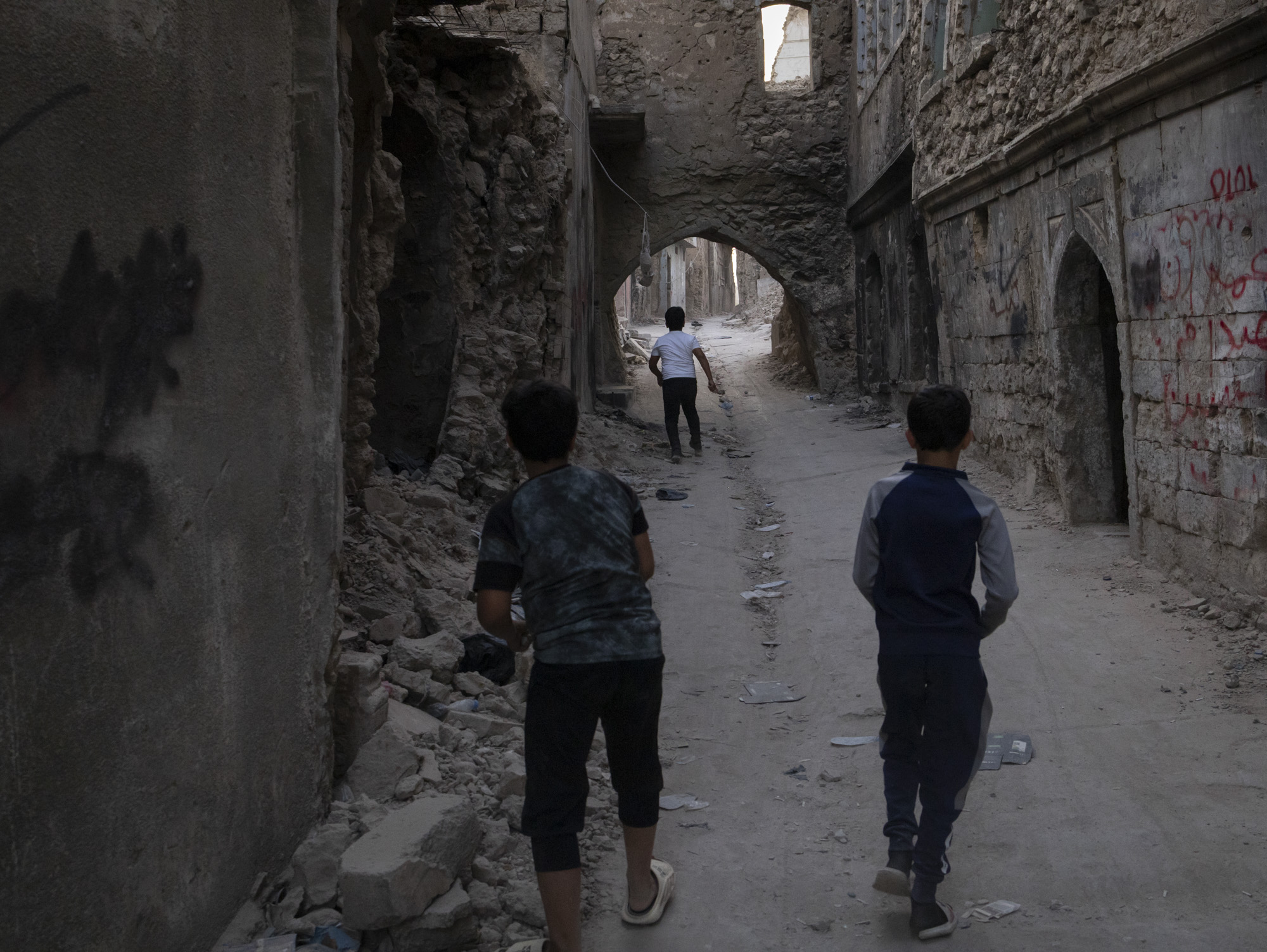
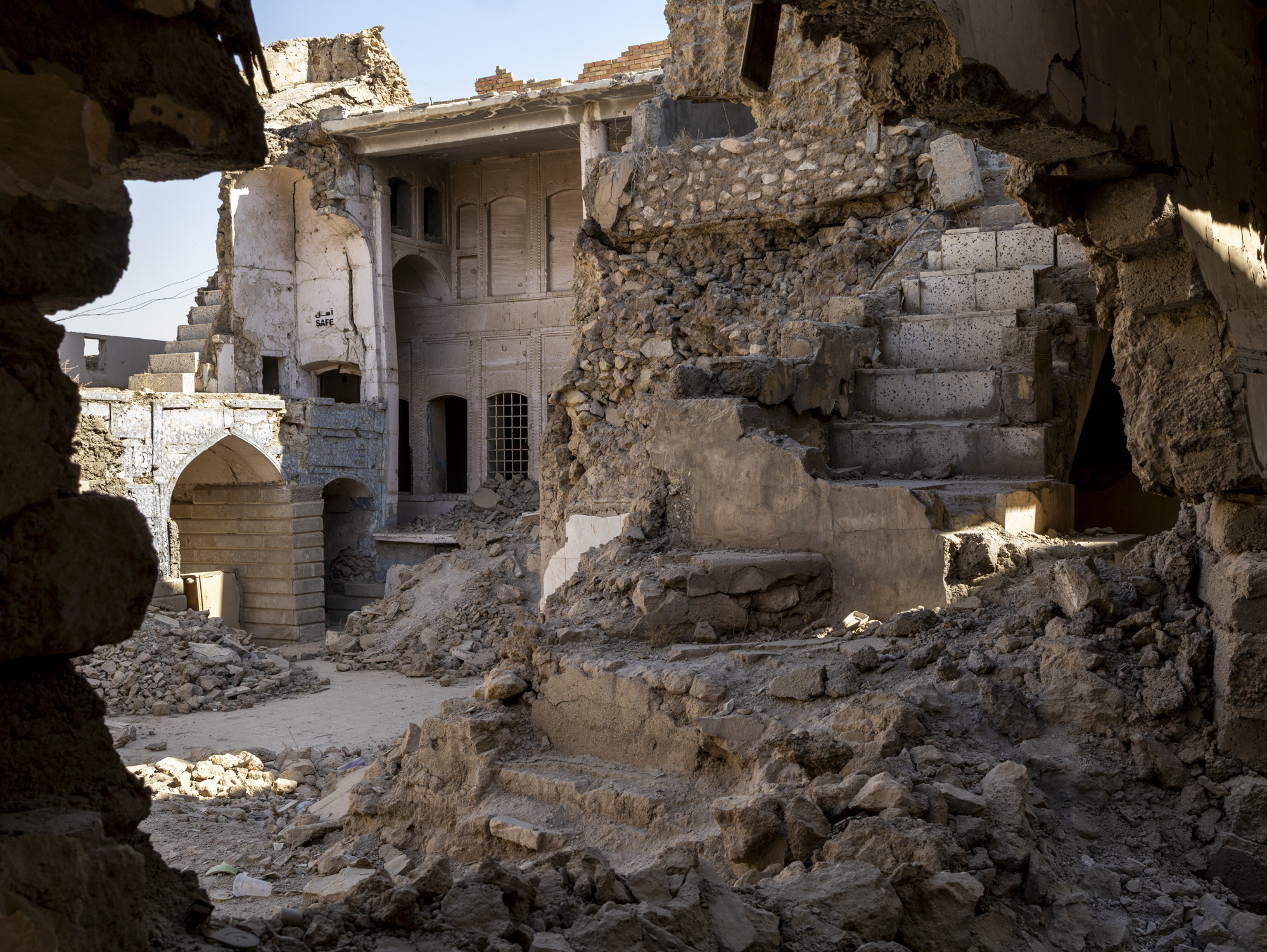
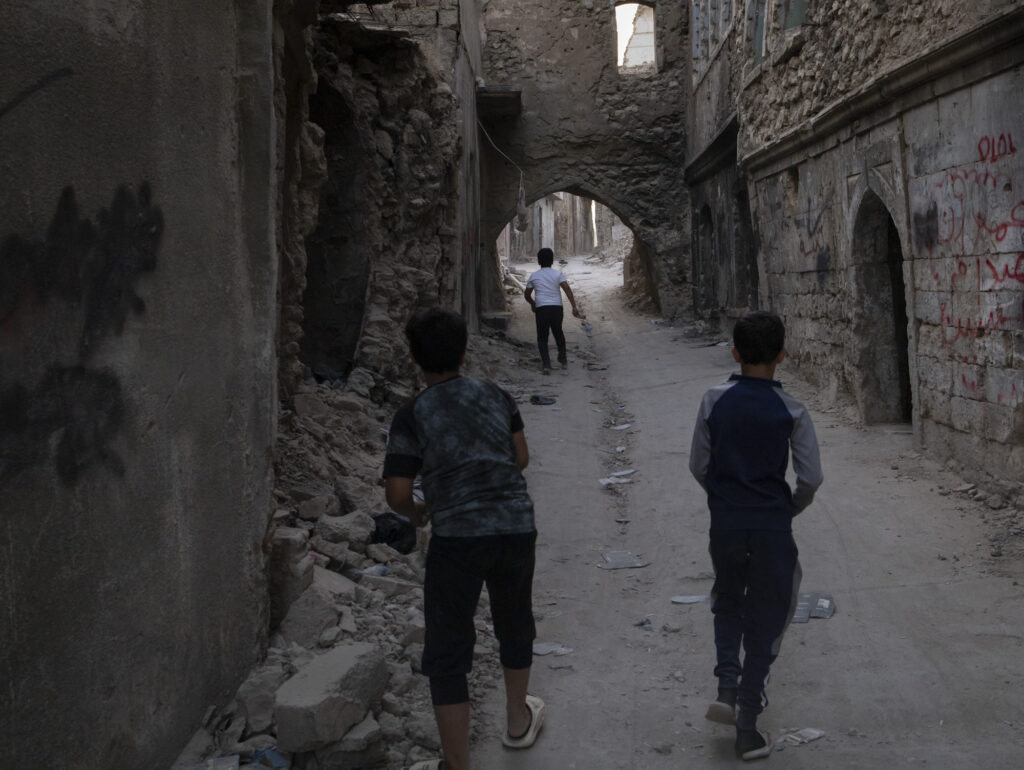
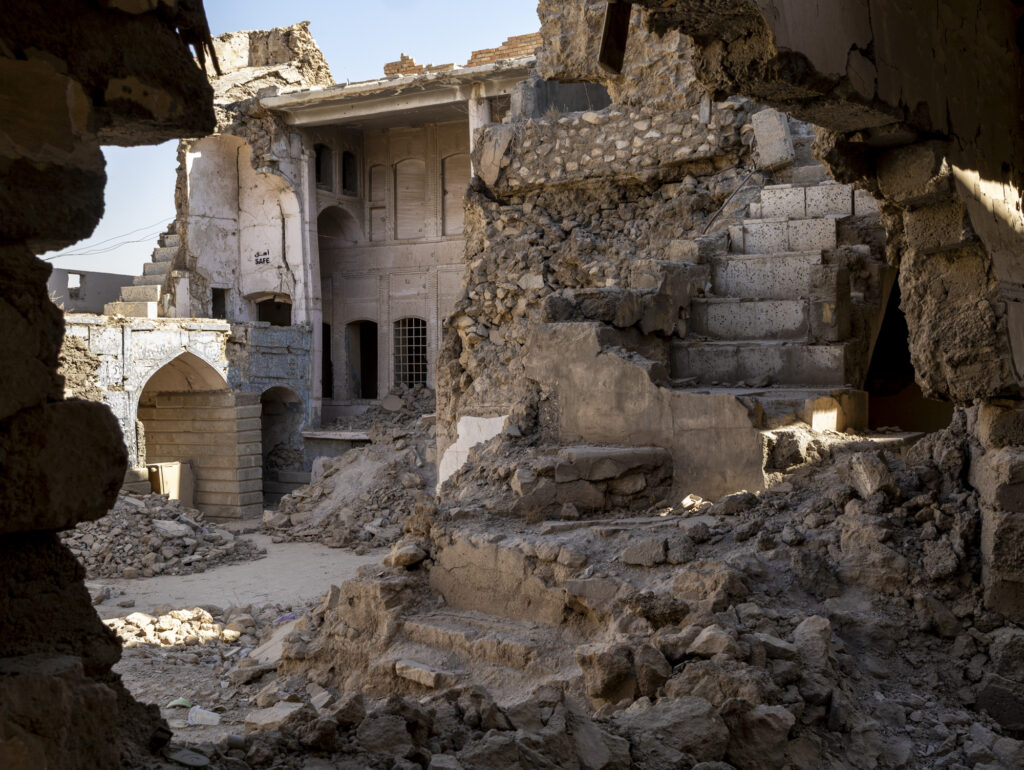
In Mosul, looking after me and showing me around is Mustafa, another guy found on Couchsurfing, waiting for me outside the hotel in an old white ’91 car. On the way down to Baghdad, passing through the city, I had been strongly struck by the number of armed military and police on the streets: a patrol or an outpost every few hundred meters. With Mustafa, however, I discover the more human, everyday, living side of the former capital of the Islamic State. Mustafa is particularly keen on introducing me to various symbolically important people, especially among the older, more respectable men. The first he presents is Noor Al Deen, a craftsman who works with copper and brass, who had the honor of rebuilding the top of the leaning minaret, the city’s symbol, destroyed by ISIS. Right after, we meet Ismail, a beekeeper whose family has carried on the trade for three generations. During the war, his small shop, wedged between the metal shacks of the bazaar, was destroyed. Little by little, however, he rebuilt it and brought his story of fine honey back to life. Amidst half-destroyed and rebuilt buildings, we cross the fish market, then emerge into the heart of the old city. In these streets, during the siege by American, Iraqi, and Kurdish forces, ISIS had entrenched itself deeply, using the narrow passages as protection. Despite the tactic of filling every occupied building with several civilians, hoping thus to halt enemy bombing, the old city remains to this day a pile of rubble. Today’s inhabitants are mainly packs of stray dogs, while the shadow of cranes falls from the surrounding districts amidst an intense clamor of hammers and bulldozers.
Mustafa guides me inside some bombed-out houses. Often the word “safe” appears, indicating an area cleared of unexploded bombs. I wonder: “And in all the places where it’s not written…?”
As we climb over piles of stones and gutted walls, he tells me about the war years, when he was a teenager: “I live on the east side of the city, the one liberated first. For almost two years, though, I practically never left the house. I watched movies, read books, learned English. Outside was too dangerous, even for an Arab. Your beard isn’t long enough, you don’t have the right clothes: they’d easily find a reason to arrest you. It wasn’t even hard to get killed for little reason, executed right there, on the street.”
During the occupation, the city was darker than ever before: a lit house meant a house inhabited by someone powerful, and therefore a likely target for fighter-bombers. So, for almost three years, Mosul’s inhabitants spent their nights gathered in the dark, sometimes enjoying the moonlight for those luckier enough to have a courtyard. At other times, simply enveloped in the terror of the darkness.
We visit the great mosque and then proceed through other alleys, until Mustafa says to me: “Back here, there’s a corner that feels like Italy!” I actually agree, but what surprises me most is that right there, in that small square, there is even a group of Italians. I recognize them from afar, without even hearing them speak. I approach and attempt a “ciao.” In the most unexpected place, I find myself drinking coffee with compatriots, who are on a one-week organized tour around Iraq. Nice and disorienting at the same time: I feel like I’m part of the same world yet living in a different one. What are they doing in “mine”?
Mustafa leaves to go home; we arrange to meet later. To let him go peacefully, I lie, saying I’ll also go back to rest at the hotel. His sense of hospitality would lead him to continue with me if I wanted to stay out. I return to the old city. This time I want to wander alone, or let fate lead me to new chance encounters. And so, shortly after, a gang of children enlists me. Excited by my presence, they drag me through the streets, where in some parts, houses are still lived in, including theirs. A friend comes out of a door to walk the dog, just like in the most normal of situations. Then we head towards the Tigris, where from atop the embankments and amidst the large reconstruction sites, we go to throw stones into the murky, algae-filled waters. The rhythm is childish, though, and soon we find ourselves again among the ruins of the old city, where first we flee from a pack of large, fierce dogs, only to counterattack with stones and sticks. Now we are the ones chasing them. It seems absurd to be fighting a battle in such a place, but when you’re little, you can truly play at anything, and the only world that exists is the one you have. Every now and then, around a corner we run, a sign appears: unexploded mines, do not enter. We end up throwing stones at each other too, then, on tiptoes peeking under a window, spy on the bar where the older kids can play pool. The social categories must be more evident than I can recognize, or the band of little kids is more famous and disreputable than I know: the fact is that on more than one occasion, the group is sent away, whether from the pool bar or from other shops along the streets.
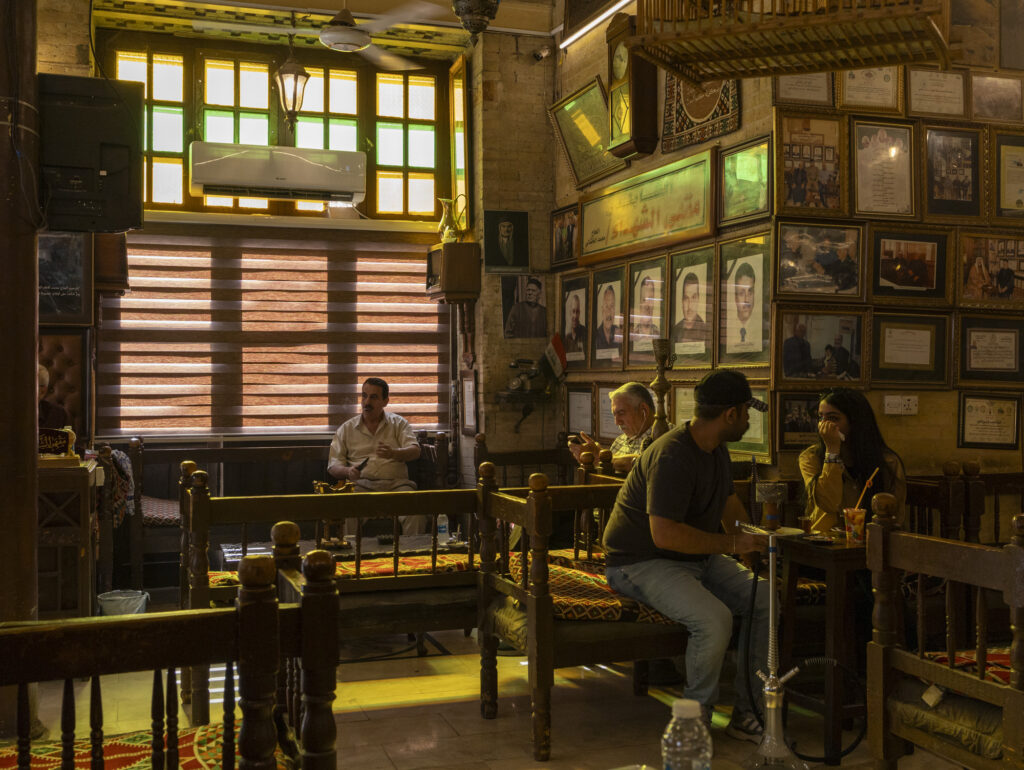
I lose them when I’m invited to visit a government building where civilians hid during the siege, and where mortar and cannon fire showed no mercy to the upper floors. Finally, I find Mustafa again, with whom I enjoy the last evening hours. The streets, even at night, are full of crowded cafes. Some drinking tea, others playing cards or chatting: Mosul is extremely alive. And there are so many lights on.
Leaving Mosul turns out to be more complicated than I thought. To get back to Duhok, which is less than 80 kilometers away, I try hitchhiking, but the experience proves literally ridiculous. Almost comical. Many people stop to help me, but the concept of what I’m doing is simply incomprehensible. Some pick me up to take me to a “better” area, which turns out to be better only from a socio-architectural standpoint, rather than good for finding a ride. Others, without understanding, take me to where the taxis leave from. Someone gives me a ride just for the pleasure of chatting with a foreigner. In a pizzeria, they play Italian music at full volume and offer me lunch, but the repeated subsequent “help” continues to do nothing but make me go in circles. At the umpteenth ride that brings me back to a shared taxi stop, with the sun now heading for the horizon and my energy half drained, I decide to give up. I take the shared taxi.
I’m on the road to Duhok, to Kathleen’s house, which in Iraq I now truly feel as “home.” This country, however, has taught me that not even while sleeping can I be immune to surprises, let alone during the day. And so, even in these last kilometers, where I’ve now relaxed and think of nothing but the sofa, another chapter lies hidden.
“Are you engaged?”
Sitting next to me, in the back seat, is a woman completely dressed in black. Coming from Mosul, where I practically don’t remember seeing any women, I’m taken aback by such assertiveness. Her name is Nur, and I discover she is Kurdish, which explains the confidence in talking to a strange man. We talk using a translator, partly because she doesn’t know English, partly to avoid being overheard by those sitting in front. “Do you like Kurdish women? And do you like talking to a Muslim woman? How does it feel? Christians and Muslims are the same, we are human, we are brothers.” She tells me she has four children. The youngest lives in Mosul with his father. The other three, now teenagers, are in Germany, where she lived for ten years. Her residence permit, however, expired and she was sent away. The children were placed in foster care, and she hasn’t seen them for two years. Now accustomed to German life, she hates being in Iraq, can’t wait to leave, to feel “free” again. But above all, to be with her children again. Amidst the various chats, she invites me home to meet her father and brothers, which I accept, and so, once we arrive in Duhok, I get off with her.
At home, I am welcomed like a son: Baba, the father, covers me with kisses on the head. He will continue to do so for the entire time I stay with them, adding kisses on the shoulder, hugs, and smiles. He’s quite tall, with a long white beard that hides a deep and sincere gaze. I meet Zeid, Nur’s brother, returning from work. He’s a mechanic, and is now the only one supporting the whole family, with very little money. I also meet Dunia, his wife, and Musah, their son who turns three today. Baba meanwhile keeps bringing me things: he dresses me in a jacket, puts various hats on me, gives me a necklace. The house is very humble. It’s built around a courtyard and consists of one bedroom, a small bathroom, a laundry room with a shower, a kitchen, a living room, and a storage room. None of the rooms are connected to another; you have to go outside every time to move from one space to another. I think about winter, when it’s not uncommon for it to snow on the surrounding mountains.
We have dinner together, and as is the custom, they make me eat excessively. Then we go out; they want to take me to taste other things. Zeid’s car is the classic beat-up jalopy from the movies, extremely stereotypical, with the exhaust popping, sinister engine noises, and far more noise than speed. My stomach starts to suffer; the questions return cyclically: “Are you married? Would you like to marry a Kurdish woman?” Not satisfied, we stop to get a cake for Musah, which we eat just before going to bed. A truly wise choice, so much so that when I lie down, I feel like the food is coming out of my nose. Baba, as usual, is extremely tender: he gives me three mattresses, three pillows, and two blankets. He also brings me water to drink. Essential, since I spend the night sweating.
In the morning, we pick up where we left off. Eggs fried in goose fat for a mega breakfast worthy of a guest. Nur starts again: “Would you like to go for tea or coffee together in the coming days and get to know each other? If we get along, then we could go to Germany together.” Very kindly, I explain that I’ll be leaving again in two days, that I live on a bicycle, and my home is a tent. I’m not going to Italy, much less Germany. I’m not even going to Europe, but towards India, and I’ll be at it for at least the next two years. Maybe more. She’s disappointed, but seems to drop it. Shortly after, we all go out together: we go to the center to buy meat that Baba, every day, takes to some stray dogs. While Baba and Zeid are in the shop, we wait in the car, and this time it’s Dunia’s turn to start the spiel: “Are you married?” Oh god. “Would you like to settle down somewhere? No!? Why don’t you try getting to know Nur and see how it goes? Maybe you’ll like it and you can go live in Germany together.” Help. I’ve slept little and the pressure is starting to get challenging, also because they are extremely kind otherwise, and because Nur’s story is very difficult and touches me deeply. My generosity, however, doesn’t go that far. Luckily, the men arrive and we leave again. We slowly reach the area where the dogs are, while tension has risen slightly in the car due to my refusal. Baba gets out and starts whistling. We’re in a peripheral market area, with huge piles of rubbish. From various ditches and piles of wood and sheet metal, a multitude of dogs start appearing. Baba whistles, the dogs appear, run, greet him. I count about twenty, almost all large breeds.
We return home. This time we really say goodbye. I’ll stay only with Baba and Zeid, who want to help me fix the rack, which unfortunately Nirari, the Assyrian friend, couldn’t get repaired. It’s made of aluminum and needs a special welder, not very common. Along the way, we stop at a mechanic’s, where they want to show the car before accompanying me home. We stop for a while, so I also get out of the vehicle and sit among the Kurdish mechanics. No time to get distracted before the mechanic sits in front of me and starts, also: “Are you married? Girlfriend? Why don’t you find yourself a Kurdish wife? You should!”
No one can fix the rack, but the farewell with Baba and Zeid is very warm and sincere.
The “breakdown,” however, opens the future to new scenarios: it’s the third time I’ve arrived at this house, and each time I’ve stayed longer than I thought.
How long will I stay this time?
For now, though, I’m back on the sofa. Finally.
______________
- If you’d like to support my project and read more stories, articles, and see photos, send me a contribution here!
If you have any stories, situations, or places you’d like me to share, please write to me! –> emibarbieriphoto@gmail.com
The Images
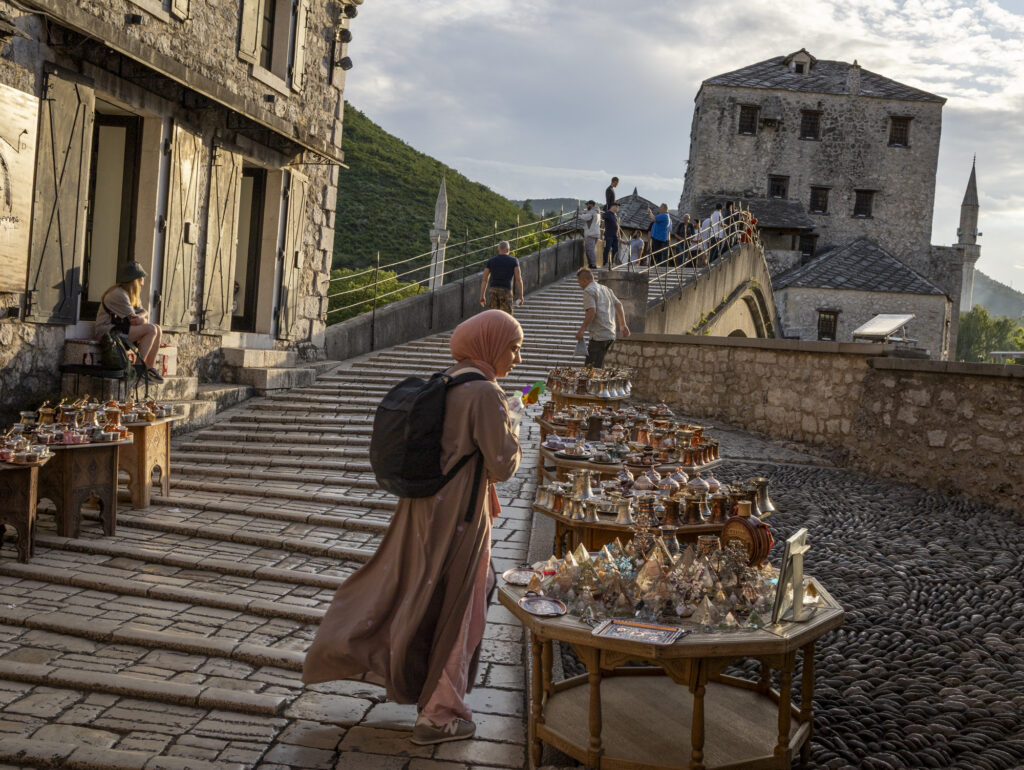
1 – Najaf, Iraq
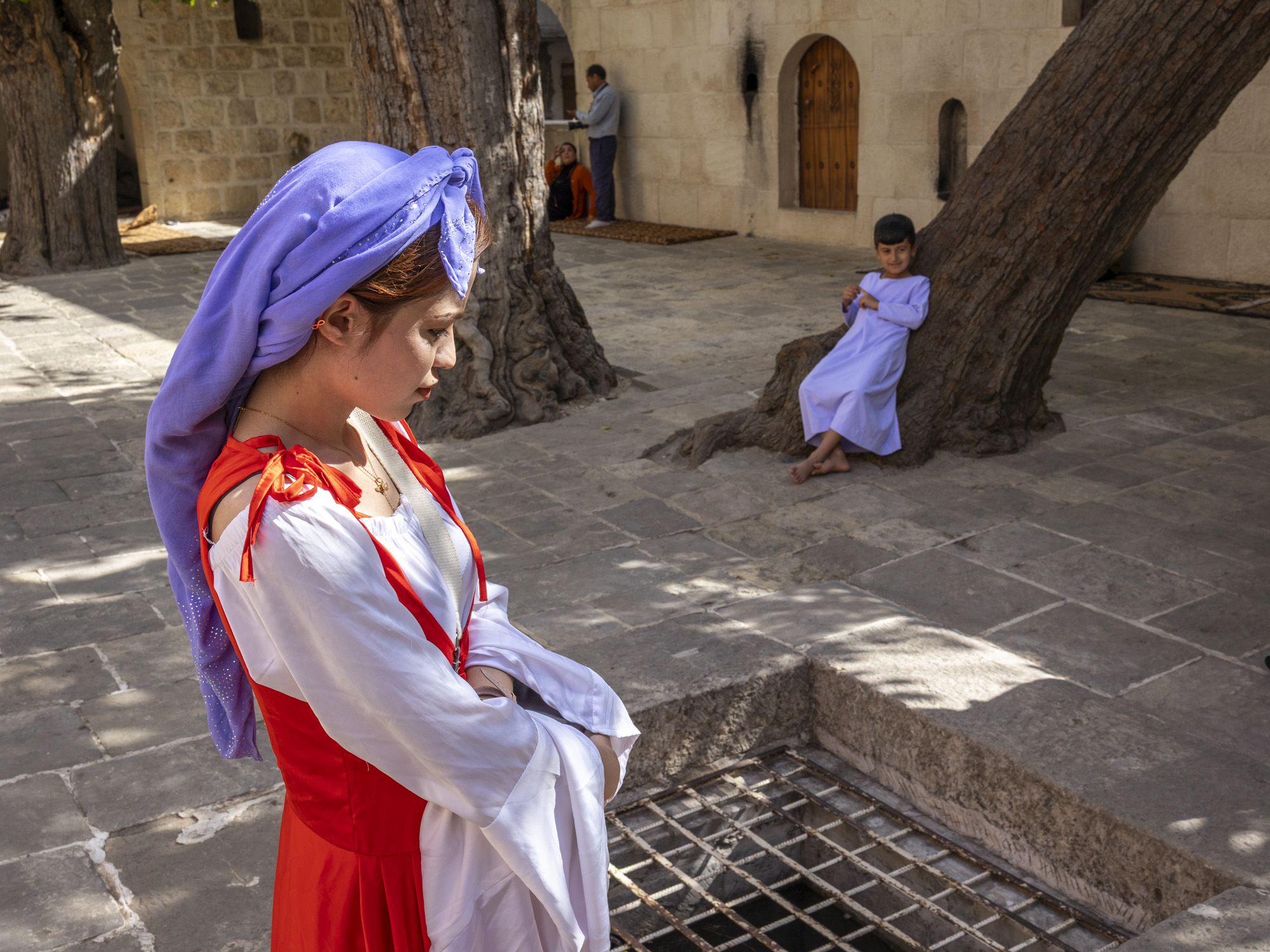
2 – Lalish, Iraqi Kurdistan (KRG)
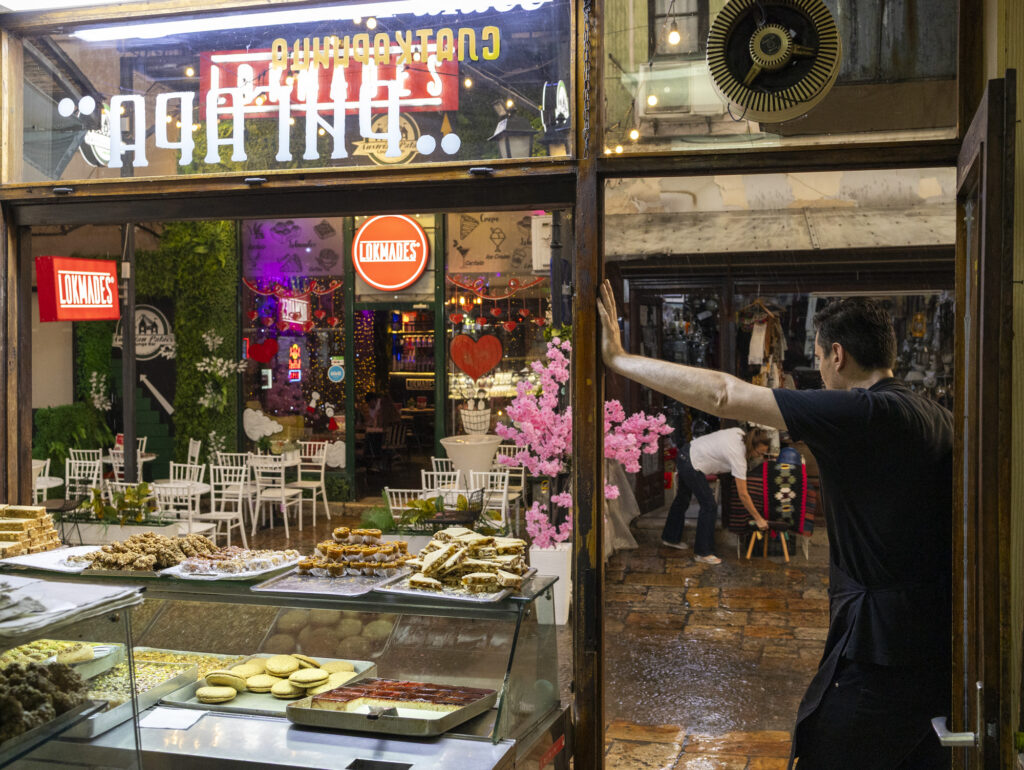
3 – Mosul, Iraq
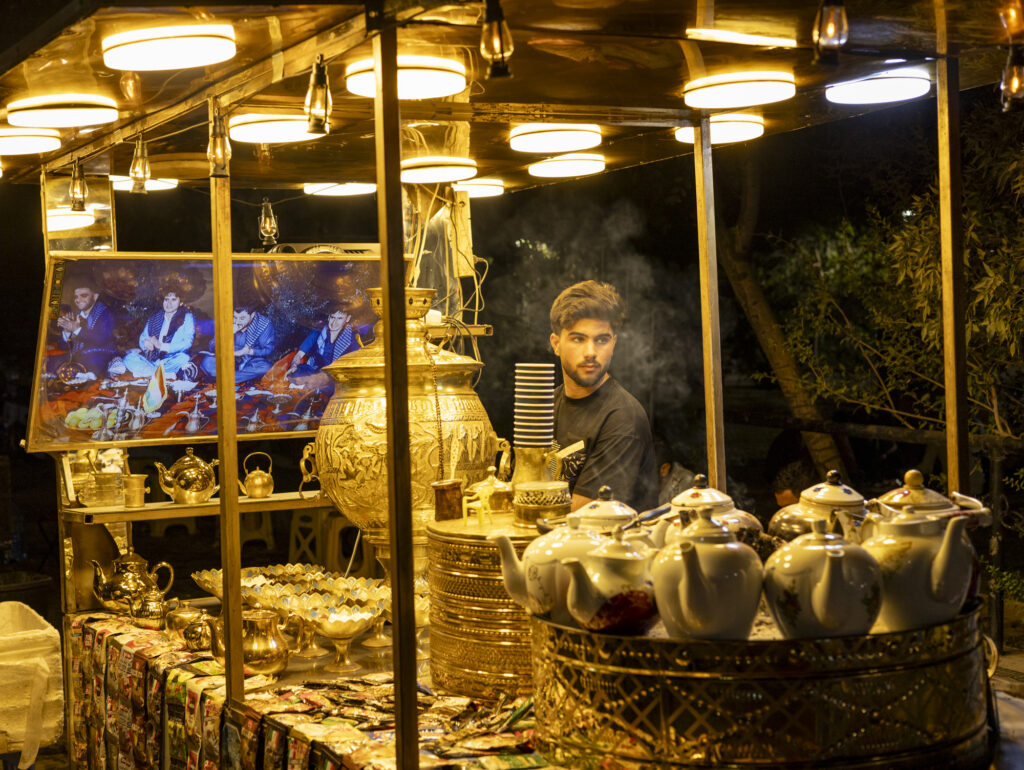
4 – Ranya, KRG
5 – Sulaymaniyya, KRG
6 – Sulaymaniyya, KRG
7 – Dukan Lake, KRG
8 – Dukan Lake, KRG
9 – Lalish, KRG
10 – Karbala, Iraq
11 – Najaf, Iraq
12 – Baghdad, Iraq
13 – Rawandiz Canyon, KRG
14 – Mosul, Iraq
15 – Baghdad, Iraq
16 – Baghdad, Iraq