1 — Entering Afghanistan
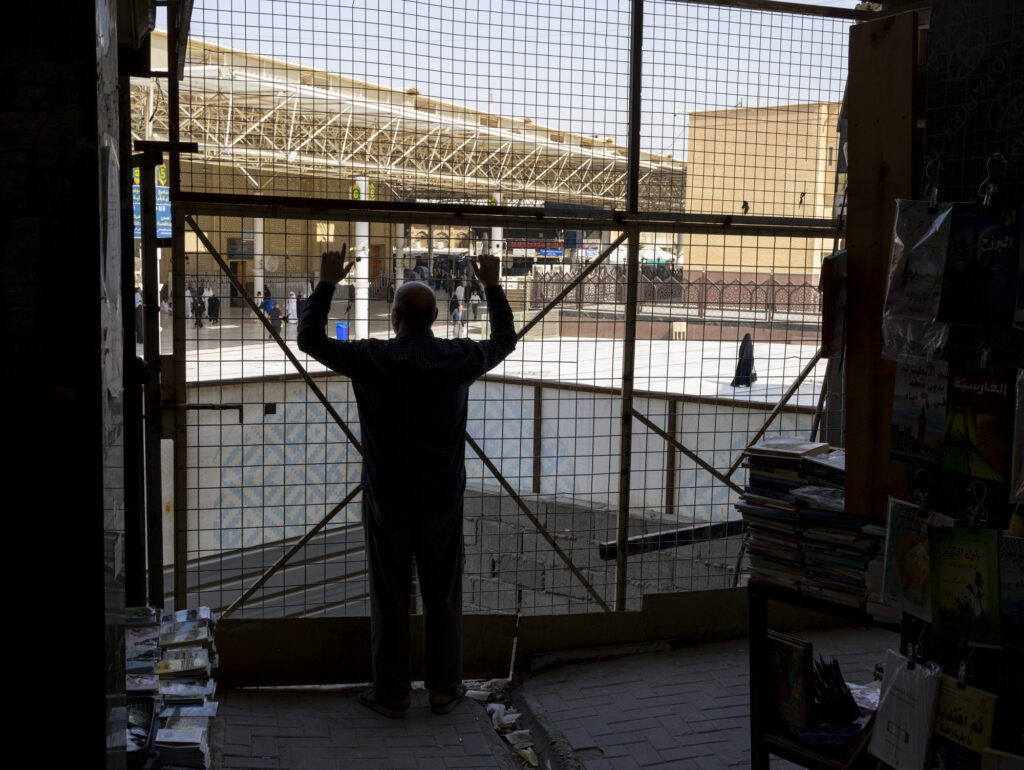
In the sand skimming across the road, driven by the wind, you leave the border behind — and its little chai room — only to find yourself, a few kilometres later, exposed in the middle of the desert. Dust clings to the turbans people use to cover their faces, catches on the hides of goats and sheep, stings the eyes and smudges the black kohl around them. There is barely enough time to wonder how long it will take to find shelter before the first curious locals stop to offer help, to invite you into their homes. A moment later, you are shaking hands with a smiling, bearded man who carries an AK-47 slung from his arm.
The only word that comes to mind when I think of Afghanistan is: intense.
There is no respite, no emptiness, no silence. People are everywhere, fighting their way through life with thermoses of green tea, always keeping an extra glass ready in case a guest arrives. The problems and images you encounter linger in the mind, even where a small stream flows and birds whistle among the trees. The mountains rumble where engines do not, ready to crumble and reshape the landscape within a matter of hours.
Afghanistan holds pain, often hidden behind smiles that shine with disarming sincerity. It holds scars that have no time to heal, because new ones must constantly be avoided. There may be nothing, yet there is always someone. Even fear is never alone; it is always accompanied by hope. Hope of surviving, of finding work, of leaving. Hope that somehow God will put things right. All that remains is to wait.
Sometimes the doors that open lead to a new life. Other times, to paradise.
You never know whether a late-night visit — flashlights illuminating rifle magazines in the darkness — is meant to bring you in for questioning or simply to shake your hand. You never know whether beneath a field of flowers the anger of the past still sleeps, waiting to silence the future.
2 — A Passport Without Borders
“Can you help me?”
Like a persistent hum, an echo that never quite fades, this question rings out day after day. Not only since 2021, but for nearly sixty years. According to the Henley Passport Index—the ranking of passports by their freedom of movement—Afghanistan sits at the very bottom of the global list. For decades, the struggle to escape in search of a better life has been a defining feature of existence for countless Afghans.
Legal pathways are virtually nonexistent. Illegal ones are fraught with extreme danger and hardship, often ending in deportation—or worse, death. It is like trying to climb a sheer vertical wall with bare hands, where only the luckiest find a crack wide enough to let them pass, a pair of eyes willing to see them, ears willing to hear them.
From the Soviet invasion of 1979 to the present day, there has been no real pause. The civil war, the first Taliban Emirate, the American invasion and bombing campaigns, and finally the Taliban’s return in 2021. Every generation has had its own exodus.
Historically, Pakistan and Iran have been the easiest countries in which to seek refuge, though reports of discrimination and humiliation have long been widespread there as well. Since the Taliban returned to power, however, even neighbouring countries have launched large-scale deportation campaigns. Afghans are often viewed with suspicion—seen as poor, unstable, and a threat to security. Raids, arrests, and deportations have become commonplace, affecting even people with valid documents and families that had lived in those countries for decades. Men and women born there, people with jobs, children attending school. In the last three years alone, more than six million Afghans have been forced to return, according to UNHCR figures.
My phone rings constantly. WhatsApp messages arrive in endless waves. Many people greet me warmly, but sooner or later the inevitable question comes: “Can you help me get to Italy?” Me—the man who arrived on a bicycle and lives in a tent, driving its pegs into the soil of a long list of countries. Me—the one who chose to be here of his own free will.
“How many countries did you cross to get here?” they often ask, with a mixture of amazement and weary envy. My answers have become tired, drained by the constant effort of searching for possibilities in a field that is completely empty. Because in 2026, being Afghan means living on a planet detached from the rest of the world. It means being somewhere while longing to be elsewhere. It means knowing what lies beyond without any way of crossing the distance. It means walking endlessly, fingernails breaking against the walls of a glass cage.
There are no legal routes into Europe. No legal routes out.
And yet the world is right there. Cousins live there. Friends live there. People who, like me, simply arrived one day from somewhere else.
Sometimes, for those who have spent many years abroad, even their own homeland no longer opens its arms to them. Men and women who no longer belong anywhere, foreigners in the only country where they are allowed to remain. Like Ibrahim, who was forced to return after sixteen years overseas and now lives rejected by his own family. “They think I’ve become a Christian, and they hate me for it. When I came back, my father threw my passport into the fire and burned all the documents I needed to return to England.” He had nine children, but two died because medicine never reached their village. “At home they call me a fake Muslim. I’m desperate. I’m trying every possible way to get back to Europe. But soon I’ll leave. I’ll make it. I’ll migrate again. And this time, I’ll take my children with me.”
For days I kept thinking about Afghanistan.
In the end, though, I realised that there are two things for which I am most grateful: the chance to know this country—and the freedom to leave it.
3 — The Everyday Face of the Taliban
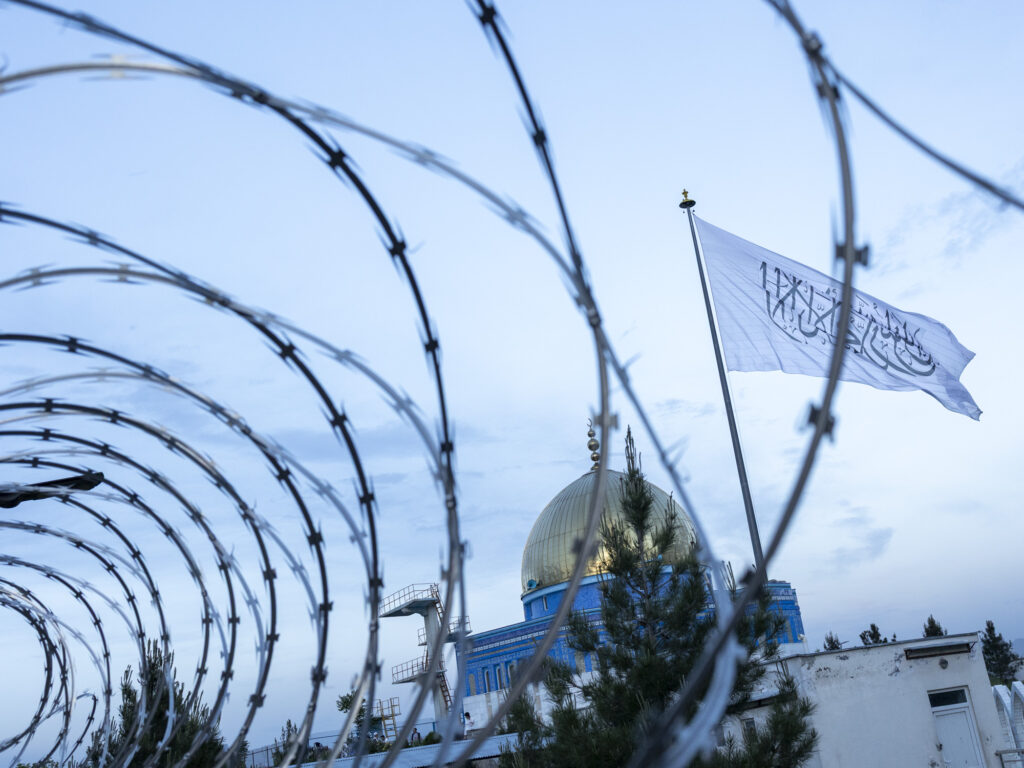
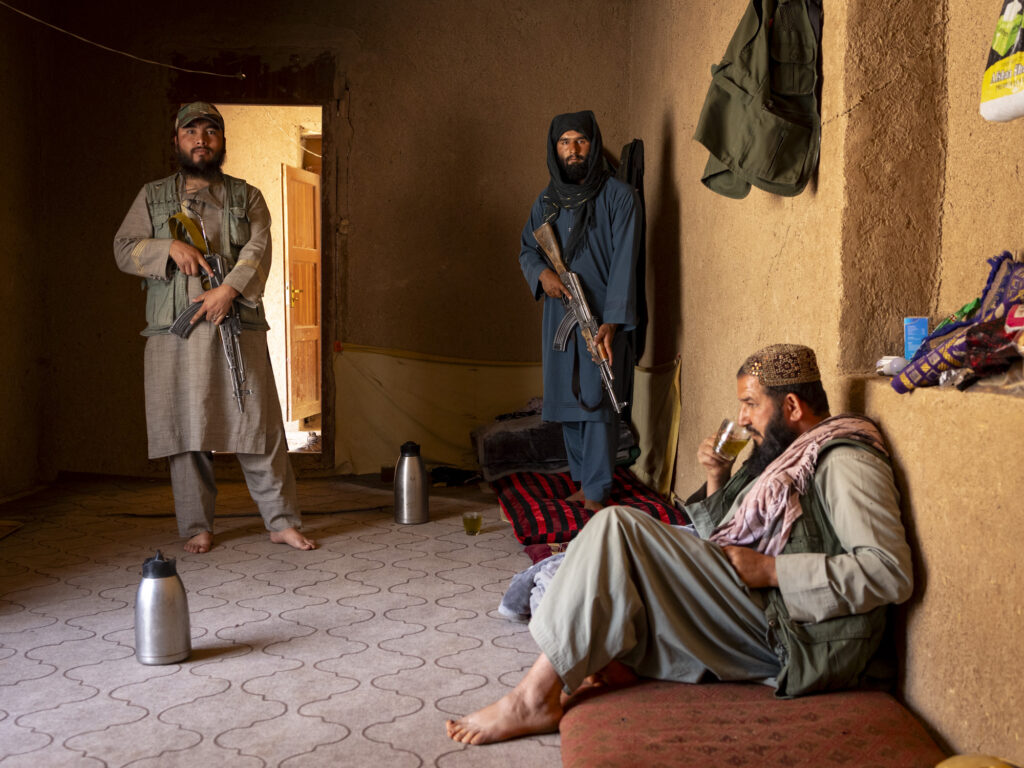
When, from a distance, you see a smile gleaming beneath long hair and a thick black beard, waiting impatiently and waving you over to stop, you do not know whether to trust the smile or pay more attention to the rifle that comes with it. When balaclavas and scarves conceal the only clues you have to decipher the kind of welcome awaiting you, the only card left to play is the one you know how to read yourself: smile.
The Taliban are an almost impossible figure to decipher: the image—and often the arm—of an extremely rigid and repressive administration, yet also men who, in 2026, are increasingly curious about the outside world. Men who poke their heads out of the bunker and, between cups of tea, bombard you with questions. Above all, they are sons of the Pashtun people, an ethnic group for whom hospitality is among the most sacred of all values.
Originally little more than a movement of religious students, the Taliban emerged in 1994 promising to restore order and peace to an Afghanistan torn apart by civil war, where murder, robbery, and rape had become part of daily life.
Mullah Omar was their first leader—formally a president, in reality a spiritual guide who governed through an extremely strict interpretation of Sharia, where religion, morality, and everyday life became inseparable. His vision was shaped as much by Islamic tradition as by Pashtun tribal culture.
What happened thirty years ago echoed once again in 2021, when the Americans left Afghanistan. They left behind a country where part of the population feared the return of the Taliban, while another part saw in them a promise of order, security, and shared religious values.
Today’s administration is undoubtedly different from the one that ruled in the past. Back then, the world was a tightly sealed box, and the minds of those in power moved within the same confines. Today, the gates of information are infinitely more open. Smartphones are everywhere. Afghans observe the outside world in ways that were once unimaginable. They know, they hear, they see. And what is true for ordinary people is equally true for soldiers.
It is not uncommon, between a Kalashnikov, a passport check, and a cup of tea, for Taliban fighters to ask for your Facebook account or express surprise that you do not have a YouTube channel or a TikTok profile. In 2025, the government imposed several internet blackouts and restrictions, officially to combat content deemed immoral. Yet it quickly became clear just how dependent Afghanistan itself had become on the web. The authorities were forced to acknowledge that controlling the internet is now almost impossible, even in a country where signal is scarce and connectivity often poor, but where nearly everyone carries a phone.
As information has become harder to contain, so too have Afghanistan’s borders become more open to foreign tourists. In the past—and to some extent still today—one of the Taliban regime’s main concerns was preserving the purity of the country by keeping out anything that might contaminate it from beyond its borders.
Taken to its logical extreme, the reasoning is similar to the way some parents forbid television because it fills the mind with nonsense and distraction. In this case, however, the threat is perceived to come from a West overwhelmed by capitalism, seen as morally corrupt and the bearer of values many Afghans regard as deeply harmful. For many, it is a world that presumes to decide what is right and what is wrong while looking down on Islamic culture with arrogance. “Why should we become like you? Who decided what is good and what is bad? What makes you better than us?”
Today, however, filtering out all of this is no longer possible in the way it was thirty years ago. And the Taliban, being human, are gradually succumbing to the same curiosity that the wider world inspires—whether for better or worse. The doors to difference have begun to open.
A tourist brings money, but also carries a potentially dangerous cultural baggage. At the same time, a guest is a source of immense honour. In Pashtun culture, hospitality and revenge have long existed side by side as absolute values. There is nothing more sacred than receiving a guest. Blood may be shed for a feud, but it may also be shed to protect a stranger welcomed into one’s home.
And so I often find myself meeting men who still proudly describe themselves as mujahideen—fighters in a holy war—who shake my hand and declare: “I am completely at your service. You are my guest. As long as you are with me, you will have nothing to worry about.” A roof, tea, and food are never lacking. “Now you are safe!” they tell me with pride.
Forms of censorship remain widespread. Journalists and media continue to face restrictions, as do music and dance, often accused of corrupting Islamic purity. Yet from the regime’s perspective, the issue is not art itself. The concern is that after decades of war and isolation, much of the music, entertainment, and popular culture available in Afghanistan inevitably comes from abroad—and therefore from that same corrupting world believed to erode the hearts and souls of the faithful.
Many people suffer because of these policies, especially those who have lost their livelihoods and now struggle to survive. Combined with many other restrictions that are difficult to accept, the burden is considerable. Yet it is also true that Afghanistan has not been this safe in decades.
Whether they support the current government or oppose it, many people acknowledge the same reality: “Four years ago it would have been impossible to travel these roads. You could be robbed, kidnapped, or worse—killed.” You hear it repeated in the mountains, in villages, and on the outskirts of cities.
Even for women—the primary victims of a deeply restrictive system—daily life has changed in some respects. Before 2021, robbery, violence, and abuse were constant fears in many parts of the country. Today, many people say they feel safer walking the streets. A small drop of comfort in an ocean that remains difficult.
The Taliban are everywhere, woven into daily life. Checkpoints, motorcycles buzzing endlessly along the roads, outposts hidden among the earth and rock of narrow gorges. It is rare to go a day without seeing a rifle. In my experience, it has never happened.
Encounters are constant and reveal a remarkably broad human landscape. More often than not, they involve men who are courteous, helpful, and curious. Among younger fighters especially, questions come in a flood: love, women, Christianity, the prayers of other religions, foreign customs, food.
Most of the time, this curiosity is accompanied by genuine respect, whatever the answer may be. Personally, I rarely filter myself. I speak openly about women’s freedom, Christianity, and love outside marriage—subjects that are hardly comfortable. Only once did an older officer look at me with visible disgust and walk away. Sometimes they have tried to convert me to Islam. More often they have simply listened before sharing their own opinions.
I have been afraid. One night, thirteen armed men woke me by shining flashlights into my face and surrounding my bed. They questioned me for more than twenty minutes. I have also laughed sincerely. At a checkpoint, I handed my camera to a commander who immediately began tormenting his companions by taking the most intrusive photographs imaginable. Then he dressed me like them, loading me with ammunition and pistols for pictures.
Of course, the treatment of a foreigner is undoubtedly different. More than once I have seen men behave with excessive harshness and arrogance toward fellow Afghans. For that reason, drawing clear conclusions is difficult. Understanding where appearances end and reality begins is rarely straightforward. Still, something has changed. Music sometimes drifts from cars and motorcycles. Shakira appears on the national sports television channel, bringing her Latin warmth into Afghan living rooms. Increasing numbers of foreigners are finding the courage to visit the country, inevitably bringing change with them. Most importantly, after forty years of war, many people are now able, for the first time, to make it home alive.
4 — The Hazara People
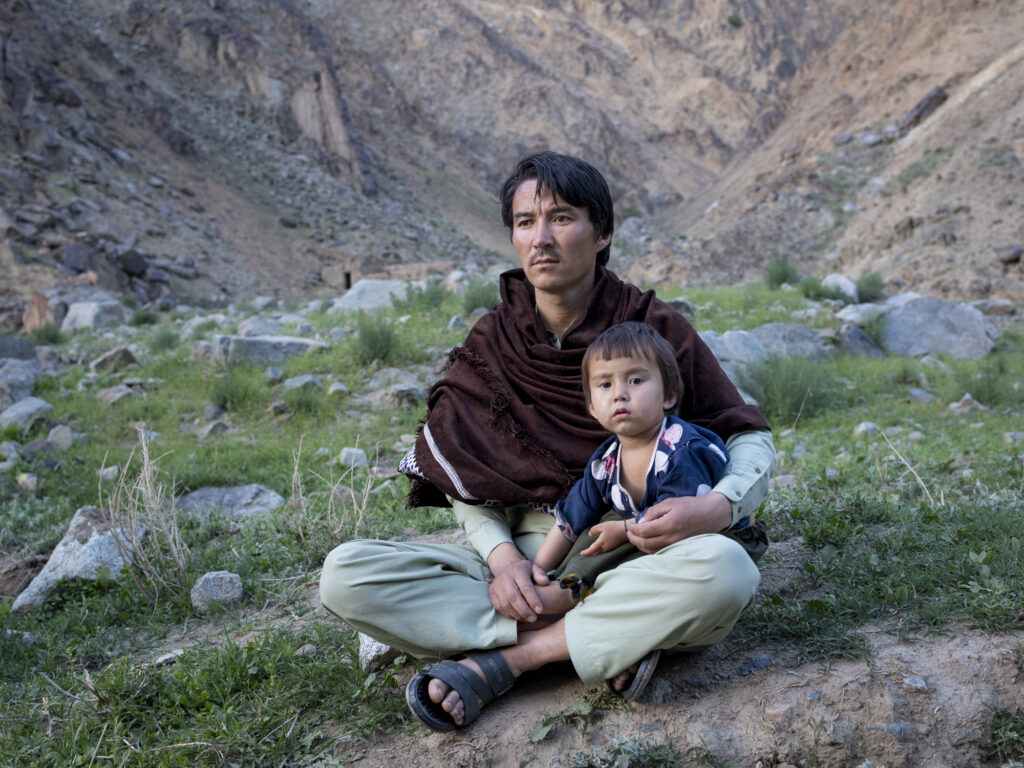
Green eyes set in almond-shaped faces. Blue eyes on sun-darkened skin. Deep black irises hidden beneath the shadows of thick, curly beards. If there is one thing that is difficult in Afghanistan, it is recognizing all the different peoples you encounter every day. The Middle Eastern features of the Pashtuns blend with the Central Asian traits of the Uzbeks, while the faces of the Hazara often evoke East Asia.
Historically discriminated against and persecuted, the Hazara are still widely regarded as the descendants of Genghis Khan. In the eyes of many, they bear more than one stigma: that of descending from the Mongol invaders who devastated these lands centuries ago, and that of being Shia Muslims. For some, that alone is enough to make them infidels.
Travelling along dirt roads through the mountains, passing village after village built from clay and straw, it becomes impossible not to notice how sharply the ethnic and social landscape changes. Within a matter of kilometres, a Tajik village gives way to an Uzbek one, its people marked by entirely different features. Pashtun Taliban fighters are replaced by others from the northern provinces. Yet it is on the rocky climbs leading toward Bamyan Province that the transition into Hazara territory becomes unmistakable.
Almond-shaped eyes begin to fill the fields and roads. More women appear. More glances. More quiet laughter as you pass by. In pharmacies and small shops, women sometimes serve customers themselves—something almost unimaginable in other parts of the country.
The visual and social impact of this diversity can be confusing for an outsider like me. The uncertainty over who belongs to which community disappears, however, the moment you begin listening to people’s stories. “We can face many problems because of our religion,” Reza tells me. He sells apples from his orchards and hosts me for the night in the shipping container where he lives with a friend. “People often try to persuade us to change our faith. They put pressure on us. And sometimes that pressure becomes violent.” He is referring to the Taliban. “Some people would even kill us because of our religion. We have been threatened many times.”
Hassan, his friend, looks at me and adds quietly: “Just a few days ago, many Hazara were killed in the Herat region simply because they were Shia.” He is referring to an attack that had taken place only days earlier, when armed men opened fire on a group of Shia civilians gathered near a religious shrine in Herat. Women and children were among the dead. The attack was claimed by the group that has become the Hazara people’s principal persecutor in recent years: ISIS-K.
The Afghan branch of the so-called Islamic State, ISIS-K is openly hostile not only toward the West but also toward the Taliban themselves, whom it considers too moderate and too focused on Afghanistan rather than global jihad. Shia Hazara are among the group’s primary targets. In recent years, ISIS-K has carried out attacks against schools, mosques, markets, and Hazara neighbourhoods, particularly in Kabul.
It is in the market of Bamyan—the main city of the Hazara homeland—that I meet Omar. A former journalist, he now runs a small shop where business is poor. “In 2010 these streets were full of tourists. A shop like mine could make four or five hundred dollars a day. Now I make about two thousand afghanis.” Around thirty dollars. “The rent alone costs me ten thousand. Life is very hard here. I’m worried, especially for my children. I don’t know what future they can have—especially with a father guilty of two crimes: being a journalist and being Hazara.” Then he begins to tell me about the persecutions that have haunted his people for more than a century. The most devastating chapter came at the end of the nineteenth century, under Emir Abdur Rahman Khan, who launched brutal military campaigns against the Hazara in what is remembered as the Hazara genocide. Thousands were killed, enslaved, or forced to flee to Iran and Pakistan. Land and property were confiscated from those who survived. “The Iron Emir massacred much of my people. In Kabul they built a tower from the heads of those who were killed. Other structures were made from earth mixed with human bones.” A way of spreading terror. A warning against future rebellion.
In the valleys beyond Bamyan, peace seems to reign. In some remote areas, small villages survive far from the regions most closely watched by the Taliban, often without electricity. “We are very poor people,” Mohammad tells me. “We cannot get government jobs. We are farmers and shepherds. That is all we have left.” Some have tried moving to Kabul, where services make life easier. But the air is suffocating, and distance from their community weighs heavily on them. Better to return home, where nature is more likely to kill you than another human being.
At sunset, young men who have finished working in the fields gather to play volleyball—the country’s most popular sport and one of its few diversions. In Bamyan I found myself beside a volleyball court where I expected to see only Hazara. Instead, Pashtun Taliban fighters had laid their AK-47s in the dust and joined the game. Men with different faces and different destinies challenged one another beneath the fading light, becoming teammates for an evening.
Perhaps one day they will be able to become teammates beyond the court as well.
5 — The Roads of Dust
Your eyes fall on a map, tracing lines of different colours, guided by assumptions you hardly question. A thick orange line means a safe road—or at least one that is reasonably passable. A white line serves as a warning. A blue line marking a river that remains “above” the road, signalling the absence of a bridge, prepares you for what lies ahead.
Cities are vast anthills, chaotic clusters of faces and noise where points of reference quickly disappear. Afghanistan lives in its roads. It begins just beyond the edge of town, where rock and earth replace concrete.
Then come the horns. The voices calling out from every house and shop: “Chai bakhar!” Come and have some tea? Cars and motorcycles slow down, match the rhythm of your pedals, and begin conversations that last either a few seconds or several minutes, all without taking a foot off the accelerator. Even checkpoints—places you imagine to be hostile—often end up offering shade, water, and a chance to rest.
Broken-down cars. Motorcycles with snapped chains. Men walking through the middle of an isolated gorge. “My vehicle broke down. I’m heading to the village to look for spare parts.” How many days will it take him to get back?
Often, roads are little more than imaginary drawings. A slightly paler line of stones than those around it, which someone has optimistically marked on a map as a main road. Sometimes you spend hours barely moving forward at all, and there is nothing left to do but sing a song and let time take its course. Yet the doors these roads open belong to remote worlds. Eyes widen at your arrival. Nobody believes you could possibly have emerged from there. Surprise quickly turns into delight. “You came all the way here? Why? You crossed Tooth-Breaker Road just to visit us?” The smiles are countless. The village gathers around the stranger. Invitations become a competition. Who will have the honour of hosting the traveller? A moment later, another sea of stones accompanies your journey. Intersecting tracks of dirt force you to the ground. A shepherd and his goats help you back to your feet.
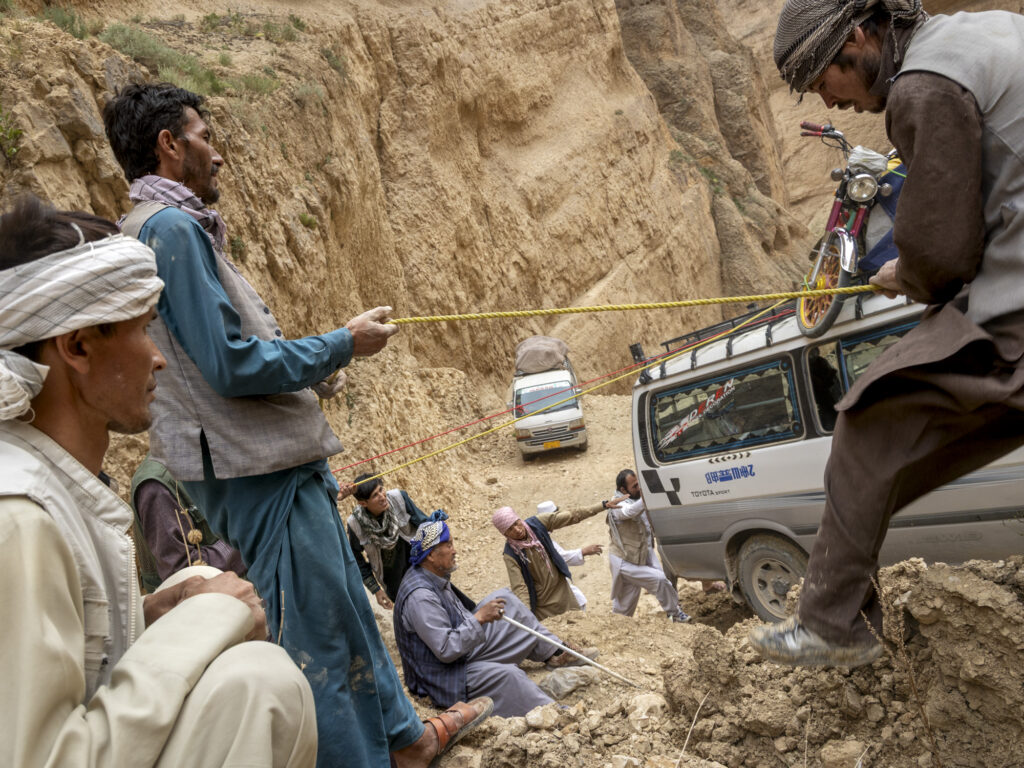
Other invented roads pretend to carve a path through the gorges, where landslides alone decide who advances and who does not. You encounter men moving rocks by hand in an attempt to discover a route. Minibuses that, at every bend, unload their passengers and send them uphill with ropes and cables, trying to stop the vehicle from becoming a single mouthful for the abyss below. The people who choose to travel by donkey are probably right. Whether that choice is imposed by poverty or not, it remains the only one truly suited to the terrain.
When a mountain collapses, for a moment it feels as though the world has ended. “This is Afghanistan,” someone says, shaking his head. We’ll never leave this place.
But in Afghanistan, anything can become a road. A river. A cluster of rocks. A pile of tree trunks. A strip of earth. An idea. All you have to do is see it that way, and there will be no village beyond your reach.
In Afghanistan, the few vehicles that venture beyond the main roads are like bumblebees: they fly without knowing they are not supposed to be able to. They do not know they should fail. And yet, more often than not, they make it through.
6 — Sacred Hospitality
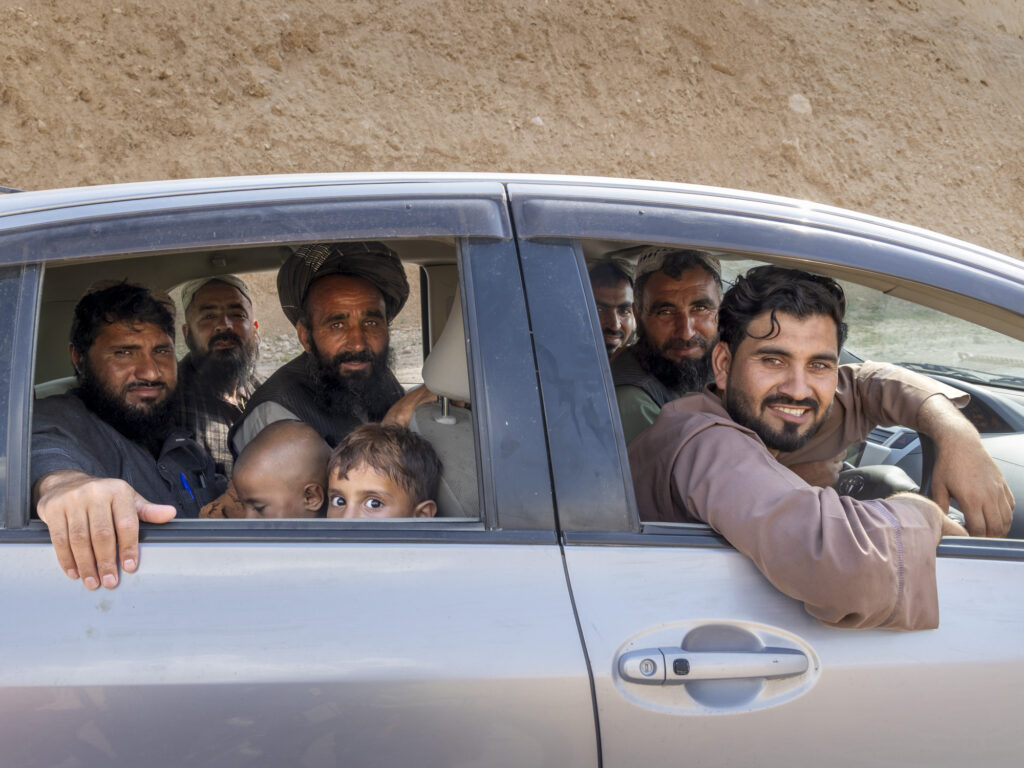
When the sun is about to disappear behind the mountains, in a land that rarely offers places for travellers to sleep and where hidden spots for pitching a tent may conceal unexploded ordnance, there is a very simple formula. Stop at the first people you meet and ask for a place that you already know does not exist. It does not matter, because at least one of them will offer to take you home.
Every day, dozens of times, if you wanted. Every evening, several times over, if only there were more nights in a single day.
Hospitality in Afghanistan is something surreal, almost impossible to comprehend. Raised in societies where everything has a price and where individual interest is often the highest priority, Westerners experience a genuine emotional shock when they step inside Afghan homes.
Poverty is everywhere. Faces bear scars and are marked by deep wrinkles long before old age. People’s stories are filled with pain, and they make no effort to hide wounds that are still bleeding. There are no tools to close them. Not yet.
And yet there seems to be no limit to the generosity with which arms are opened.
A simple cup of tea—an invitation that echoes every few dozen metres as you pass through a village—is enough to begin with a polite handshake. The next step often comes only minutes later: “Are you hungry?” Many conversations unfold almost in silence, because the language barrier is strong and few people can use a translation app. Among those who speak English, or at least a few words of it, the phrase they know best is often the same one, and it usually follows shortly afterwards: “Be my guest.” Otherwise, the gesture is simple enough. Two hands pressed against the cheek. Eyes closed. Head tilted. Will you stay?
At times it is painful. You enter a home and are treated like a prince, even though the people who opened their door to you possess almost nothing. Sometimes families live for days on bread and rice stained with tomato sauce. Sometimes that is all they have. Yet for a guest, it is always enough.
People gather together. A plastic tablecloth is spread on the floor. Everyone eats from the same dishes, with their hands, because cutlery is not merely a distant tradition—it is often an unnecessary luxury. And when the meal is almost finished, none of them will ever take the last bite. Everyone steps back, leaving the guest the privilege of eating the final mouthfuls, of ensuring that his stomach is fuller than anyone else’s.
The houses, built from earth and straw and surrounded by bricks of dried dung left in the sun to fuel the fire, almost always reserve their finest room for guests. Brightly coloured carpets cover floors and walls. Cushions support weary backs. Thin mattresses serve at once as chairs, sofas, and beds. How can we, in the West, truly understand such generosity? We who often ask to be reimbursed for dinner among friends. We who feel unusually generous simply because we buy someone a beer. Of course, nothing should be taken for granted. Yet I travel by bicycle, carrying only a limited number of possessions, and even so I often feel almost obscene in my abundance when faced with these people. “The economy in my country is going to hell,” I sometimes think to myself. But how could I possibly say such a thing in the middle of what I am experiencing? And yet here, doors open to you as they would to a son. Everything that can be shared is shared. And when you have had more than enough, when you cannot possibly accept another cup of tea or another piece of bread, someone will inevitably return to make sure you need nothing else.
The influence of religion runs deep. For Allah, there is no greater gift than welcoming a guest. Hosting someone is a profound honour for a family. Yet Islamic faith also encourages people to see one another as brothers and sisters, members of the same family. Whoever arrives at the door will be fed, given water, and helped. It happens among Pashtuns. Among Hazaras. Among Tajiks. Among Uzbeks. It happens in cities, in valleys, and in the mountains. It happens among the few who own a four-wheel drive, and among those whose wealth can be counted on one hand in sheep or apricot trees.
I think of Ten Ha, the veterinarian from the village of Kahmard, who proudly takes me home on his motorcycle, speeding through crowds of villagers gathered to see the newcomer. We stop constantly. He buys rice, chicken, fermented yoghurt, bread, and soft drinks. When we arrive, he never gives himself a moment’s rest. He puts water on for tea, serves me dried apricots, then heads into the garden to pick tomatoes, cucumbers, radishes, and rocket. In the end he prepares a dinner so lavish it feels almost royal. Then he gives me his own bed and makes himself a small sleeping space beside it, in the only room of the house.
When travelling, being invited into someone’s home is one of the deepest privileges there is. An experience that is often rare. In Afghanistan, it becomes so constant that at times you almost want to run away from it. People are wonderful and endlessly kind, but hospitality demands attention. It requires energy, and after long days on the road that energy disappears quickly. After day upon day of travel, you begin to dream of spending even a single hour alone, with your own space. Yet alongside that feeling grows another: the desire to give something back. Then, when you finally manage to hide away somewhere, guilt arrives for having turned down so much kindness. And so, in Afghanistan, even solitude begins to feel like a luxury.
7 — In the River of Drought
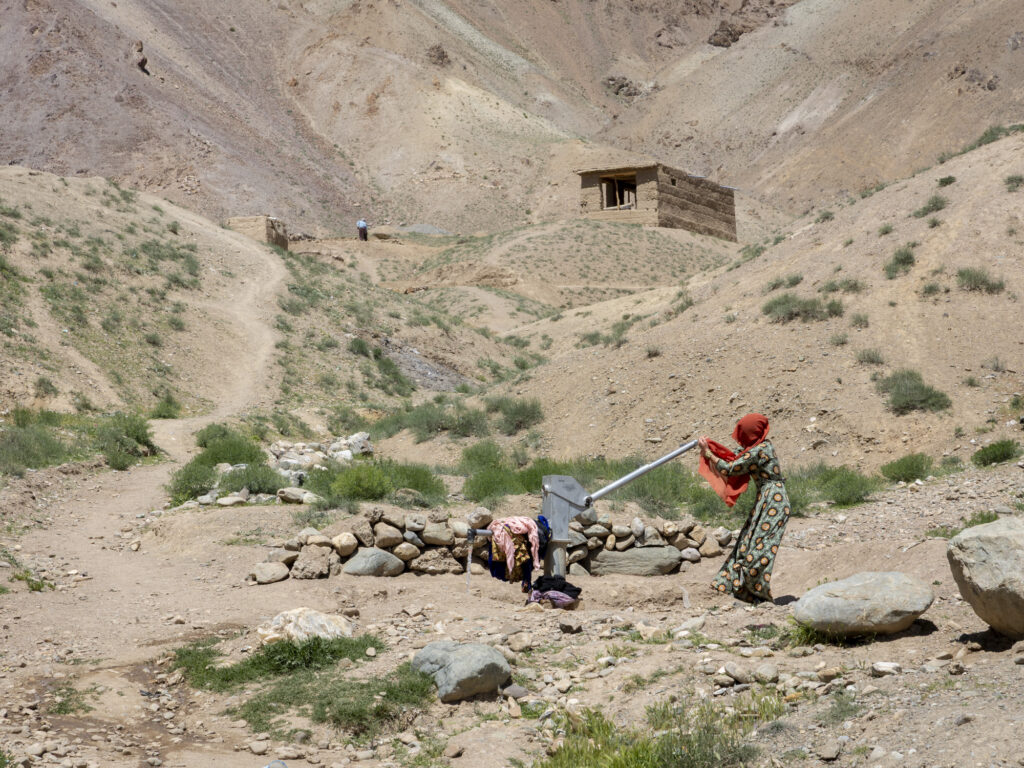
A red veil ripples in the wind, struggling to escape the efforts of a young woman who, beneath the heat of the afternoon sun, repeatedly bends over the lever of a well. The water comes out slowly. At times her face slips from behind its fragile hiding place and falls into my line of sight. Around her, the mountains stretch away barren and stony, growing hotter with each passing day.
In spring, Afghanistan is painted in just two colours. Sharp, almost divided by a clear boundary. Light brown everywhere. Deep green below, in the valleys where water still flows. Only the skyward streaks of snow alter the face of the mountains.
Spring is the season of water: the rains arrive and the snow begins to melt. Long before reaching Afghanistan, I had prepared myself mentally to cross rivers without bridges, to encounter torrents carrying the cold of the high peaks, transformed into powerful and intimidating currents. Yet many of them, to my surprise, reveal themselves as little more than piles of dry stones.
In a land where even the houses—built from the same colours and materials as the mountains—seem thirsty, glaciers and snow have always been more than a hope. They have been a certainty. An essential one. And yet they too are disappearing, cruelly stealing the dreams of so many people who depend on them. Fourteen percent of Afghanistan’s glaciers vanished between 1990 and 2015 alone, while the rest continue to retreat rapidly, victims of ever-rising temperatures.
In the villages I often come across abandoned wells. As a little girl drinks brown water from a narrow irrigation ditch, scooping it up with her hands, I find myself wondering whether the wells have been abandoned because nobody maintains them anymore—or because there is simply nothing left to pump.
Afghanistan, a country already burdened by severe shortcomings in water infrastructure for obvious historical reasons, is now being drawn into a cyclone of thirst more than almost any other nation on earth. It is a paradox. One of the world’s smallest contributors to greenhouse gas emissions is among the countries suffering most from climate change.
Kabul, a city that continues to expand above ground, is rapidly emptying below it. It is estimated that by 2030 the city may no longer have enough water for its inhabitants. The aquifers are nearly exhausted.
In a country that survives through agriculture and livestock farming, water is the most important ally of all. Everything depends on it. The harvest feeds people not only today but also provides the reserves needed to survive the entire year. Livestock are among the few forms of wealth people can rely on. They provide milk and meat through the winter. They produce the dung used to heat homes. Yet those who live in these valleys never know, when dark clouds gather overhead, whether they should rejoice because their fields and animals will drink, or tremble because the mountains themselves may fall from the sky.
“You know, everything changes here all the time,” someone tells me. “The lakes you saw in the valley are quite recent. One was created when an earthquake brought down part of a mountain. Another was formed by a landslide. Every spring we face major problems with floods. They take our fields, our animals, our roads. Many times they take our people as well.”
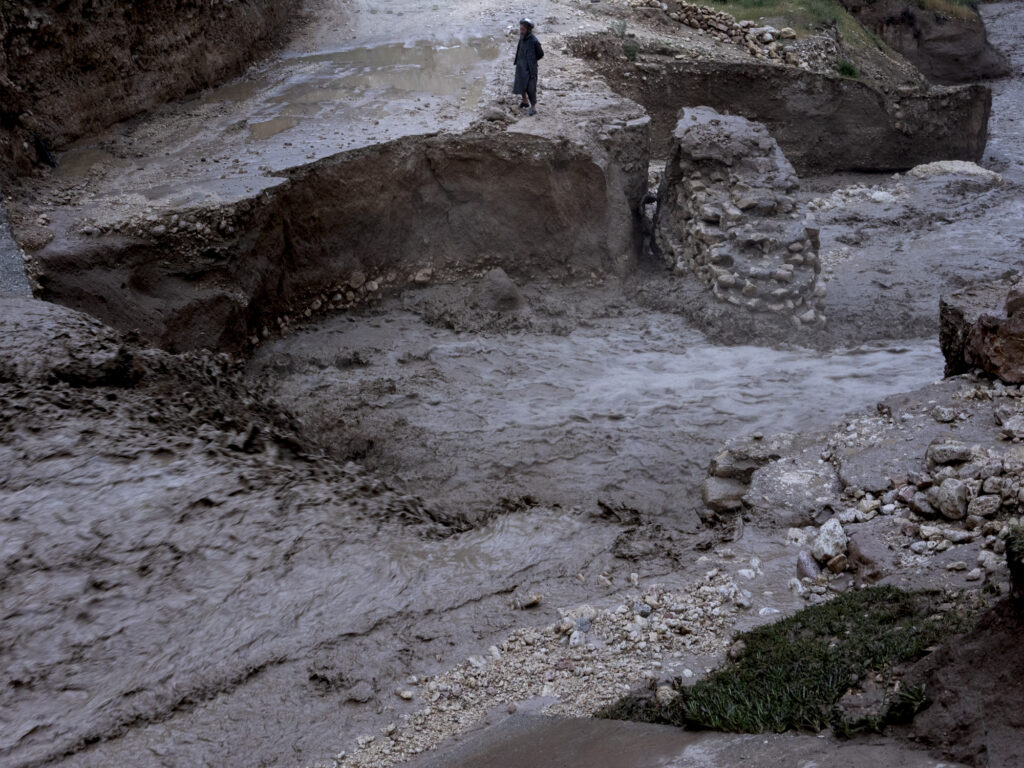
And so it happens before my eyes. A couple of hours of rain are enough—not even particularly heavy rain. Roads disappear beneath centimetres of muddy, restless water. Great canyons, which only hours earlier had been nearly dry, begin to roar and scream, sweeping away everything in their path beneath immense waves of brown mud. The mountains cannot hold the rain. They are giant slides made of clay and stone, shedding everything from pebbles to boulders the size of buildings. When they collapse, they devour whatever lies below.
Then, suddenly, the rain stops. Within a few hours the rivers fall asleep. From wild beasts they become innocent children once more. It seems as though nothing has happened. Yet the landscape has changed. Riverbanks have widened, creeping a few threatening centimetres closer to homes. New stones have settled on the valley floor. Something—or someone—has disappeared forever. Many times, the current carries away more than a loved one or the product of hard work. It tears away the sweat that secures the present and robs families of their future.
8 — The War After the War
In spring, the valleys that cut through Afghanistan’s barren mountains turn green. The wind brushes through the soft tufts of wheat, while leaves tremble with pleasure in the breeze. The sun has not yet become oppressive. Red poppies mingle with tiny yellow, violet, and blue flowers, creating colourful expanses that stretch beyond the horizon. At last, the air no longer carries the sound of American B-52 bombers. The only metallic noise is sometimes that of a hammer striking somewhere in a village house.
Since the Taliban returned to power, the country appears to have stabilised. The risk of robbery and kidnapping has almost disappeared, as has the danger of firefights between armed groups. The calm is occasionally disturbed by clashes with neighbouring Pakistan or by the increasingly rare attacks carried out by ISIS-K insurgents, but in general travelling Afghanistan’s roads has not been this safe since the 1970s.
The enemies, however, are still there. Not in flesh and blood, but in the terrible ingenuity that drives human beings to slaughter one another through deception. Landmines.
In Afghanistan today, people no longer fear the sky, but they still fear the ground.
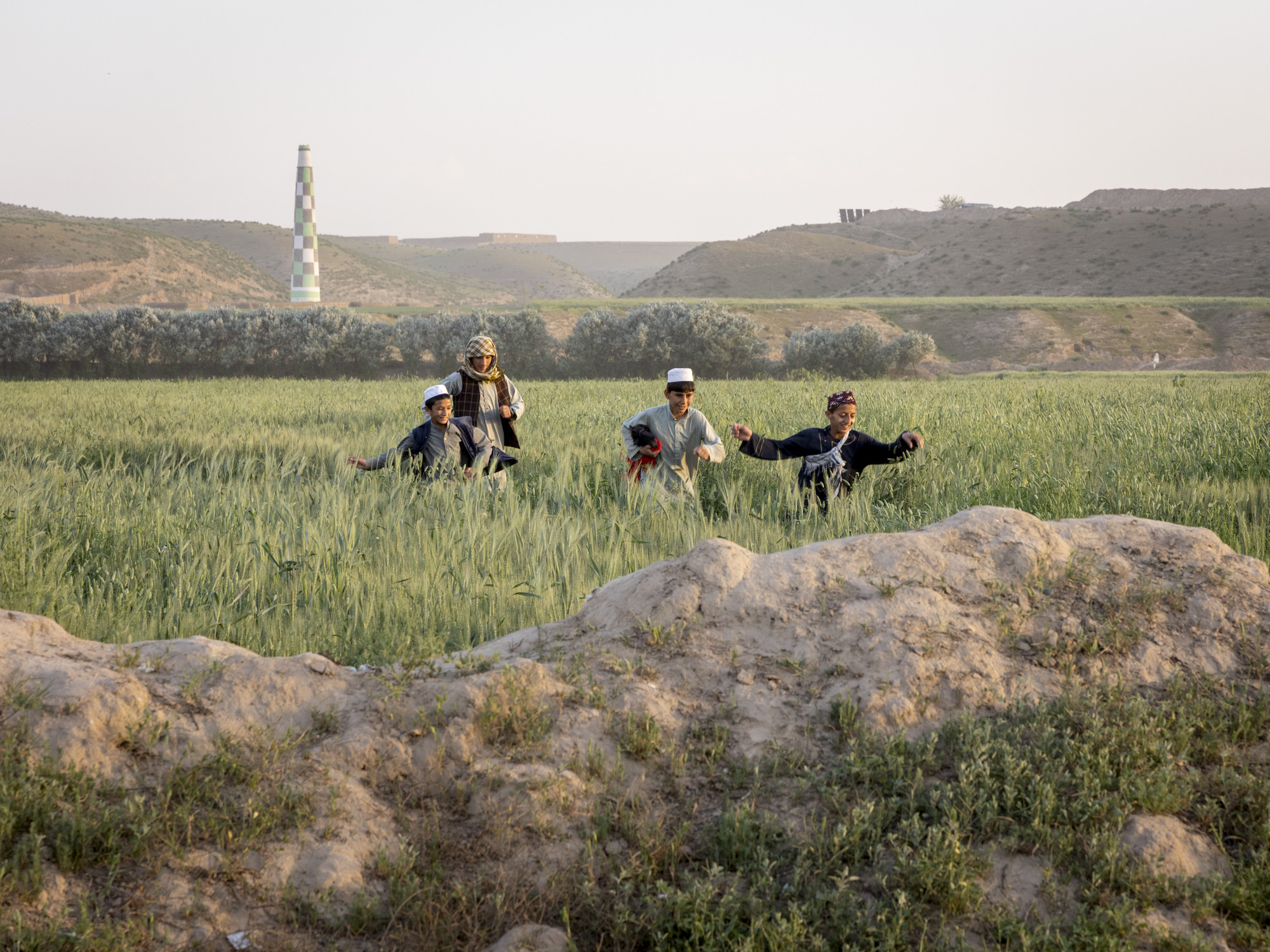
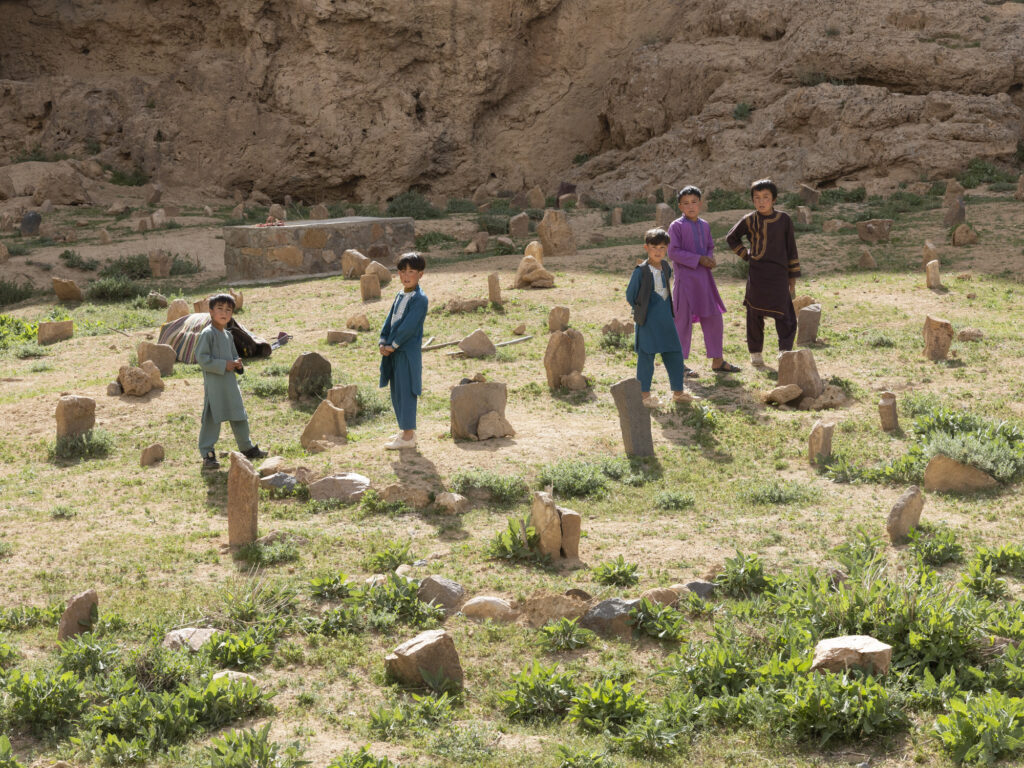
The enchanted valleys where children run and livestock graze are among the most dangerous traps in the world. Since 1989, more than seven hundred thousand anti-personnel mines have been removed, along with over thirteen million explosive devices. Yet demining operations are now almost nonexistent, and the true number of mines still buried beneath the soil remains impossible to know. It is estimated that more than one thousand square kilometres of land remain contaminated, affecting around 1,500 high-risk communities.
Warning signs are rare. The only people who stop me are farmers, pointing to the edge of their fields and telling me where it is safe to walk. Along the road from Kabul to Bamyan, however, there is a series of small mounds beside the track—a reminder of the danger. One mound for every person who was blown up there by a mine.
Around seventy percent of the victims are children, either playing or taking animals out to graze. “We receive so many of them,” Mattia tells me from Emergency’s hospital in Kabul. “Most of the patients we treat are road accident victims, people injured in shootings, or children who fall from buildings because they were left unattended. But none of those compare to mine victims. We see people who have lost one leg or both. Children without arms, children with faces torn apart.” In 2024, Emergency’s Kabul hospital was receiving a landmine victim every three days. In 2025, there were 92 deaths and 375 injuries.
The Soviets, the mujahideen, NATO, the Taliban—everyone left explosives behind. And so it happens that a child born today can lose a leg because of a war that began before his father was even born.
9 — The Hunger of Opium
In conversations with friends and fellow travellers who, like me, were heading towards Afghanistan, one topic kept coming up. Opium.
It was something taken for granted, a symbol recognised around the world, and each of us, in one way or another, had wondered: How am I going to deal with it? In a month spent cycling across Afghanistan—through both major routes and some of the most remote regions imaginable—I never saw a single cultivated poppy field.
I saw occasional red poppies growing wild here and there, scattered freely and randomly across the landscape, but never the vast plantations behind the crop for which Afghanistan has become so famous in recent decades.
Nor did I see, in Kabul, the epidemic of drug addiction that so many people describe. To my eyes, the addicts were invisible. They simply were not there. No doubt I walked the wrong streets, or perhaps the crowds swallowed them up before I could recognise them. The facts, however, continually remind me that they exist. One example was the deafening news from Pakistan, where in March 2026 a bombing struck a hospital and rehabilitation centre, killing hundreds of men who were trying to recover from addiction.
Yet in 2026, opium poppy cultivation is a crop that appears to be disappearing from Afghanistan. As happened once before in the late 1990s, the Taliban government has once again imposed a harsh ban on its production. In some regions, cultivation seems to continue. The economic value of a trade on this scale is simply too great to erase entirely. But much of the crop appears to have vanished, leaving behind both the relief of those who hope for a slow recovery from addiction and a long, hungry line of people whose dependence on poppies was of a very different kind: economic dependence.
In a country as arid as Afghanistan, with almost no industry and few opportunities for rapid economic growth, opium poppies are one of the rare crops capable of surviving and rewarding the effort invested in them. In a land where almost nothing guarantees a reliable harvest, they endure. They require little water, they grow quickly and they provide immediate income. The conversation therefore slips rapidly away from narcotics trafficking and addiction and towards something far simpler and more ordinary: Agriculture. Work. Food. Survival. What has become of all those families who once lived from poppy cultivation and for whom the Taliban government has offered no viable alternative?
In Dushanbe, in Tajikistan, I had seen the fruits of money laundering linked to the Afghan drug trade: endless rows of enormous, empty buildings constructed for no one. In Afghanistan itself, however, I found only stories. And so I am left with the sense of a reality I cannot fully grasp—unsure whether it remained hidden just around the corner, or whether it is genuinely on the road to defeat.
10 — Women
Women are present on the streets of Afghanistan.
Or rather: they are both present and absent at the same time, as though their visibility were governed by something that is never entirely seen. Today, the images a storyteller can capture must follow a strict set of rules: women cannot be photographed. A raised phone or a camera in hand is enough for someone to disappear behind a wall, a veil, or a doorway. And it is not simply a matter of respecting a rule. There is also the risk of reprimands from families or from the authorities, both for the woman and for the person taking the photograph. Their presence therefore becomes intermittent. Real when you live alongside them. Invisible when you try to preserve it in an image.
After a few days cycling through the country, I decided to stop greeting young girls. Every time I tried a “Salam Alaikum” or simply waved, the reaction was almost always the same: shocked faces, sometimes cries of annoyance, sometimes sharp reprimands, as though I had crossed a boundary I did not understand. It felt as if I was doing more harm than good, even without intending to. Then, once I had forced myself to stop, two girls I was deliberately ignoring greeted me with cheerful shouts and broad smiles. As if the problem was not the gesture itself, but the context in which it occurred. At that moment, I stopped understanding what the right thing to do was.
Afghanistan is one of the most religious countries in the world, but stopping at that observation would mean understanding very little about it. Because religion here is not merely faith. It is social structure, everyday language, moral code and, inevitably, politics. It changes from valley to valley, from city to village, from family to family. Above all, it changes over time, following shifts in power more than shifts in ideas.
Over the last century, the relationship between women and public space has followed these fluctuations in almost brutal ways. During the 1970s, and later in the years following 2001, new opportunities opened in cities for education, employment, and public life. Yet it only takes leaving the urban centres to realise that this was never the whole story. In rural areas, arranged marriages, rigid gender roles, and social restrictions continued without any real interruption. Even when Kabul was portrayed as “modern”—with photographs of hippies reaching Western audiences as symbols of an almost unreal Afghanistan—that image represented only a tiny fragment of the country. Not the country as a whole. “Kabul: High Heels and Lipstick,” read a headline in the Italian newspaper Corriere della Sera in 2001 after the arrival of American forces. For many Afghans, that narrative felt less like an attempt to understand the country than an effort to simplify it. For many women in particular, it was perceived almost as an insult.
Travelling through Afghanistan today, the differences from one place to another are immediate. There are villages where women flee at my approach, almost as though my presence disturbs an already fragile balance. Elsewhere, they simply cover their faces and continue on their way. Then all it takes is crossing into another province to find the opposite. A woman greets you with a smile. Young women film you on their phones and ask questions after their boyfriends have stopped the minibus they were travelling in.
There is never a single version of reality. Among the Hazara, in Bamyan Province, women can even be found working in shops. There it becomes even harder to orient yourself, because everything you thought you had understood in the previous days suddenly stops making sense. You hesitate for a moment, unsure whom you should address. As if the rules you had unconsciously absorbed were valid only until the previous valley. Then you speak. You exchange smiles. You buy something. And you leave without being entirely sure that you truly understood the moment you just experienced.
Perhaps that is where it becomes most difficult to understand what freedom really means. Because as Westerners, we risk assuming that every human aspiration must automatically take the same shape as our own. Yet in Afghanistan, many women may desire things that appear contradictory to us: wanting to study and work while also choosing to wear the veil with conviction; believing in traditional gender roles without necessarily experiencing them as a prison; living religion not as an external imposition but as a profound part of their identity. Understanding this does not mean justifying violence or the restrictions imposed by Taliban rule. It means accepting that freedom, dignity, and desire do not always speak the same language everywhere. And that the boundary between choice, faith, habit, and coercion is often far harder to read from the outside than we would like.
Yet it is precisely this diversity of experiences that makes it even harder to understand where tradition ends, where social pressure begins, and how much weight the rules imposed by the new authorities carry today.
Because Afghanistan’s patriarchal system did not begin with the Taliban’s return, nor will it end with them. It existed long before them and continues beyond them, though with varying intensity. What changed after their return to power is that it became more visible, more rigid, more official. Something that had once been distributed among customs, families, and villages became law, institution, and control.
In some villages you find yourself surrounded entirely by men, with women existing only through indirect traces. Kahmard is called “the city of women,” or so Ten Ha tells me. Yet when you arrive, you find yourself wondering where they actually are.
In Mazar-i Sharif, by contrast, the streets are full of them. They shop. They argue. They bargain. A young woman is bumped by a man in a crowded street. She turns around, shouts something at him, and, without much ceremony, smacks him over the head with her handbag. He accepts it and walks away without reacting. In that brief moment, you realise there is no single image of the Afghan woman, just as there is no single way of living within these rules.
In the more rural regions, men and women often do not even meet each other’s gaze. Staring at a woman is not merely frowned upon. It is understood instinctively as a mistake.
I experienced this while staying with a farming family in Baghlan Province. We ate and slept in the guest room, always under someone’s watchful eye. Every time I stepped outside to fetch something or simply to go to the bathroom, someone would position himself along the passage leading to the courtyard, almost like a wall between me and the women. A barrier that was not only physical, but visual.
The paradox is that inside the house, women are rarely seen at all. Their presence seems displaced elsewhere, into a space that remains inaccessible. Yet the separation of spaces—especially in relation to guests—is not generally experienced as a violent imposition. It is understood sincerely as respect, modesty, and protection.
For many questions I could not answer, I relied on the stories of other travellers. A French woman I met in Kunduz, travelling with her boyfriend, explained one of the most difficult concepts to understand: the mahram, the male guardian. The rule is not always written or enforced in exactly the same way everywhere, but it exists in practice. Women may move around alone over short distances and within familiar local settings, but longer journeys, public offices, and institutional spaces generally require a male companion. She told me about entering a government ministry where nobody looked at her. Every question was directed to her partner. As if she were not there.
Later, at a mobile phone shop, she was taken into a separate room with other women while the men completed the paperwork. In the end, only her boyfriend was allowed to register the SIM card—even though it was for her.
Since the Taliban returned to power in 2021, restrictions on female education have become increasingly systematic. For many girls, access to education effectively ends after primary school or becomes extraordinarily difficult. What remains are the madrassas, religious schools where education is centred exclusively on the Quran. Employment opportunities become more limited. Public-sector jobs are almost inaccessible. Even within NGOs and international organisations, everything becomes more complicated. Then there is perhaps the most difficult paradox of all: healthcare. According to many conservative interpretations, only a woman should treat another woman. But if women are prevented from training, who will provide care?
Within this contradiction survive small, fragile, almost invisible spaces. Madrassas that teach subjects beyond religion. NGOs searching for ways to continue training female staff. Endless negotiations with local authorities. Rules that open and close again, as though they belonged not to a stable system but to something constantly changing shape.
This is precisely what makes Afghanistan so difficult to understand. Because it is never just one thing. Laws have local interpretations, provincial interpretations, family interpretations. At times it feels as though every village has its own version of what is possible. And perhaps that is why outsiders struggle so much to read the country without misunderstanding it.
For a foreign man, the world of Afghan women remains, in part, a territory of imagination—of echoes, fragments, and second-hand stories. A constant attempt to understand where what you can see ends and where what you are not allowed to see begins. In the end, one simple feeling remains, difficult to escape: It would be presumptuous to believe that I have truly understood it. Because the only people who could fully tell that story are them. The women of Afghanistan.
This project is reader-supported.
If you’d like to support independent slow reportage from the road and receive field notes, unpublished photographs and behind-the-scenes writing from the journey across Asia by bicycle, you can join the project on Substack.
You can also support the journey directly via PayPal or Ko-fi.